Desserts · Part 2 of 3: Instructions
Silky Hong Kong Egg Tarts with Flaky Pastry Step-by-step instructions
- Prep
- Cook
- Total
- Serves
- 12
Before you start
Before beginning, ensure all ingredients are at room temperature to help them emulsify smoothly. Preheat your oven to 375°F (190°C) well in advance so it reaches a consistent temperature. Have your tart tins ready and organized on a baking sheet to make transferring them to the oven easier.
Clear your workspace to allow for the careful straining process, and ensure you have a clean whisk and a fine mesh strainer ready for the custard. Preparation is the key to success with delicate pastries.
Ingredients at a glance (5)
- 300 g butter-lard flaky pastry
- 4 eggs
- 100 g sugar
- 200 ml hot water
- 80 ml evaporated milk
Instructions
Pastry Preparation
- Prepare the CrustPress the butter-lard flaky pastry evenly into the fluted tart tins, ensuring it reaches the edges without tearing the delicate layers.Look for Pastry is snugly fitted into the tins.Tip Keep the pastry chilled until you are ready to press it into the tins to ensure it stays flaky.
The pastry should be pressed into the tins so that it is uniform in thickness and follows the contours of the fluted edges perfectly. Ensure there are no thin spots or holes in the pastry that could cause the custard to leak during baking. The dough should feel firm and cold to the touch before it goes into the oven.
Custard Emulsification
- Whisk and Strain CustardWhisk the eggs, sugar, hot water, and evaporated milk together in a mixing bowl until the sugar is fully dissolved, then strain the mixture through a fine mesh strainer three times to remove any bubbles or solids.Look for Custard is completely smooth and free of air bubbles.Tip Straining is the secret to that mirror-glossy texture.
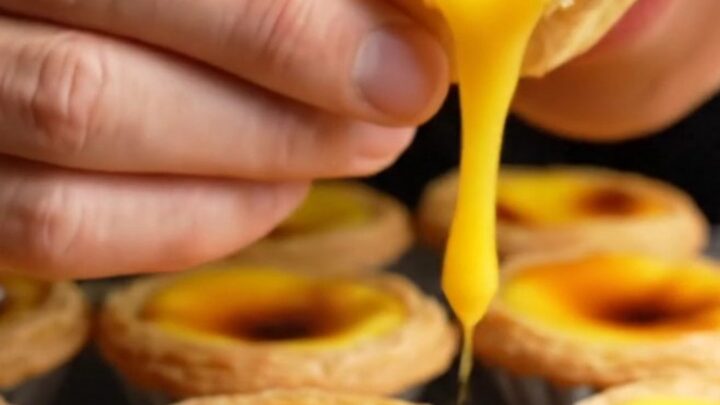
The custard should be completely smooth, with a pale yellow color and a liquid consistency that pours easily. After straining, it should appear glossy and uniform, with no visible foam or bubbles on the surface.
If you see any small lumps or bubbles, strain the mixture one more time to ensure a perfect, professional finish.
Final Baking
- Bake the TartsPour the custard into the pastry-lined tins and bake at 375°F (190°C) for twenty minutes, propping the oven door slightly ajar for the final 5 minutes to ensure the custard sets perfectly without bubbling. The custard is done when it reaches 160°F (71°C).Look for Custard is set but still trembles slightly when moved.Safe temperature 160°F (71°C) internal temperature (egg dishes)Tip The cracked door helps maintain an even heat for a smooth finish.
The tart shells should look crisp, flaky, and golden, while the custard should be set and appear mirror-smooth. When you gently shake the tray, the custard should tremble uniformly without any liquid sloshing. The edges of the pastry should be slightly browned and pulling away just a fraction from the sides of the tins.
Common mistakes
Avoid over-whisking the custard mixture, as this introduces excess air that is difficult to remove even with straining. Do not rush the straining process; passing the mixture through the mesh three times is vital for the final texture.
Finally, resist the urge to keep the oven door closed during the final minutes of baking. If the oven temperature gets too high, the custard will bubble and create an uneven, pitted surface, which is the most common mistake when making these tarts.
How to tell it’s done
The tarts are done when the pastry is golden brown and crispy, and the custard has set firmly around the edges while still having a slight, gentle wobble in the center.
It should reach an internal temperature of 160°F (71°C) to ensure the eggs are fully cooked. The surface should be smooth, glossy, and free of any cracks or bubbles, indicating that the custard was baked at the correct, gentle heat without boiling.
- Egg dishes: 160°F (71°C) in the thickest part
Up next · Part 3 of 3
2 variations · storage & make-ahead · 3 answers · printable card
Tips, FAQ & printable recipe (Part 3)← Back to the ingredients (Part 1)