Dinner · Part 2 of 3: Instructions
Sheet Pan Sausage and Onion Bake: One-Pan Dinner in 45 Minutes Step-by-step instructions
- Prep
- Cook
- Total
- Serves
- 4
Before you start
Before the oven even comes on, gather everything on the counter: the sausages, onions, a sharp knife, a cutting board, and the baking sheet. Take the sausages out of the refrigerator while the oven preheats; ten minutes at room temperature takes the chill off and helps them cook evenly from casing to center.
Cut the onions into thick, even wedges and keep the root ends on where you can, since intact layers hold their shape through the long roast. Position the rack in the center of the oven so hot air circulates around the whole pan, and have the tongs and thermometer standing by. Nothing else needs preparing, which is the quiet appeal of this dinner.
Ingredients at a glance (2)
- 1 1/2 lb fresh Italian sausages (about 4 to 6 links)
- 2 large yellow onions, cut into thick wedges
Instructions
Prep and pan setup
- Heat the oven and prep the panPosition a rack in the center of the oven and heat it to 425°F (220°C). Pull out a rimmed baking sheet and set it aside for a moment; there is no need to line it, since the sausages release a little fat that keeps the onions from sticking and helps them brown.Look for The oven should reach a full 425°F before the pan goes in, so wait for the preheat signal.Tip A preheated, dry pan encourages better browning than a cold one loaded straight into a warm oven.
- Cut the onions into thick wedgesTrim the ends of each onion, halve it pole to pole, and peel off the papery skin. Cut each half into three or four thick wedges, keeping the root end intact where possible so the layers hold together as they roast and caramelize instead of scattering across the pan.Look for Aim for wedges about 1 inch thick at the widest point, uniform enough to roast at the same pace.Tip Thicker wedges turn silky and golden; thin slices would burn before the sausages finish.
- Arrange the onions on the panSpread the onion wedges over the baking sheet in a single, even layer, cut sides down where possible. Leave deliberate gaps between the wedges; those open spaces are where the sausages will sit, and they also let hot air reach every surface of the onions as they roast.Look for The wedges should lie flat with visible metal between them, not stacked or leaning in a pile.Tip Space on the pan is what separates caramelized wedges from steamed, pale ones.
By the end of this phase the oven has reached a full 425°F (220°C), the onions are cut into thick, even wedges, and the pan looks organized, not chaotic: wedges spread in a single layer with clear gaps reserved for the sausages. If the wedges are stacked or leaning against each other, spread them out before moving on, because piled onions will steam instead of caramelizing. Everything else should be within arm's reach of the oven before the pan goes in.
Roast and turn
- Nestle in the sausagesSet the sausages directly on the pan between the onion wedges, leaving a finger's width of space around each link so hot air can circulate and the casings brown instead of steaming. Do not prick them; intact casings keep the juices inside the links where they belong.Look for The pan should look full but not crowded, with onions and sausages alternating in a single layer.Tip Space between the links is what gives you that deep brown blush on the casings.
- Roast for 20 minutesSlide the pan onto the center rack and roast for 20 minutes. Fat will render from the sausages and pool around the onions, which is exactly what you want: the wedges fry gently in that flavorful fat and start taking on a golden edge along their cut sides.Look for After 20 minutes the sausage casings should look taut and lightly browned, with visible rendered fat on the pan.Tip Resist opening the oven; steady heat is what builds the caramelization on the onions.
- Turn and finish roastingPull the pan out and, using metal tongs, turn each sausage and flip the onion wedges so their pale sides meet the hot metal and the rendered fat. Return the pan to the oven and roast another 12 to 15 minutes, until the onions are deeply golden and the sausages are browned all over.Look for The onion edges should be dark golden to deep amber, glossy with rendered fat, never blackened.Tip Turning once is enough; constant fussing breaks the wedges apart before they caramelize.
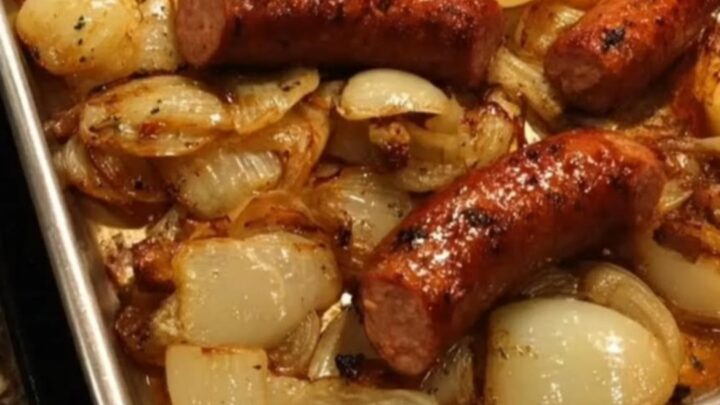
Midway through roasting the pan should already smell like a good deli counter: sizzling fat, browning casings, sweetening onions. After the turn and the second stretch in the oven, the sausages are browned on every side and the onion edges have gone from pale gold to deep amber, glossy and collapsing slightly at the tips.
The pan juices should be bubbling gently around the wedges. What you are checking before the final phase: even color across the pan, no pale raw-looking sausage sides, and no scorched onion edges.
Temperature check and serve
- Check the internal temperatureInsert an instant-read thermometer into the center of the thickest sausage. It must read at least 160°F (71°C), the safe internal temperature for fresh sausage. If any link reads lower, return the pan to the oven for 5 more minutes and test again in the same spot.Look for The thermometer should slide into the center easily and hold a steady reading of 160°F (71°C) or above.Safe temperature 160°F (71°C) internal temperature (ground meat)Tip Test the plumpest link; thin ones always finish first and can mislead you.
- Rest briefly and serve hotTransfer the sausages and onions to warm plates with tongs, spooning the glossy pan juices and onions over the top. Give the sausages a minute or two before cutting so the juices settle into the meat instead of running onto the plate at the first slice.Look for The onions should drape softly over the sausage, shiny and amber, with a faint sweet smell of caramelized allium.Tip A splash of the pan juices over each plate carries more flavor than any sauce could.
In this last phase the sausages are verified done at 160°F (71°C) in the center of the thickest link, and the pan comes out for good. The onions drape softly over the links, shining with pan juices, and the kitchen smells sweet and savory at once. Serve within a few minutes while the casings are still snappy and the juices are hot; the dish holds well but is at its best straight from the oven, steaming on the plate with juices spooned over the top.
Common mistakes
The most common slip is cutting the onions too thin, which turns them into dark, brittle shards before the sausages finish; keep the wedges about an inch thick. Pricking the sausages is the second: every puncture drains juice into the pan and leaves the meat dry.
Overcrowding is the third, since a packed pan traps steam, and steamed onions stay pale and limp instead of caramelizing. Finally, skipping the halfway turn gives you browning on one side only. Check the temperature in the thickest sausage, not a thin one, and pull the pan the moment every link reads 160°F (71°C).
How to tell it’s done
The sausages are done when an instant-read thermometer inserted into the center of the thickest link reads at least 160°F (71°C), the safe internal temperature for fresh sausage; the juices should run clear, not pink, and the casings should be browned and taut.
The onions are ready when they are deeply golden at the edges, glossy with rendered fat, and tender enough that a fork slides through the thickest wedge with no resistance. If the onions reach that state before the sausages do, simply keep roasting; a little extra color on the wedges only deepens the flavor.
- Ground meat: 160°F (71°C) in the thickest part
Up next · Part 3 of 3
4 variations · storage & make-ahead · 5 answers · printable card
Tips, FAQ & printable recipe (Part 3)← Back to the ingredients (Part 1)