Dinner · Part 2 of 3: Instructions
Roasted Sausage and Sweet Onions — One Pan, 30 Minutes Step-by-step instructions
- Prep
- Cook
- Total
- Serves
- 4
Before you start
Give the oven time to reach a steady 425°F (220°C) before anything goes in — a properly preheated oven is what separates browned, juicy sausages from pale, steamed ones. Set the rack in the middle position so the pan sits close enough to the heat for color but far enough that the onions do not scorch on the bottom.
Peel the onions and cut them into thick wedges, keeping a little of the root end attached so the layers stay together. Pat the sausages dry with a paper towel; dry surfaces brown, damp ones steam. Have the tongs and the thermometer within reach so the pan can go straight from the counter to the oven without delay.
Ingredients at a glance (2)
- 1 1/2 lb fresh Italian sausages
- 3 sweet onions, cut into thick wedges
Instructions
Prep and heat
- Heat the ovenSet a rack in the middle of the oven and heat it to 425°F (220°C). A fully hot oven is what gives the sausages a browned exterior while the onions soften and caramelize rather than steam. Let the oven come all the way to temperature before the pan goes in.Look for The oven display reads 425°F (220°C) and holds it steady for a few minutes.Tip Preheating fully takes 10 to 15 minutes; starting cold steams the onions instead of roasting them.
- Cut the onionsPeel the sweet onions and cut each one into 6 to 8 thick wedges, leaving the root end partly attached so the layers hold together as they roast. Thick wedges turn golden and jammy at the edges instead of burning thin and drying out on the hot pan.Look for Even wedges, about 1 inch thick at the widest point, with layers intact.Tip Keep a bit of root on each wedge so the onion stays in one piece and slices neatly on the plate.
- Arrange on the panSpread the onion wedges across a rimmed sheet pan in a single, even layer, then nestle the sausages on top and among them. Leave visible space between every piece so the dry heat can circulate and brown each surface instead of trapping steam underneath.Look for Every onion wedge lies flat and the sausages sit in a single layer with space between them.Tip Crowding the pan traps steam; use two pans if the sausages touch the sides.
By the end of this phase the oven reads a steady 425°F (220°C), the onion wedges are cut thick and arranged flat on the pan, and the sausages sit on top with visible space between them. The pan should look organized, not piled — every piece of onion flat against the metal, every sausage dry and in place. Check that nothing overlaps before the pan goes in; this is the moment to split onto a second pan if the pieces touch.
Roast and brown
- Roast the first 15 minutesSlide the pan onto the middle rack and roast for 15 minutes. The sausages will plump and begin to brown on top while the onions slump and turn translucent at the center. Keep the oven door closed so the heat stays high and the surfaces dry out properly.Look for Sausage casings look taut and lightly browned; onion edges are just starting to color.Tip You should hear a gentle sizzle — silence means the pan is crowded or the oven runs cool.
- Turn and continue roastingPull the pan out and, with metal tongs, turn each sausage and each onion wedge so the pale sides face the heat. Return the pan to the oven for another 10 to 15 minutes, until the sausages are deeply browned and the onions are caramelized at the edges.Look for Onion wedges show deep golden, almost mahogany edges and smell sweet and toasty.Tip Turning once is enough; fussing with the onions breaks the wedges apart.
- Check the temperatureInsert an instant-read thermometer into the center of the thickest sausage. Fresh sausages are safe at 160°F (71°C) — if the reading is lower, roast 3 to 5 minutes more and check again. The juices should run clear and the casing should feel firm under the tongs.Look for The thermometer reads at least 160°F (71°C) in the center of the thickest sausage.Safe temperature 160°F (71°C) internal temperature (ground meat)Tip Angle the probe into the middle, not touching the pan, for an accurate reading.
After the first roast and the turn, the sausages are plump with taut, browned casings and the onions have slumped into soft, translucent centers with golden edges. The pan sizzles steadily and the kitchen smells sweet and savory.
Before moving on, verify the internal temperature: 160°F (71°C) in the center of the thickest sausage, or 165°F (74°C) for poultry. If the onions are coloring too fast, nudge them away from the pan's hottest spots.
Rest and plate
- Rest the panLet the sausages and onions rest on the sheet pan for 3 minutes out of the oven. Resting lets the juices settle back into the sausage instead of running out at the first cut, and the onions finish softening in the residual pan heat.Look for The sizzling quiets down and steam rises gently off the onions.Tip Cover loosely with foil if the kitchen is cold and you want to hold the heat.
- Plate and serveLift a sausage and a tangle of onions onto each plate with the tongs, spooning the glossy pan juices over the top. Slice through a sausage at the table to show the juicy interior, and serve immediately while the onions are still steaming and sweet.Look for The sausage slices moistly, and the onions glisten with caramelized pan juices.Tip Crusty bread or mashed potatoes are natural partners for those pan juices.
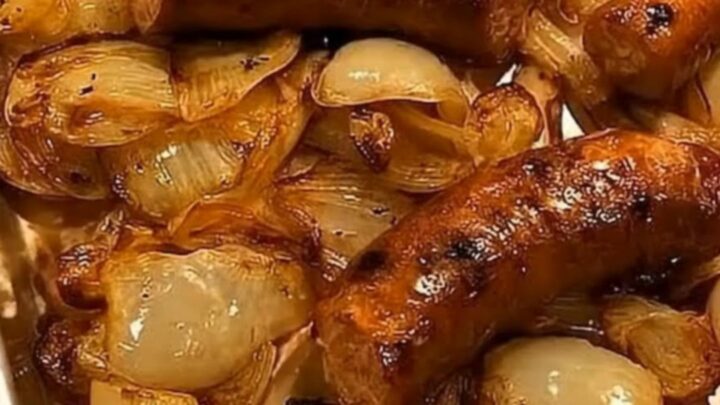
The finished pan holds browned, glistening sausages and caramelized onion wedges sitting in a shallow pool of glossy juices. After the 3-minute rest, the sausage should slice moistly with clear juices, never pale or pink ones, and the onions should hold their wedge shape while melting under the fork. Plate immediately while everything steams, spooning the pan juices over each serving.
Common mistakes
The most common fault is crowding: when sausages and onions overlap, steam builds up and everything turns pale and limp instead of browned. Use two pans if needed. The second mistake is cutting the onions too thin — thin slivers burn before they caramelize, so keep the wedges about an inch thick.
Third, skipping the preheat. Sausages that start in a cold oven release their fat slowly and sit in it, greasy and pale, instead of searing. Finally, do not skip the thermometer; sausage color can be deceiving, and only 160°F (71°C) at the center guarantees doneness.
How to tell it’s done
The most reliable test is temperature: the center of the thickest sausage must read at least 160°F (71°C) on an instant-read thermometer — 165°F (74°C) for poultry sausages. Visually, the casings should be deeply browned and taut, with the juices running clear when the sausage is pierced.
The onions are done when their edges are deep golden to mahogany and the centers are completely tender under the tongs. The pan should smell sweet and toasty, with a light sizzle still audible. If the onions color before the sausages are cooked through, slide them to the cooler edge of the pan and give the sausages a few more minutes.
- Ground meat: 160°F (71°C) in the thickest part
Up next · Part 3 of 3
4 variations · storage & make-ahead · 5 answers · printable card
Tips, FAQ & printable recipe (Part 3)← Back to the ingredients (Part 1)