Desserts · Part 2 of 3: Instructions
Red Velvet Molten Lava Cake with Cream Cheese Filling Step-by-step instructions
- Prep
- Cook
- Total
- Serves
- 4
Before you start
Before starting, read through the entire recipe and gather all ingredients. Let the cream cheese soften at room temperature for about 30 minutes. Butter the ramekins generously and place them on a baking sheet.
Preheat the oven to 425°F (220°C) so it’s ready when the batter is. Have all your bowls, whisk, and piping bag ready. The steps move quickly, so being organized ensures a smooth process.
Ingredients at a glance (12)
- 4 tbsp unsalted butter, melted, plus more for greasing
- 3 oz white chocolate, chopped
- 3 oz dark chocolate (60-70% cacao), chopped
- 2 large eggs
- 1/2 cup granulated sugar
- 2 tbsp unsweetened cocoa powder
- 1 tsp red velvet extract (or 1 tbsp red food coloring)
- 4 oz cream cheese, softened
- 1/4 cup confectioners' sugar
- 1/2 tsp vanilla extract
- Confectioners' sugar, for dusting, to taste
- White chocolate curls, for garnish, to taste
Instructions
Prepare the Fillings and Batter
- Make the Cream Cheese FillingIn a small bowl, beat the softened cream cheese, confectioners' sugar, and vanilla extract until smooth and creamy. Transfer the mixture to a piping bag or a zip-top bag with a corner snipped off. Set aside.Look for The filling should be thick, smooth, and pipeable, with no lumps.Tip Make sure the cream cheese is fully softened to avoid lumps in the filling.
- Melt the Chocolates and ButterIn a microwave-safe bowl or a small saucepan, combine the white chocolate, dark chocolate, and melted butter. Heat in 20-second bursts or over low heat, stirring frequently, until completely melted and smooth. Let cool slightly.Look for The chocolate mixture should be glossy and fully melted.Tip Do not overheat the chocolate; it can seize if it gets too hot.
- Whisk the BatterIn a large bowl, whisk the eggs and granulated sugar until pale and slightly thickened. Gradually pour in the melted chocolate mixture, whisking constantly. Sift in the cocoa powder and add the red velvet extract, then whisk until the batter is smooth and no streaks remain.Look for The batter should be thick, glossy, and uniformly red.Tip Sifting the cocoa powder prevents lumps and ensures a smooth texture.
By the end of this phase, you should have a smooth cream cheese filling ready in a piping bag, and a glossy, red velvet batter in a bowl. The batter should be thick enough to hold its shape when spooned. The filling should be thick and pipeable, with no lumps. The melted chocolate mixture should be cool enough to touch, but still liquid. Everything should be ready to assemble.
Assemble and Bake
- Prepare the RamekinsGenerously butter the insides of four 6-ounce ramekins. Place them on a baking sheet for easy handling.Look for The ramekins should be fully coated with butter to prevent sticking.Tip Use a pastry brush to ensure even coverage, especially on the bottom edges.
- Fill and Pipe the CoresDivide the red velvet batter evenly among the prepared ramekins, filling each about halfway. Pipe a generous dollop of the cream cheese filling into the center of each, then top with the remaining batter to cover the filling completely.Look for The filling should be fully encased in batter, with no visible cream cheese.Tip Do not overfill the ramekins; leave a little room for rising.
- Bake the CakesPreheat the oven to 425°F (220°C). Bake the ramekins for 12 minutes, until the tops are puffed and set but the centers still look slightly moist and glossy.Look for The cakes should be risen with a tender crimson crumb and a slight jiggle in the center.Safe temperature 160°F (71°C) internal temperature (egg dishes)Tip Bake on a baking sheet to catch any overflow and ensure even heat distribution.
The ramekins are filled with batter, a dollop of cream cheese filling, and topped with more batter. The cakes are baking in a hot oven, and the kitchen smells of rich chocolate.
After 12 minutes, the tops are puffed and set, with a slight gloss in the center. The edges look firm, and the cakes have risen slightly. They should be removed from the oven promptly to prevent overbaking.
Unmold and Serve
- Cool and UnmoldLet the cakes cool in the ramekins for 2 minutes. Then, carefully run a knife around the edges and invert each cake onto a serving plate. The cakes should unmold easily.Look for The cakes should release cleanly, with a soft, molten center.Tip Cooling too long can cause the center to set; keep the cooling time short.
- Garnish and ServeDust the tops generously with confectioners' sugar and sprinkle with white chocolate curls. Serve immediately while the centers are still warm and flowing.Look for The sugar should create a snowy contrast against the deep red cake.Tip For a dramatic presentation, place a few extra white chocolate curls on the plate.
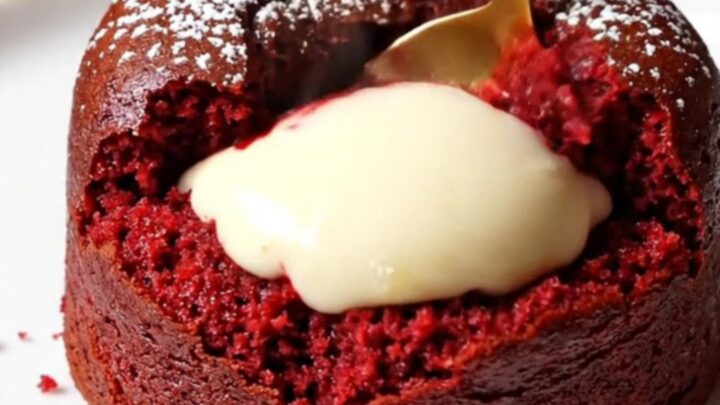
The cakes have cooled for just a couple of minutes and are now unmolded onto plates. The tops are dusted with powdered sugar and adorned with white chocolate curls. When you cut into one, the molten cream cheese and chocolate flow out in a dramatic stream. The texture is tender and moist, with a crisp outer edge. Serve immediately for the best experience.
Common mistakes
One common mistake is overbaking the cakes, which results in a fully set center instead of a molten one. Keep a close eye on the time and check for the slight jiggle. Another mistake is overmixing the batter, which can make the cakes tough.
Mix just until the ingredients are combined. Also, ensure the cream cheese filling is thick enough; if it’s too thin, it may leak out during baking. Finally, don’t skip buttering the ramekins—this ensures the cakes unmold cleanly.
How to tell it’s done
The cakes are done when the tops are puffed and set, and the edges look firm, but the centers still have a slight jiggle. The internal temperature of the cake should reach 160°F (71°C) to ensure the eggs are fully cooked.
To check, insert an instant-read thermometer into the center of a cake; it should read at least 160°F (71°C). If the center is still very liquid, bake for another minute or two, but be careful not to overbake.
- Egg dishes: 160°F (71°C) in the thickest part
Up next · Part 3 of 3
4 variations · storage & make-ahead · 5 answers · printable card
Tips, FAQ & printable recipe (Part 3)← Back to the ingredients (Part 1)