Desserts · Part 2 of 3: Instructions
Japanese Soufflé Cheesecake, Cloud-Airy in 90 Minutes Step-by-step instructions
- Prep
- Cook
- Total
- Serves
- 8
Before you start
Take the cream cheese, butter, milk and eggs out of the refrigerator about 30 minutes before baking; room-temperature cream cheese melts into the water-bath base without lumps, and room-temperature whites whip higher than cold ones.
Line the cake pan with parchment, leaving overhangs on two sides to lift the finished cake out, and wrap the pan in two layers of heavy-duty foil. Put a rack in the center of the oven and heat it to 300°F (150°C). Fill a kettle and start it boiling — the water bath needs boiling water, and it is the last thing added once the pan is already in the oven.
Ingredients at a glance (6)
- 8 oz cream cheese, at room temperature
- 4 tbsp unsalted butter, at room temperature
- 7 tbsp whole milk
- 6 large egg whites, at room temperature
- 1/2 cup granulated sugar
- confectioners' sugar, for serving
Instructions
Build the base and the meringue
- Set up the oven and water bathHeat the oven to 300°F (150°C) and place a rack in the center position. Line an 8-inch round cake pan with parchment so the paper overhangs two opposite sides, then wrap the outside in two layers of heavy-duty foil. Fill a kettle and bring the water to a boil for the bain-marie.Look for The foil should wrap snugly up the sides with no seams near the waterline.Tip Two foil layers matter: any leak floods the oven and the cheesecake bakes unevenly.
- Melt the cream cheese baseSet a saucepan with an inch of simmering water over medium-low heat and place a heatproof bowl on top. Add the cream cheese, butter and milk and whisk until the mixture turns completely smooth and glossy, about 5 minutes. Lift the bowl off the heat and let the batter rest until just warm.Look for No flecks of cream cheese should remain; the base should ribbon thickly off the whisk.Tip Keep the water at a bare simmer — scorching the base against boiling water makes it grainy.
- Whip the meringue to stiff peaksWhip the 6 egg whites in a spotlessly clean bowl, first on medium speed until foamy, then with the sugar added a tablespoon at a time. Raise to medium-high and whip to stiff, glossy peaks that stand straight when the beater lifts. Do not push past this stage or the meringue turns dry.Look for Peaks should hold their shape and the whites should look shiny, never matte or clumpy.Tip Wipe the bowl with a little vinegar on paper towel; any trace of fat blocks the whites from whipping.
By the end of this phase the base should be completely smooth — glossy, pourable, with no flecks of cream cheese — and resting warm while the meringue stands in stiff, shining peaks that hold a clean point. The oven should be at 300°F (150°C), the pan lined and foil-wrapped, and the kettle steaming. Check three things before folding: the base must not be hot (it would deflate the whites), the peaks must not slide or slump, and the foil must show no gaps. Everything that follows depends on these three details holding.
Fold gently, then steam-bake
- Fold the first third of meringueStir one generous spoonful of the meringue into the warm base to lighten it, then add a third of the remaining meringue and fold with a silicone spatula: cut to the bottom, sweep along the side, and turn the bowl a quarter turn. Work slowly so the air stays in the batter.Look for The batter should look evenly pale with no white streaks after about a minute of folding.Tip A slightly thin base at this stage is normal; the remaining meringue brings the structure.
- Finish folding and fill the panFold in the rest of the meringue with the same gentle cut-and-turn motion, stopping the moment no streaks remain. Pour the batter into the lined pan, then tap the pan twice on the counter and pop any large bubbles with a skewer. Smooth the top with an offset spatula.Look for The batter should mound off the spatula and settle into the pan in thick ribbons.Tip Over-folding is the fastest way to lose height; count strokes rather than folding until it feels right.
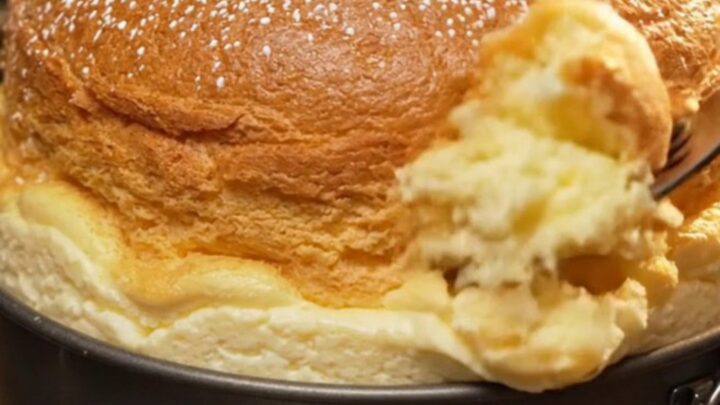
- Steam-bake in the bain-mariePlace the cake pan in a deep roasting pan and set both in the oven, then pour boiling water into the roasting pan to reach about 1 inch up the sides. Bake at 300°F (150°C) for 60 minutes, until the top is deep golden and the center registers 160°F (71°C) on an instant-read thermometer, the temperature at which the eggs are fully cooked.Look for The dome should rise tall and evenly golden with no cracks across the surface.Safe temperature 160°F (71°C) internal temperature (egg dishes)Tip Resist opening the door before minute 50; a draft of cold air collapses a rising soufflé bake.
Out of the oven, the cheesecake should be tall, evenly golden, and free of cracks, with the edges just releasing from the pan. The thermometer test is the one that counts: the center must read 160°F (71°C). Visually, look for a dome that has risen well above the rim and colors uniformly, not in pale patches. The water level in the roasting pan should still be visible. If any of these is missing — a pale top, a low dome, a reading under temperature — give it another 5 to 10 minutes before moving on.
Cool, unmold and finish
- Cool the dome down slowlyTurn the oven off, crack the door open with a wooden spoon, and leave the cheesecake inside for 10 minutes. This slow landing eases the temperature change so the dome settles instead of sinking or pulling away from the sides. Then lift the pan out and set it on a wire rack.Look for The dome may drop slightly; it should stay well above the rim of the pan.Tip A sudden move from oven heat to room temperature is the top cause of a shrunken, wrinkled surface.
- Chill, unmold and dustCool the cheesecake in its pan on a rack for 1 hour, then chill for 2 hours more for the cleanest slices. Lift it out by the parchment overhang, peel the paper away, and dust the top generously with confectioners' sugar through a fine-mesh sieve right before serving.Look for The surface should feel springy and the edges should release cleanly from the pan.Tip Dust just before serving; confectioners' sugar slowly sinks into a warm crumb and disappears.
After the slow cool-down and the hour on the rack, the cake should be settled and springy, well above the rim, with the parchment releasing cleanly when it is lifted. Chilled, it slices with a smooth, creamy crumb and no gaps.
The finish should be an even white dusting of confectioners' sugar, applied through a sieve only at serving time. Before calling it done, taste one point: the texture should feel airy and melt quickly, never dense or rubbery. If it seems dense, the fold was rough — note it and fold more gently next time.
Common mistakes
The most common failure is a dense, collapsed center, and it usually traces back to one of three moments: whites whipped past stiff peaks until they turn dry and clumpy, meringue folded in too roughly, or the oven door opened in the first 50 minutes. Cold cream cheese is the second trap — flecks that never melt show up as specks in the finished crumb.
Skipping the double layer of foil risks a flooded oven, and cooling the bake abruptly on the counter instead of in the switched-off oven causes the dome to sink and wrinkle. A cracked top almost always means the heat was too fierce or the bath ran dry.
How to tell it’s done
At 60 minutes the dome should stand tall above the rim, deep golden on top with no cracks, and the edges should just begin to pull from the sides. An instant-read thermometer in the center should read 160°F (71°C), the temperature at which the eggs in the batter are fully cooked.
The surface should feel springy under a light tap, and the whole cake may tremble faintly when the pan is nudged — that movement settles as it cools. If the top colors too fast before the center reaches temperature, tent it loosely with foil and continue; if the bath has evaporated, top it up with boiling water.
- Egg dishes: 160°F (71°C) in the thickest part
Up next · Part 3 of 3
4 variations · storage & make-ahead · 5 answers · printable card
Tips, FAQ & printable recipe (Part 3)← Back to the ingredients (Part 1)