Desserts · Part 1 of 3: Ingredients
Japanese Soufflé Cheesecake, Cloud-Airy in 90 Minutes
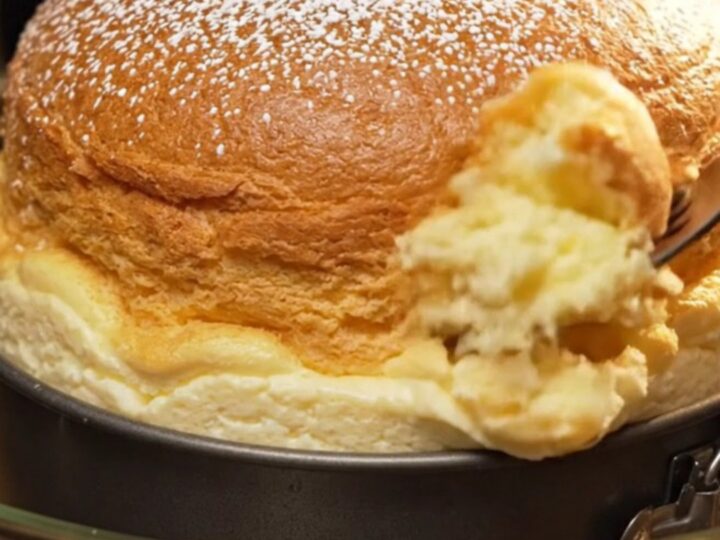
- Prep
- Cook
- Total
- Serves
- 8
A slice of Japanese soufflé cheesecake should bounce on the plate before it melts on the tongue. That cloud-like texture comes from one technique: stiff meringue folded into a warm cream cheese base, then steam-baked in a water bath at a gentle 300°F. Six egg whites do all the lifting, and a slow, even bake keeps the dome tall and crack-free. Follow the folding and temperature cues below and the crumb stays cottony from edge to center.
Japanese soufflé cheesecake — often called cotton cheesecake — trades the dense richness of a New York bake for something airy and almost weightless. The ingredient list is short: cream cheese, butter, milk, six egg whites and sugar, whipped into a meringue and folded through a warm base.
A bain-marie does the rest, surrounding the pan with gentle steam so the dome rises tall, stays golden and crack-free, and settles into a crumb that barely holds its own weight. This page walks through every stage: the base, the meringue, the fold, the water bath, and the slow cooling that keeps the dome from sinking, followed by storage, serving and variations.
Ingredients
- 8 oz cream cheese, at room temperature
- 4 tbsp unsalted butter, at room temperature
- 7 tbsp whole milk
- 6 large egg whites, at room temperature
- 1/2 cup granulated sugar
- confectioners' sugar, for serving
Why this recipe works
The water bath is the whole secret. Steam keeps the oven air humid and holds the temperature steady at the pan's walls, so the eggs in the batter set slowly and evenly instead of curdling against hot metal. A gentle 300°F gives the meringue time to expand fully before its structure fixes, which is why the dome climbs so high.
Because the heat arrives through water rather than dry air, the top colors gradually — deep gold, never scorched — and the interior stays creamy from edge to center. Without the bath, the same batter bakes faster, shrinks harder and almost always cracks.
The fold matters just as much. The warm base keeps the butter fluid, so it blends into the meringue without deflating it, and folding in stages — a spoonful first to lighten, then the rest — protects the air cells that become the crumb. Tapping the filled pan releases oversized bubbles that would tear the structure as it rises.
Turning the oven off and cracking the door for the last ten minutes lets the dome down gradually; a bake that goes from oven heat straight to room temperature contracts too fast and sinks. Every step either builds height or protects it.
Notes and substitutions
Use block-style, full-fat cream cheese; the spreadable tub kind contains too much water to give the base its body. Unsalted butter and whole milk keep the flavor clean, and nothing here needs extra salt. Superfine or regular granulated sugar both whip into the whites — superfine dissolves a little faster and gives a glossier meringue. Confectioners' sugar is for the finish only; it contains a little cornstarch, which is why it holds on the surface instead of melting straight into the crumb.
An 8-inch round cake pan with straight sides and at least 2-inch depth, lined with parchment and wrapped in two layers of heavy-duty foil, is the core setup. The foil matters more than it looks: one leak in a water bath floods the oven and ruins the bake.
A deep roasting pan holds the bath, an electric hand mixer or stand mixer whips the six whites quickly, and an instant-read thermometer removes all guesswork about doneness. A fine-mesh sieve gives an even snowfall of confectioners' sugar at the end.
- cream cheese: Mascarpone works in the same weight and gives an even creamier crumb; reduce the butter to 3 tbsp.
- whole milk: Reduced-fat milk works, but the crumb is slightly less creamy; avoid nonfat milk.
- granulated sugar: Superfine sugar dissolves faster in the whites; use the same 1/2 cup.
- confectioners' sugar: Blitz granulated sugar in a blender for 30 seconds to make an even, fine dusting sugar.
Equipment
- 8-inch round cake pan
- heavy-duty aluminum foil
- deep roasting pan
- electric hand mixer
- instant-read thermometer
- fine-mesh sieve
Up next · Part 2 of 3
8 steps · 1 h of cooking · what to look for at each stage
Step-by-step instructions (Part 2)