Dinner · Part 3 of 3: Tips & recipe card
Crockpot Pork Loin in Creamy Bacon Gravy — Dump-and-Go Dinner Tips, FAQ & printable recipe
- Prep
- Cook
- Total
- Serves
- 6
Tips for success
Cook on low whenever the schedule allows. Low heat gives the bacon time to render fully and the pork time to tenderize gently, and it is far more forgiving of a delayed dinner than high. Keep the thermometer readings honest by testing the thickest part of the roast, not the end nearest the wall of the insert, which runs hotter.
If the gravy tastes flatter than expected at the end, a stir and 10 minutes uncovered on high will concentrate it — the flavor is in the liquid, not in more seasoning. Save any leftover bacon fat for another dish, but do not add it to the cooker; the recipe balances without it.
Slice the pork against the grain and about half an inch thick; thinner slices dry out faster on the plate, and thicker ones lose the gravy coverage that makes the dish. Warm the serving plates in a low oven for a few minutes so the gravy stays fluid to the last bite. If serving a crowd, hold the sliced pork in the gravy on the cooker's warm setting for up to 30 minutes rather than plating early. For a second-day meal, chop the remaining pork and fold it back into the gravy with the potatoes — the flavors sit overnight and the reheated version is arguably the best of the batch.
Variations
- Mushroom gravy version: Swap the cream of chicken soup for an equal can of cream of mushroom soup. The method and timing stay the same, and the gravy takes on a deeper, earthier flavor that pairs especially well with the bacon.
- Shoulder roast swap: Use a 3-pound boneless pork shoulder instead of loin. Shoulder has more fat, so cook it on low for about 8 hours; it shreds rather than slices, and the gravy turns slightly richer.
- High-heat timeline: When dinner needs to move faster, cook on high for about 3 hours instead of low for 4 to 5. Check the temperature early, since high heat reaches 145°F sooner and punishes overcooking.
- Smoother gravy finish: For a silkier sauce, stir the gravy well at the end and press a few of the softest potatoes against the insert wall so their starch thickens the sauce without any extra ingredients.
Storage and make-ahead
- Fridge
- Refrigerate leftovers in airtight containers for up to 3 days; keep the gravy with the pork.
- Freezer
- Freeze pork and gravy together for up to 2 months; thaw overnight in the refrigerator before reheating.
- Reheat
- Reheat gently on the stovetop or in the microwave until steaming throughout, 165°F (74°C); add a splash of water if thick.
Cool the leftovers no longer than 2 hours after cooking, then transfer the pork, potatoes and gravy to shallow airtight containers. Store in the refrigerator for up to 3 days. Keep the gravy with the meat rather than separate — it protects the slices from drying in the cold.
Reheat gently on the stovetop over medium-low, stirring once or twice, or in the microwave at half power, until steaming throughout at 165°F (74°C). A splash of water loosens the gravy if it has set thick in the fridge. Do not leave the slow cooker on warm for storage; that setting is for holding, not for safe cooling.
The prep splits neatly across a day. Crisp the bacon, chop it, halve the potatoes and refrigerate them in separate containers the night before; in the morning, the assembly is nothing but layering. The fully loaded insert can also be assembled, covered and refrigerated overnight, then set in the cooker base in the morning and started on low — add roughly 30 minutes to the cook time to account for the cold start.
Cooked pork in its gravy keeps well, so the whole dish can be made a day ahead, refrigerated after cooling for no more than 2 hours, and reheated gently on the stovetop or in the microwave until steaming throughout.
Serving ideas
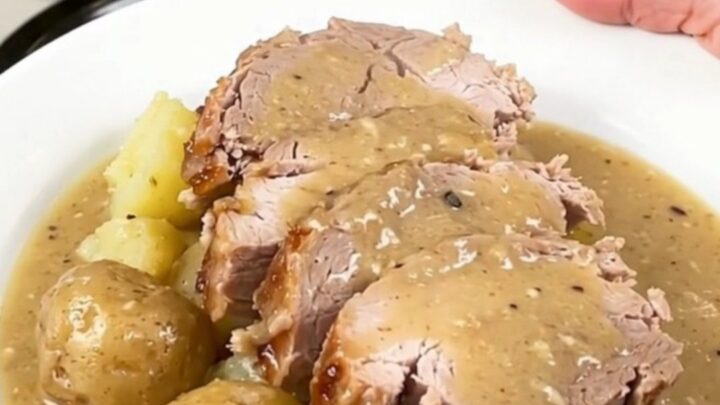
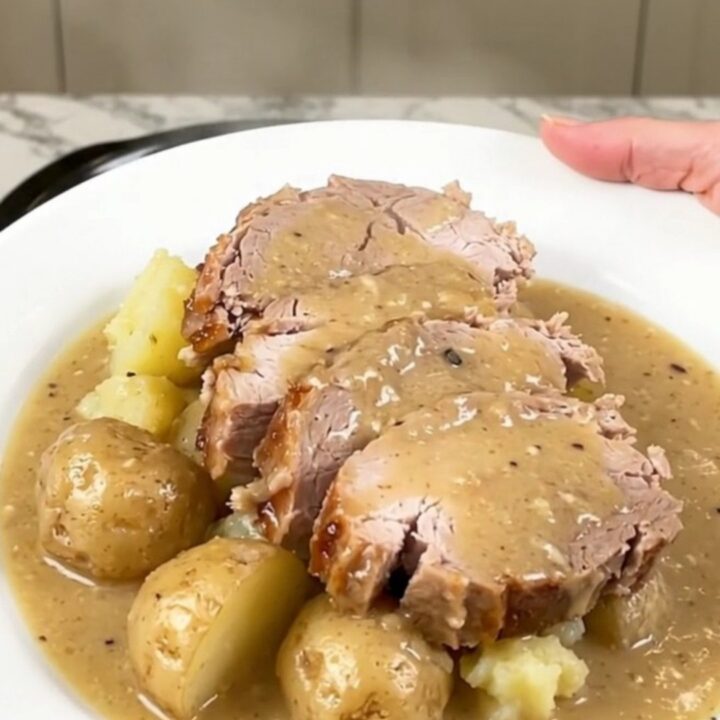
Serve the pork in thick slices fanned over the potatoes, with the bacon gravy ladled on generously — the sauce is the dish, so be liberal with it. A slotted spoon lifts the potatoes cleanly, and a wide, shallow bowl or warmed dinner plate keeps the gravy where it belongs.
This is a complete plate on its own: meat, potatoes and sauce in every forkful. If the table wants more, something crisp and fresh alongside cuts the richness — a simple green salad or steamed green beans do the job without competing. Put the extra gravy in a small pitcher so anyone who wants a heavier hand can help themselves.
For a family-style presentation, bring the whole insert to the table on a trivet and slice the roast in front of everyone, then spoon the gravy straight from the ceramic. The dish also travels well to potlucks: pack the sliced pork and gravy together in a covered container, reheat gently on arrival, and the gravy loosens right back up with a stir. Portion planning is simple — a 3-pound roast feeds six generously, and any extra slices reheat well the next day. Leftover pork and gravy spooned over toast or folded into a warmed roll makes a lunch worth planning for.
Frequently asked questions
Can this be made ahead?
Can this be frozen?
Why did the gravy turn out thin?
Can a pork tenderloin be used instead?
What size slow cooker works best?
Crockpot Pork Loin in Creamy Bacon Gravy — Dump-and-Go Dinner
Ingredients
- 3 lb boneless pork loin roast
- 8 slices cooked bacon, chopped
- 1 1/2 lb baby potatoes, halved
- 2 tsp onion powder
- 10.5 oz cream of chicken soup (one can)
Instructions
- Set the boneless pork loin roast in the center of the slow cooker insert and press it down gently with your hand so it sits flat and level on the ceramic. A level roast cooks evenly; if it teeters on a fat cap, turn it until it rests steady.
- Scatter the chopped cooked bacon and the halved baby potatoes around the roast, letting them pile naturally against the sides of the insert. Aim for an even ring rather than a heap, so every potato has contact with the ceramic and picks up the bacon drippings as they render.
- Sprinkle the onion powder evenly over the pork, bacon and potatoes. Reach across the whole insert rather than dumping it in one spot — an even dusting seasons the gravy that forms later, while a single pile dissolves into one concentrated patch and leaves the rest flat.
- Spoon the cream of chicken soup over the top of everything, letting it sit in generous dollops rather than stirring it in. The soup stays concentrated on the surface through the cook, then melts down into the drippings to become the gravy at serving time.
- Cover and cook on low for 4 to 5 hours, or on high for about 3 hours, until the pork is fork-tender. Keep the lid closed the whole time; every lift releases the steam that is doing the cooking and adds roughly 20 minutes to the clock.
- Check the pork with an instant-read thermometer in the thickest part of the roast: it should read 145°F (63°C), the safe internal temperature for whole cuts of pork. Let the roast rest at least 3 minutes before slicing so the juices settle back into the meat.
- Lift the roast out with tongs or two large forks and set it on a cutting board. Tent it loosely with foil and slice it into thick, even pieces — about half an inch — while the potatoes and gravy stay warm in the insert below.
- Give the gravy in the insert a good stir, folding in any soup that has pooled at the edges and scraping the bottom where the bacon flavor collects. The sauce should be thick enough to coat a spoon; if it looks thin, leave the lid off on high for 10 minutes.
- Plate the pork slices over the soft potatoes and ladle the creamy bacon gravy generously over everything, letting it run into the crevices. Serve straight away, with extra gravy passed at the table, while the steam is still rising off the plate.
Estimated nutrition per serving
- Calories
- 620
- Protein
- 45 g
- Carbohydrates
- 24 g
- Fat
- 32 g
Next recipe
Pan-Seared Ribeye Steak with a Golden Crust in 20 Minutes
See the recipe → →This recipe is based on a short cooking video and is published under the pen name Clara Weller. It was checked before publication, but errors can slip through. Nutrition, when shown, is an estimate. Read more in our editorial policy and on our food safety page.
More recipes to try

Dump-and-Go Crockpot Thai Coconut Chicken Soup
Total time: 4 h 20 min
Bacon-Wrapped Sonoran Hot Dogs, Crispy in 30 Minutes
Total time: 30 min
New Mexico Stacked Green Chile Enchiladas Ready in 25 Minutes
Total time: 22 min
Red Chile Beef Enchiladas with a Fried Egg on Top
Total time: 45 min
Crunchy Carne Asada Takis Burrito with Nacho Cheese
Total time: 25 min