Dinner · Part 2 of 3: Instructions
Crispy Turkish Lahmacun Pide with Spiced Beef Step-by-step instructions
- Prep
- Cook
- Total
- Serves
- 4
Before you start
Before starting, clear a work surface and have a large bowl, a rolling pin, and a baking stone or heavy baking sheet ready. Measure out the warm milk and water—they should be about 110°F (43°C), warm to the touch but not hot. Set the yeast to proof in the liquid with a pinch of salt.
While the dough rises, prepare the topping and refrigerate it. Preheat the oven with the stone inside for at least 30 minutes before baking. Have a pizza peel or rimless baking sheet dusted with flour ready for transferring the pide.
Ingredients at a glance (14)
- 1/2 cup warm milk
- 1/2 cup warm water
- 2 tbsp olive oil
- 2 1/4 tsp active dry yeast
- 1 tsp salt
- 3 cups all-purpose flour
- 1 lb ground beef
- 1 onion, finely grated
- 2 tbsp tomato paste
- 1 tsp red pepper flakes
- 1 tsp ground cumin
- salt and black pepper to taste
- 1 lemon, cut into wedges
- 1/2 cup fresh parsley leaves
Instructions
Dough and Topping
- Make the doughIn a large bowl, combine the warm milk, warm water, olive oil, active dry yeast, and salt. Let stand for 5 minutes until the yeast is foamy. Add the flour and stir with a wooden spoon until a shaggy dough forms. Turn out onto a floured surface and knead for 5 minutes until smooth and elastic. Place in a lightly oiled bowl, cover with a damp towel, and let rise in a warm spot for 30 minutes, until puffy.Look for The dough is smooth, springy, and has doubled in size.Tip If the dough is too sticky, add a little more flour, 1 tablespoon at a time.
- Make the toppingWhile the dough rises, prepare the topping. In a bowl, combine the ground beef, finely grated onion, tomato paste, red pepper flakes, ground cumin, salt, and black pepper. Mix with your hands until everything is well combined. The mixture should be spreadable but not wet. Cover and refrigerate until needed.Look for The topping is a uniform, thick paste.Tip Grating the onion releases its juice, which keeps the beef moist.
After this phase, you should have a smooth, elastic dough that has doubled in size and a well-mixed topping that is thick and spreadable. The dough should be pillowy and slightly tacky but not sticky.
The topping should be fragrant with cumin and red pepper, and the onion should be evenly distributed. If the dough hasn't risen much, give it a few more minutes. The topping can sit in the fridge while you shape the dough.
Shaping and Topping
- Preheat the oven and shape the pidePlace a baking stone or heavy baking sheet on the middle rack of the oven. Preheat the oven to 450°F (232°C) for at least 30 minutes. Meanwhile, punch down the dough and divide it into 4 equal pieces. On a floured surface, roll each piece into a thin long oval, about 1/8 inch thick. Pinch the two short ends to form sharp, pointed canoe tips.Look for The dough is thin enough to see your hand through it.Tip Keep the dough covered with a towel while working to prevent drying.
- Top the pideSpread a quarter of the beef mixture evenly over each dough oval, leaving a small border at the edges. Use the back of a spoon to press the topping into the dough so it adheres. Transfer the topped pide to a pizza peel or rimless baking sheet dusted with flour.Look for The topping covers the dough in a thin, even layer.Tip Don't overfill—the topping should be thin for crispiness.
The dough should be rolled into thin, long ovals with pointed ends, about 1/8 inch thick. The topping should be spread evenly, leaving a small border. The dough should feel smooth and not tear when you pinch the ends. If the dough is too sticky, dust with more flour. The pide should be easy to lift onto the peel. At this point, the oven should be fully preheated and the stone hot.
Baking and Finishing
- Bake the pideSlide the pide onto the preheated baking stone. Bake for 8 minutes, until the crust is blistered with charred leopard spots and the edges are crisp. The beef should be cooked through and reach an internal temperature of 160°F (71°C). Use a thermometer to check the thickest part of the topping.Look for The crust is golden with dark blisters, and the beef is sizzling.Safe temperature 160°F (71°C) internal temperature (ground meat)Tip If the topping browns too quickly, move the pide to a lower rack.
- Finish and serveRemove the pide from the oven and immediately squeeze fresh lemon juice over the top. Scatter with fresh parsley leaves. Fold each pide into a tight roll and serve hot with lemon wedges on the side for extra squeezing.Look for The pide is crisp, fragrant, and the lemon brightens the beef.Tip Rolling while hot makes the crust snap.
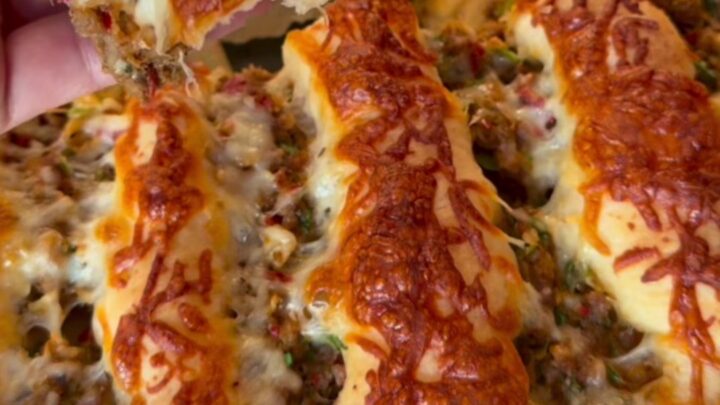
After baking, the pide should be blistered with charred spots, and the beef should be cooked through with a safe internal temperature of 160°F (71°C). The edges should be crisp and golden. When you squeeze lemon over the top, you should hear a sizzle. The parsley adds a fresh green contrast. Fold one pide to test—it should roll tightly without breaking. Serve immediately for the best crispness.
Common mistakes
One common mistake is overloading the topping—too much beef makes the pide soggy and difficult to roll. Spread it thin, leaving a small border. Another issue is rolling the dough too thick; aim for about 1/8 inch. If the dough springs back, let it rest for a few minutes before rolling again.
Not preheating the stone long enough results in a pale, soft crust—give it at least 30 minutes. Finally, avoid opening the oven door repeatedly during baking, which lets out heat and slows the crisping. Let the pide rest for a minute before rolling to avoid burning your hands.
How to tell it’s done
The pide is done when the crust is deeply blistered with charred leopard spots and the edges are crisp and golden. The topping should be sizzling and the beef cooked through, reaching an internal temperature of 160°F (71°C) when measured with an instant-read thermometer.
The dough should sound hollow when tapped on the bottom. If the crust is browning too quickly but the beef isn't done, move the pide to a lower rack and continue baking for a minute or two. The finished pide should be firm enough to fold without cracking.
- Ground meat: 160°F (71°C) in the thickest part
Up next · Part 3 of 3
4 variations · storage & make-ahead · 5 answers · printable card
Tips, FAQ & printable recipe (Part 3)← Back to the ingredients (Part 1)