Breakfast · Part 2 of 3: Instructions
Crispy Pesto Eggs on Brioche Toast Step-by-step instructions
- Prep
- Cook
- Total
- Serves
- 1
Before you start
Before starting, gather all ingredients and equipment. Measure the pesto and Parmesan to ensure accurate proportions. Crack the eggs into a small bowl to avoid shell fragments.
Toast the brioche just before serving so it stays crisp. Have a spatula and a plate ready. The entire process takes less than five minutes, so it's best to have everything within reach.
Ingredients at a glance (5)
- 30 g fresh Genovese basil pesto
- 25 g finely grated Parmigiano-Reggiano
- 2 large organic eggs
- 1 thick slice toasted brioche
- Crushed red pepper flakes, for serving
Instructions
Building the Base
- Spread the Pesto BasePlace a cold ceramic or nonstick skillet on the counter. Spread the 30 g of fresh Genovese basil pesto evenly across the bottom of the skillet. Sprinkle the 25 g of finely grated Parmigiano-Reggiano over the pesto, covering the surface in a thin, even layer.Look for The pesto and Parmesan form a thin, even layer covering the skillet bottom.Tip Use a cold skillet so the pesto spreads easily without cooking prematurely.
- Crack the EggsCrack the 2 large organic eggs directly on top of the pesto and Parmesan mixture, spacing them apart so they do not run into each other. Season with a pinch of salt if desired, though the Parmesan adds saltiness.Look for The eggs sit on the green pesto bed, yolks intact and whites spreading slightly.Tip Crack each egg into a small bowl first to avoid shell bits and ensure a clean drop.
At the end of this phase, the skillet holds an even layer of pesto and Parmesan, with the eggs cracked on top. The mixture is still cold and uncooked. The pesto should be spread thinly but completely, and the eggs should sit without spreading too far. This setup ensures even cooking and a cohesive crust.
Crisping the Crust
- Sizzle to a CrispPlace the skillet over medium heat and cook for 3 to 4 minutes. The basil oil will separate and sizzle, frying the eggs while the pine nuts and Parmesan toast into a nutty, crispy emerald-and-gold crust. Cook until the egg whites are fully set and the Parmesan is deeply golden and lacy at the edges.Look for The edges of the pesto-Parmesan crust turn golden brown and crisp, and the whites are opaque and set.Safe temperature 160°F (71°C) internal temperature (egg dishes)Tip If the skillet seems too hot, lower the heat to prevent the Parmesan from burning before the whites set.
- Check the YolksGently press the yolk with a spatula to check its consistency. For a soft, creamy yolk, remove the skillet from heat when the yolk is still slightly soft to the touch but the white is fully set. For a firmer yolk, cook an additional minute. To ensure food safety, cook until the yolk reaches 160°F (71°C).Look for The yolk gives slightly when pressed, indicating a creamy texture.Safe temperature 160°F (71°C) internal temperature (egg dishes)Tip If the whites are set but the yolk is too runny, cover the skillet for 30 seconds to gently steam the yolk.
The skillet is now over medium heat, and the pesto oil is sizzling. The Parmesan is melting and beginning to brown, and the egg whites are turning opaque. The edges of the crust are turning golden and lacy.
The kitchen smells nutty and herbaceous. The eggs should be nearly set, with the yolks still soft. Check that the crust is not burning; adjust the heat if needed.
Assembling and Serving
- Slide onto ToastWhile the eggs cook, toast the thick slice of brioche until golden and crisp. Slide the entire pesto-egg crisp onto the toasted brioche, using a spatula to lift the lacy Parmesan crust without breaking it.Look for The golden crust lifts cleanly from the skillet, carrying the eggs on top.Tip For extra crunch, toast the brioche in the same skillet after removing the eggs.
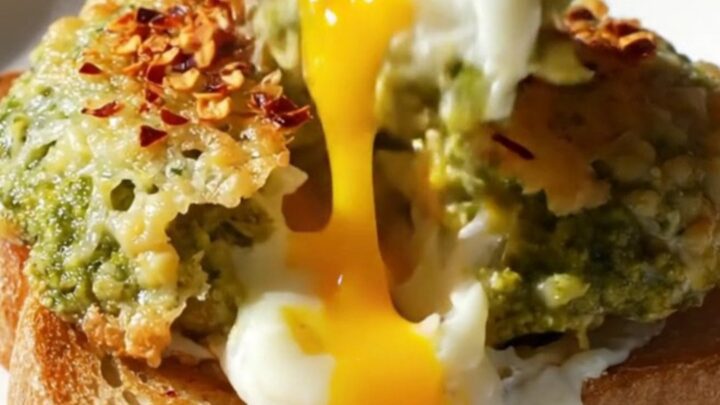
- Finish and ServeSprinkle crushed red pepper flakes over the top for a touch of heat. Slice into the runny yolk so it flows over the crispy pesto crust and brioche. Serve immediately while the crust is crisp and the yolk is still warm and glossy.Look for The yolk flows slowly, mingling with the crispy pesto and cheese.Tip Use a serrated knife to cut the toast cleanly without squishing the crust.
The crispy pesto-egg creation has been slid onto the toasted brioche. The crust is intact, golden, and crisp. The yolks are soft and glossy, and the red pepper flakes add a pop of color. The dish is ready to serve immediately, with the yolk flowing when cut. The texture should be a contrast of crunchy, creamy, and soft.
Common mistakes
One common mistake is using a hot skillet from the start, which can cause the pesto to burn before the eggs cook. Always start with a cold skillet and heat gradually. Another error is overloading the skillet with too much pesto or cheese, making the crust thick and chewy instead of crispy.
Use the specified amounts for the best texture. Also, avoid moving the eggs too early; let the crust form before attempting to slide the spatula underneath. If the whites are not set but the crust is dark, reduce the heat and cover the skillet briefly.
How to tell it’s done
The eggs are done when the whites are fully set and opaque, with no translucent areas. The yolk should be soft and creamy if desired, but for food safety, cook until the yolk reaches 160°F (71°C).
The pesto-Parmesan crust should be golden brown and crispy at the edges, lifting easily from the skillet. The brioche should be toasted to a deep golden color with a crisp exterior.
- Egg dishes: 160°F (71°C) in the thickest part
Up next · Part 3 of 3
4 variations · storage & make-ahead · 5 answers · printable card
Tips, FAQ & printable recipe (Part 3)← Back to the ingredients (Part 1)