Desserts · Part 2 of 3: Instructions
Crisp Passionfruit Pavlova with Marshmallow Center Step-by-step instructions
- Prep
- Cook
- Total
- Serves
- 8
Before you start
Before starting, bring the egg whites to room temperature by leaving them out for 30 minutes. Measure all ingredients accurately: 300 g superfine sugar, 10 g cornstarch, and 5 ml white vinegar. Prepare a baking sheet with parchment paper and position an oven rack in the center.
Heat the oven to 250°F (120°C). Have the mixer and mixing bowl clean and dry. For the topping, chill the bowl and beaters, and have the mascarpone and cream measured. Wash and dry the berries, and scoop the passionfruit pulp from fresh fruits.
Ingredients at a glance (8)
- 6 large egg whites, room temperature
- 300 g superfine sugar
- 10 g cornstarch
- 5 ml white vinegar
- 300 ml heavy cream
- 1/2 cup mascarpone cheese
- 2 cups mixed fresh berries (such as strawberries, blueberries, raspberries)
- 1/2 cup fresh passionfruit pulp (from about 4 passionfruits)
Instructions
Whip and Shape
- Whip the MeringueHeat the oven to 250°F (120°C). Line a baking sheet with parchment paper. In a large bowl, beat the egg whites with an electric mixer on medium speed until soft peaks form. Gradually add the superfine sugar, about 1 tablespoon at a time, beating well after each addition. Continue beating until the meringue is glossy and holds stiff peaks. Sprinkle the cornstarch and vinegar over the meringue and fold in gently with a spatula until just combined.Look for The meringue should be glossy, smooth, and hold a stiff peak that doesn't droop.Tip Ensure the bowl and beaters are completely clean and free of any grease or yolk for best volume.
- Shape the CloudSpoon the meringue onto the prepared baking sheet and shape it into a round about 9 inches (23 cm) in diameter, building the sides higher than the center to create a crater. Use a spatula to make decorative swoops on the sides. The center will sink slightly during baking, creating a natural well for the topping.Look for The meringue should be tall with a slight well in the center.Tip Use the back of a spoon to create the crater—this gives the pavlova its classic shape.
At the end of this phase, the meringue should be glossy, smooth, and hold stiff peaks that stand up straight. When you lift the whisk, the peak should not droop.
The meringue should be shaped into a round with a slight well in the center, and the sides can have decorative swoops. The mixture should be thick and airy, not runny or grainy. If the meringue is grainy, the sugar hasn't dissolved—beat a little longer until smooth.
Bake and Cool
- Bake Low and SlowPlace the meringue in the oven and bake at 250°F (120°C) for 90 minutes. Do not open the oven door during baking. After 90 minutes, turn off the oven and leave the pavlova inside to cool completely for at least 1 hour, or until the oven is cool. This gradual cooling prevents cracking and ensures a crisp shell with a marshmallow-soft center.Look for The pavlova should be dry and firm to the touch, with a pale cream color.Safe temperature 160°F (71°C) internal temperature (egg dishes)Tip Resist opening the oven—sudden temperature changes can cause the meringue to crack.
- Cool in the OvenOnce the oven is off, leave the pavlova inside to cool completely. This can take 1 to 2 hours. The pavlova is done when the exterior is crisp and dry, and the center feels soft but not sticky. Remove from the oven and carefully peel off the parchment paper.Look for The pavlova should lift easily from the parchment and feel light.Tip If the pavlova sticks, run a thin spatula underneath to loosen it gently.
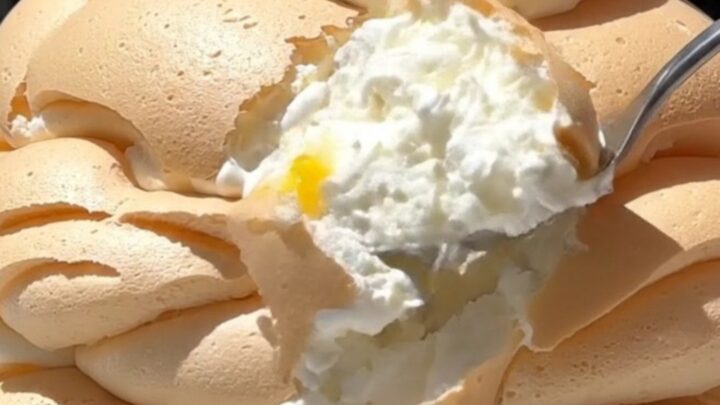
After baking, the pavlova should be dry and firm to the touch, with a pale cream color and no browning. It should lift easily from the parchment. The center should feel soft but not sticky or wet. After cooling in the oven, the pavlova should be completely cool and crisp on the outside. If there are any cracks, they are normal and will be covered by the topping.
Top and Serve
- Whip the ToppingIn a chilled bowl, combine the heavy cream and mascarpone. Beat with an electric mixer on medium-high speed until soft peaks form. Be careful not to overwhip; the mixture should be smooth and spreadable but not stiff.Look for The cream should hold a soft peak that gently folds over.Tip Chill the bowl and beaters in the freezer for 10 minutes before whipping for best results.
- Assemble the PavlovaSpoon the mascarpone cream into the center of the cooled pavlova, spreading it slightly but leaving a border of meringue visible. Top with the fresh berries and drizzle with the passionfruit pulp, including the seeds. Serve immediately for the best texture contrast.Look for The cream should be piled high, with berries and passionfruit covering the top.Tip Assemble just before serving to keep the meringue crisp.
The mascarpone cream should be soft and spreadable, holding soft peaks. The assembled pavlova should look abundant and colorful, with cream piled high and berries and passionfruit distributed evenly. The meringue should remain crisp, and when you cut into it, you should hear a light crackle. Serve immediately to enjoy the full textural contrast.
Common mistakes
A common mistake is opening the oven during baking, which can cause the meringue to crack or collapse. Another is overwhipping the egg whites—they should be stiff but still glossy; overwhipping can make them dry and grainy.
Adding sugar too quickly can deflate the meringue, so add it gradually. Also, ensure no yolk or grease contaminates the egg whites, as this prevents them from whipping to stiff peaks. Finally, assemble just before serving to avoid a soggy pavlova.
How to tell it’s done
The pavlova is done when the exterior is dry, crisp, and pale cream in color, and the center feels soft but not sticky when lightly pressed. If using an instant-read thermometer, the internal temperature of the meringue should reach 160°F (71°C) to ensure the egg whites are fully cooked.
After cooling in the oven, the pavlova should lift easily from the parchment. The topping cream should hold soft peaks, and the assembled pavlova should be served immediately for the best texture contrast.
- Egg dishes: 160°F (71°C) in the thickest part
Up next · Part 3 of 3
4 variations · storage & make-ahead · 5 answers · printable card
Tips, FAQ & printable recipe (Part 3)← Back to the ingredients (Part 1)