Dinner · Part 2 of 3: Instructions
Crispy Japanese Chicken Katsu Sando Step-by-step instructions
- Prep
- Cook
- Total
- Serves
- 2
Before you start
Before you begin, ensure your workspace is organized with a dedicated breading station. Set up three shallow bowls: one for the flour, one for the beaten egg, and one for the panko. Having all your ingredients pre-measured and the cabbage shredded ahead of time will make the assembly process seamless.
Ensure the chicken is patted dry with paper towels; excess surface moisture can cause the breading to slide off during the frying process. Set up your cooling rack near the fryer to immediately transfer the chicken once it reaches the correct temperature, preventing it from overcooking or becoming greasy.
Ingredients at a glance (8)
- 2 pieces boneless chicken thigh (220g each)
- 1/2 cup all-purpose flour
- 1 large egg, beaten
- 1 cup fresh Japanese panko
- 4 slices shokupan milk bread, toasted
- 2 tbsp karashi mustard mayo
- 4 tbsp tonkatsu sauce
- 1 cup shredded cabbage
Instructions
Breading the chicken
- Prep the chickenPlace the boneless chicken thighs on a stable cutting board. Use a meat mallet to pound each piece to an even thickness. This ensures consistent cooking and tenderness. Dredge each piece in flour, shaking off the excess, then dip completely into the beaten egg mixture. Finally, press the chicken firmly into the fresh Japanese panko until fully and evenly coated on all sides.Look for The chicken should be evenly pounded and thoroughly coated in panko breadcrumbs without any bald spots.Tip Ensure the chicken is dry before flouring to help the coating adhere properly.
The chicken pieces should be thoroughly and evenly coated in the panko breadcrumbs. Check that there are no bare spots where the egg and flour are exposed, as this will prevent the crust from forming correctly. The coating should feel dry and firm to the touch before you begin the frying process.
Frying the cutlets
- Deep fry the cutletsPreheat the deep fryer or a heavy-bottomed pot filled with oil to 355°F (180°C). Carefully lower the breaded chicken cutlets into the hot oil. Fry for 5 minutes, turning occasionally if necessary, until the panko crust reaches a deep golden-brown color and the chicken reaches an internal temperature of 165°F (74°C). Remove the cutlets and drain them on a wire rack to maintain crispiness.Look for The panko crust should be deep golden-brown and extremely crispy to the touch.Safe temperature 165°F (74°C) internal temperature (poultry)Tip Do not crowd the fryer to ensure the oil temperature remains stable.
The chicken should be a rich, deep golden-brown color. Listen for a steady, vigorous sizzling sound. The panko should look light and jagged, not smooth or greasy. Confirm the internal temperature is 165°F (74°C) before removing the chicken from the oil. The meat should be firm and springy when pressed.
Final assembly
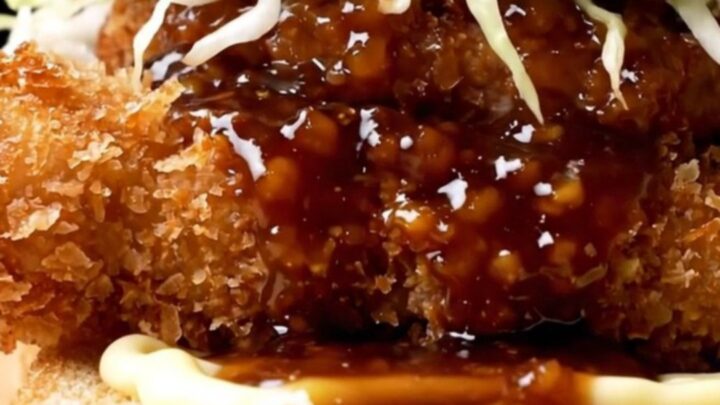
- Assemble the sandoSpread the karashi mustard mayo onto the toasted slices of shokupan milk bread. Place the fried chicken cutlet on one slice, then drench it generously with the tonkatsu sauce. Add the shredded cabbage on top for freshness and crunch. Close the sandwich with the second slice of bread. Press down slightly to set the ingredients before slicing the sandwich in half to serve.Look for The sandwich should be layered neatly, with the sauce soaking slightly into the cabbage and chicken.Tip Use a serrated bread knife to slice the sandwich cleanly without crushing the bread.
The sandwich should be neatly stacked with the mustard mayo, sauce, and cabbage holding everything together.
When sliced in half, the cross-section should clearly show the distinct layers of bread, tangy sauce, crispy chicken, and fresh cabbage. The sandwich should feel sturdy and substantial in your hands.
Common mistakes
A common mistake is failing to pound the chicken to an even thickness, which results in uneven cooking where some parts are dry while others remain undercooked. Another error is overcrowding the fryer, which drops the oil temperature and causes the breading to absorb oil rather than frying crisp.
Ensure the oil is consistently maintained at 355°F (180°C). Finally, adding the sauce too early can lead to a soggy sandwich; always apply the sauce and assemble the sandwich immediately before serving to maintain the textural contrast.
How to tell it’s done
The chicken is perfectly cooked when the panko crust is a deep, uniform golden-brown and the internal temperature reaches 165°F (74°C). The meat should be juicy and opaque throughout. Avoid overcooking, as the thigh meat can become dry if left in the oil for too long.
Use a meat thermometer inserted into the thickest part of the thigh to verify the temperature. The crust should sound crisp when tapped and should not show any signs of oil saturation. If the crust browns too quickly before the center is cooked, lower the heat slightly for the remaining duration.
- Poultry: 165°F (74°C) in the thickest part
- Egg dishes: 160°F (71°C) in the thickest part
Up next · Part 3 of 3
2 variations · storage & make-ahead · 3 answers · printable card
Tips, FAQ & printable recipe (Part 3)← Back to the ingredients (Part 1)