Dinner · Part 2 of 3: Instructions
Crispy Chicken Katsu Green Curry Udon — One-Bowl Dinner Step-by-step instructions
- Prep
- Cook
- Total
- Serves
- 4
Before you start
Before the pan goes on the heat, get the whole station set. Slice each chicken breast horizontally into two thin cutlets and pound them to an even half inch between parchment, then season both sides with kosher salt. Line up three shallow dishes — flour, beaten eggs, panko — and bread every cutlet before any frying starts; it is far easier than breading and frying at once.
Set a wire rack over a baking sheet for draining. Measure the curry paste, tear the kaffir lime leaves, grate the palm sugar and have the coconut milk, chicken stock and fish sauce within reach. Put a large pot of water on to boil for the udon.
Ingredients at a glance (14)
- 9 oz chicken breast (250 g)
- Kosher salt, to taste
- 1/2 cup all-purpose flour, for dredging
- 2 eggs, beaten, for dredging
- 1 1/2 cups panko breadcrumbs
- 2 cups neutral frying oil, such as canola
- 1/4 cup green curry paste (60 g)
- 4 kaffir lime leaves, torn
- 1 2/3 cups coconut milk (400 ml)
- 3/4 cup chicken stock (200 ml)
- 2 tbsp fish sauce
- 2 tbsp palm sugar, grated
- 14 oz thick udon noodles (400 g)
- Thai basil leaves, for serving
Instructions
Bread and fry the katsu
- Flatten and season the chickenPat the chicken breasts dry with paper towels, then slice each one horizontally into two thin cutlets. Pound them between sheets of parchment to an even half-inch thickness, then season both sides with kosher salt so every bite is seasoned through.Look for Each cutlet should look uniformly thin, with no thick ridge in the middle.Tip Even thickness is the whole secret: thin, flat cutlets fry quickly and stay juicy inside.
- Bread the cutlets in pankoSet up a breading line: flour in the first shallow dish, beaten eggs in the second, panko in the third. Coat each cutlet in flour, shake off the excess, dip it in egg, then press it firmly into panko until every surface is thickly covered.Look for The coating should look shaggy and dense, with no wet flour patches showing.Tip Press hard when coating so the panko forms big, crackly flakes that shatter when sliced.
- Fry the katsu to goldenHeat two inches of oil in a heavy skillet to 340°F. Fry the cutlets in batches for three to four minutes per side, turning once, until deep golden brown and 165°F (74°C) at the thickest point. Drain on a wire rack, never on paper.Look for Deep golden crust, steady sizzle, and 165°F (74°C) on an instant-read thermometer.Safe temperature 165°F (74°C) internal temperature (poultry)Tip Keep the oil between 325°F and 350°F so the crust crisps before the coating darkens.
At the end of this phase, every cutlet should be deep golden brown with a thick, crackly crust that sounds hollow when tapped with tongs, and an instant-read thermometer should read 165°F (74°C) at the center. The cutlets rest on a wire rack, glistening but not greasy, and the oil should smell clean, not acrid. Check the underside of one piece: it should be as golden as the top, with no pale, soggy patches. If any cutlet is still pale, the oil ran cool — give it another minute per side. The kitchen should smell like toasted bread and fried chicken, clean and appetizing rather than burnt.
Build the curry and cook the noodles
- Sizzle the curry pasteWipe out the skillet and set it over medium heat. Add the green curry paste and the torn kaffir lime leaves. Sizzle for two minutes, stirring constantly, until the paste darkens, the oil separates and the kitchen smells strongly of lime and chilies.Look for The paste looks darker and slightly shiny, and the raw chili smell turns sweet and fragrant.Tip Frying the paste first blooms its aromatics and gives the broth real depth in minutes.
- Build the coconut brothPour in the coconut milk and chicken stock, scraping up every bit of paste stuck to the pan. Bring the broth to a gentle simmer and cook for five minutes, stirring occasionally, until it turns glossy, velvety and slightly thickened.Look for A smooth emerald broth that coats the back of a spoon, with no visible oil pooling.Tip Keep the heat at a bare simmer; a hard boil can make coconut milk look curdled.
- Season with fish sauce and palm sugarStir in the fish sauce and palm sugar, mixing until the sugar fully dissolves. Taste the broth and adjust: it should land salty, sweet and bright all at once, with the lime leaves still perfuming every spoonful. Lower the heat while the noodles cook.Look for The saltiness hits first, sweetness follows, and the broth smells limey and rich.Tip Add the fish sauce a tablespoon at a time; it is easier to add saltiness than to fix it.
- Simmer the udon in the curryMeanwhile, cook the udon noodles in a large pot of boiling water until just tender, about four minutes for thick fresh noodles. Drain them well, then slide them straight into the simmering curry and let them soak for three minutes, turning gently.Look for The noodles look glossy and emerald-tinted, and the broth clings to every strand.Tip Rinse the noodles briefly if they feel sticky, then they will separate beautifully in the broth.
The broth should now be a smooth, glossy emerald, velvety enough to lightly coat the back of a spoon, with the torn lime leaves floating on top and no separated oil pooling at the edges. It should smell intensely of lime, chili and coconut, with a sweet-savory balance on the first taste: salt first from the fish sauce, sweetness right behind from the palm sugar.
The udon, after its three-minute soak, should look shiny and emerald-tinted, tender but still bouncy, with the broth clinging to every strand. If the broth tastes flat, it needs a little more fish sauce; if it tastes sharp, another pinch of palm sugar rounds it out.
Slice, plate and serve
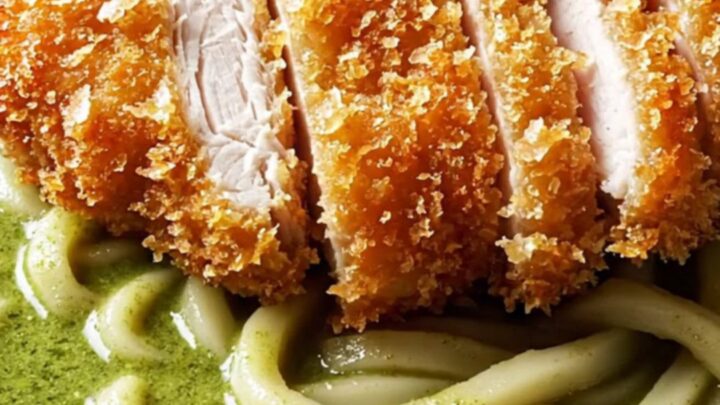
- Slice and plate the bowlsSlice the chicken katsu into thick strips. Twirl the curry-coated noodles into deep bowls, ladle the emerald broth over them, then lay the sliced katsu on top so the crust stays above the liquid. Scatter Thai basil leaves over everything and serve right away.Look for The crust still crackles when pressed, and the broth steams and smells of lime and coconut.Tip Rest the katsu a few minutes before slicing so the crust stays attached and shatters cleanly.
The finished bowl should stop the eye: emerald broth around glossy, curry-coated udon, thick golden strips of katsu laid on top with the crust fully visible, and Thai basil scattered over everything. The crust should still crackle when pressed with a chopstick — if it has gone quiet, the katsu sat too long in the steam.
The first bite should deliver the contrast that defines the dish: shattering crunch from the panko, then velvety, limey coconut broth and chewy noodles. Check the temperature of the broth; it should be steaming hot so the aromatics carry. If anything needs fixing at this point, it is balance only — a drop of fish sauce or a pinch of sugar — not more cooking.
Common mistakes
The most common failure is frying cold, crowded oil: too much oil in the pan at once drops the temperature, the panko drinks grease and the crust turns pale and heavy. Fry in batches and let the oil climb back to 340°F between rounds. The second mistake is skipping the flour shake — wet flour pastes into lumps that peel off in the oil. The third is boiling the coconut milk hard, which can make it look curdled; keep it at a bare simmer. Overcooked udon is another pitfall: thick noodles go from bouncy to bloated fast, so pull them at just-tender and let the curry finish the job.
How to tell it’s done
Two things must be done at once, and each has a clear signal. The chicken katsu is done when the crust is deep golden brown and an instant-read thermometer reads 165°F (74°C) at the thickest point of the cutlet; with thin, evenly pounded cutlets, three to four minutes per side at 340°F gets there.
The broth is done when it looks glossy and velvety, coats the back of a spoon lightly, and tastes salty, sweet and limey all together. The udon is ready when the noodles are tender all the way through with no chalky center, and after three minutes in the curry they should look glossy and emerald-tinted.
- Poultry: 165°F (74°C) in the thickest part
Up next · Part 3 of 3
4 variations · storage & make-ahead · 5 answers · printable card
Tips, FAQ & printable recipe (Part 3)← Back to the ingredients (Part 1)