Dinner · Part 2 of 3: Instructions
Crispy 100-Layer Lasagna Bolognese with Shattering Golden Edges Step-by-step instructions
- Prep
- Cook
- Total
- Serves
- 6
Before you start
Before touching the pasta, get the components lined up. The Bolognese and béchamel should be made ahead and chilled, since cool, thick sauces layer cleanly and keep the thin sheets from sliding.
Wilt the spinach, squeeze it bone-dry, and measure the flour, eggs, and salt. Set up the pasta roller clamped to the counter, dust a rimmed sheet pan with flour for the finished sheets, and cut a cardboard template to the loaf pan's footprint.
Ingredients at a glance (9)
- 3 cups 00 flour, plus more for dusting
- 4 large eggs
- 5 oz spinach, wilted and squeezed very dry
- 1/2 tsp kosher salt
- 28 oz (800 g) Bolognese sauce, pork-and-beef, made ahead or good-quality store-bought
- 2 cups (500 ml) béchamel sauce, made ahead, nutmeg-scented
- 7 oz (200 g) Parmigiano-Reggiano, finely grated
- 4 tbsp unsalted butter
- Marinara sauce, warmed, for serving
Instructions
Make and roll the pasta
- Make the spinach pasta doughBlitz the wilted, squeezed-dry spinach in a food processor with the eggs until smooth. Add the flour and kosher salt, pulsing until shaggy clumps form, then knead with the dough hook on medium speed for 8 minutes, dusting with flour only if the dough sticks. The dough should feel smooth, firm, and slightly elastic, like firm modeling clay, with no wet spots.Look for The dough pulls cleanly from the bowl sides and springs back slowly when pressed with a fingertip.Tip Weigh the dough after mixing; dividing it into four equal pieces makes every sheet the same thickness.
- Rest the doughWrap the dough tightly in plastic and let it rest at room temperature for 30 minutes, no longer. This rest relaxes the gluten so the sheets roll thin without springing back or tearing. Meanwhile, set the Bolognese, béchamel, and grated Parmigiano on the counter so assembly moves quickly once the sheets are ready.Look for The wrapped dough feels supple and yields to gentle pressure instead of resisting like a ball of tension.Tip Rest on the counter, not in the fridge; cold dough stiffens and fights the roller.
- Roll 35 paper-thin sheetsDivide the dough into four pieces and keep them covered. Roll each piece through a pasta roller, starting at the widest setting and working down one notch at a time, until the sheets are thin enough to read print through. Cut into rectangles sized to the loaf pan, trimming ragged edges, until you have 35 sheets stacked under a damp towel.Look for Hold a sheet to the light: you should see your hand's shadow through it, with no holes or thick spots.Tip Cut one perfect template from cardboard and trace it; uniform sheets make clean architectural layers.
At the end of this phase, the dough is smooth, firm, and elastic, having rested long enough to roll without springing back. The sheets are rolled to the point of translucence, cut to the template, and stacked under a damp towel with no drying edges. Run a fingertip across a sheet: it should feel silky, not tacky, and hold its shape when lifted from the corners without drooping immediately.
Layer, weight, and bake
- Layer the loaf panLine a 9x5-inch loaf pan with parchment, leaving overhang on the long sides. Spread a thin veil of béchamel on the bottom, then build: pasta sheet, a scant spoon of béchamel, a spoon of Bolognese, a pinch of Parmigiano, repeating. Finish with a pasta sheet, remaining béchamel, and the last of the Parmigiano, pressing gently after every few layers to remove air pockets.Look for The pan looks plump and even, with sauces peeking between sheets but never pooling at the corners.Tip Keep sauces in thin, even spreads; thick dollops create heavy bands that blur the strata.
- Bake weightedHeat the oven to 350°F (175°C). Cover the pan with parchment, set a second loaf pan or a foil-wrapped brick on top to compress the layers, and bake 45 minutes. The weight is what fuses the strata into a single sliceable block. Check that the center reaches 160°F (71°C) so the Bolognese is heated through safely.Look for The top is deeply golden, the edges pull slightly from the pan, and the center reads 160°F (71°C) on a thermometer.Safe temperature 160°F (71°C) internal temperature (ground meat)Tip Reposition the weight halfway through so the top compresses evenly across the whole surface.
This phase ends with a plump, even loaf that has baked 45 minutes under its weight at 350°F (175°C). The top should be deeply golden and set, the edges pulled slightly from the parchment, and the center at 160°F (71°C) so the Bolognese is heated through.
When pressed lightly through the parchment, the surface feels firm and springy, not sunken or sloshing. The kitchen smells of browned cheese and simmered meat, with no raw-flour scent.
Chill, slice, and sear
- Chill to set the blockTransfer the pan to a wire rack, keep the weight on, and let it cool 20 minutes, then refrigerate at least 1 hour until fully cold and firm. Chilling is not optional: a warm block slumps and smears when cut, while a cold one slices into clean, thick architectural slabs with crisp, defined strata.Look for The block feels solid and dense when pressed, and the parchment releases without sauce smearing the sides.Tip Leftovers cool for no more than 2 hours before going into the refrigerator.
- Slice into thick blocksLift the cold block from the pan using the parchment overhang and set it on a cutting board. With a long, sharp knife, cut straight down into thick slabs about 1 1/2 inches wide, wiping the blade between cuts. Aim for 6 even blocks, each showing the full cross-section of alternating pasta, ragù, and béchamel.Look for Each face shows clean, parallel strata with no smearing or squashed edges.Tip Press the knife straight down in one motion; sawing blurs the layers you worked to build.
- Sear the faces in butterMelt the butter in a heavy skillet over medium-high heat, about 400°F (200°C) at the surface. Sear the cut faces of each block 2 to 3 minutes per side, until deep golden and glass-crisp, then sear the top briefly. Work in batches without crowding, adding butter as needed, and drain the blocks briefly on a rack.Look for The seared faces are mahogany-gold, blistered in spots, and sound crisp when tapped with a fork.Tip Resist moving the blocks early; the crust releases on its own once it is properly crisped.
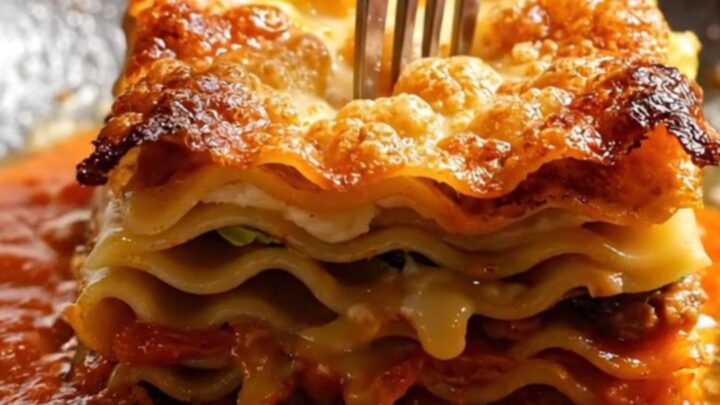
- Plate over warm marinaraSpoon warm marinara into shallow bowls or onto plates and set a seared block on top, crispy face up so the first bite breaks through the shattering crust. Serve immediately while the edges crackle and the interior stays steaming and tender. Pass extra grated Parmigiano at the table for anyone who wants a sharper, saltier finish.Look for The fork cuts through with an audible crack, revealing dozens of distinct, tender layers inside.Tip Warm the marinara gently; hot sauce wilts the crisp face before it reaches the table.
The final phase delivers the payoff. The chilled block cuts into six clean slabs, each face showing sharp, parallel strata with no smearing. In the butter, the faces sear to deep mahogany in 2 to 3 minutes per side, blistering in spots and releasing from the pan on their own when ready.
Tap a face with a fork: it should crackle like glass. The interior, reheated by the sear, is steaming and tender. Plated over warm marinara, the first bite should break audibly through the crust.
Common mistakes
The most common failure is watery spinach: any residual moisture turns the dough sticky and the layers slack, so squeeze it until it is nearly dry. Rolling all the settings at once is the second trap; skipping notches makes sheets that shrink and tear.
Over-saucing is the quiet killer of the striped effect, since thick bands of ragù or béchamel blur the strata and make the block heavy, so keep spreads scant and even. Skipping the weight, or lifting it to peek, lets steam separate the layers.
How to tell it’s done
The baked block is done when the top is deep golden, the edges pull slightly from the parchment, and the center reads 160°F (71°C) on an instant-read thermometer, which confirms the pork-and-beef Bolognese is safely heated through. After chilling, the block should feel dense and firm, releasing cleanly from the pan. During the sear, the faces are done at deep mahogany gold with blistered spots, and the block sounds crisp when tapped.
- Ground meat: 160°F (71°C) in the thickest part
Up next · Part 3 of 3
4 variations · storage & make-ahead · 5 answers · printable card
Tips, FAQ & printable recipe (Part 3)← Back to the ingredients (Part 1)