Breakfast · Part 2 of 3: Instructions
Authentic Japanese Tamagoyaki Rolled Omelette Step-by-step instructions
- Prep
- Cook
- Total
- Serves
- 2
Before you start
Before beginning, ensure all ingredients are measured and ready, as the cooking process moves quickly. Place the eggs in a bowl and have your dashi, sugar, soy sauce, and mirin measured nearby. Prepare a small bowl of grated daikon radish for garnish.
If you are using a new tamagoyaki pan, lightly grease it with a small amount of oil to ensure the egg layers do not stick. Have your chopsticks or a heat-resistant spatula ready to facilitate the rolling process, and maintain a consistent, medium-low heat to ensure even cooking throughout.
Ingredients at a glance (7)
- 4 large eggs
- 45 ml bonito dashi stock
- 10 g sugar
- 5 ml soy sauce
- 5 ml mirin
- 20 g grated daikon radish
- 1 tbsp soy sauce for drizzling
Instructions
Mixing the base
- Prepare the egg mixtureIn a mixing bowl, gently combine the four eggs, bonito dashi stock, sugar, soy sauce, and mirin. Use chopsticks or a whisk to mix the ingredients thoroughly, taking care not to create foam or bubbles in the mixture, as a smooth texture is essential for the final result.Look for The mixture should be well combined but free of excessive foam.Tip Strain the egg mixture through a fine-mesh sieve if any large egg white strands remain to ensure a silky texture.
The egg mixture should be perfectly smooth and well-incorporated. Check for any undissolved sugar or large pieces of egg white and ensure the dashi and seasonings are fully integrated. The liquid should be uniform in color and texture, signaling that it is ready for the cooking phase. If you notice any significant foam on top, skim it off gently with a spoon to ensure the final omelette has a refined, silky appearance.
Rolling the layers
- Cook the layersHeat a rectangular tamagoyaki pan to 165°C (329°F). Pour a thin layer of the egg mixture into the pan. As it sets, use chopsticks or a spatula to roll the delicate sheet forward. Repeat this process by adding more egg mixture and rolling it onto the existing roll until all the mixture is used and the omelette is plump and golden. To cook the eggs through, ensure the internal temperature reaches 160°F (71°C).Look for The eggs should be set but still moist and custardy.Safe temperature 160°F (71°C) internal temperature (egg dishes)Tip Keep the heat controlled to prevent browning, as the goal is a beautiful, uniform golden color.
The omelette should look like a plump, golden, rectangular block. Each layer should be distinct but tightly bonded to the previous one. The edges should be neat, and the interior should feel soft and moist to the touch. If the omelette appears too dry, reduce the heat slightly for the next layer. Check that the final roll is fully set and holds its shape before removing it from the pan to rest on a plate.
Slicing and plating
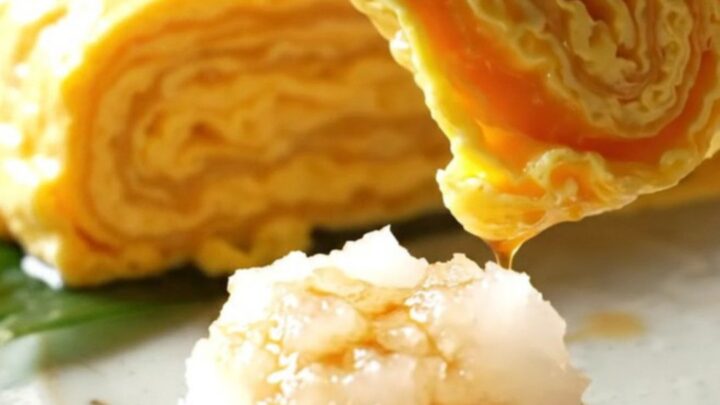
- Serve the omeletteRemove the tamagoyaki from the pan and let it rest for two minutes. Slice into thick, multi-layered pieces. Serve immediately with a generous mound of grated daikon radish and a light drizzle of soy sauce over the radish.Look for The cross-section should reveal distinct, beautiful layers.Tip Serve while still warm to enjoy the soft, bouncy texture of the omelette.
The finished tamagoyaki should be firm enough to slice into clean, thick pieces without crumbling. Each slice should reveal the beautiful, layered interior.
Arrange the slices neatly on a ceramic plate, and ensure the grated daikon radish is placed alongside with a fresh drizzle of soy sauce. The dish should smell savory and slightly sweet, looking inviting and well-prepared, ready to be enjoyed as a classic Japanese breakfast.
Common mistakes
A common mistake is using heat that is too high, which can cause the egg to brown quickly and become tough. Aim for a steady, gentle heat. Another error is failing to incorporate the layers properly; ensure each layer is partially set before rolling so the next layer adheres correctly.
Additionally, whisking too vigorously can introduce air bubbles, leading to a porous texture. Finally, not letting the finished omelette rest for a few minutes before slicing can cause the layers to separate or lose their shape.
How to tell it’s done
The tamagoyaki is done when all layers are cooked through, firm enough to hold their shape, yet still retain a soft, bouncy, and moist custardy texture. The internal temperature of the egg mixture must reach 160°F (71°C) to ensure it is safely cooked.
The exterior should be a light, uniform golden color without any dark brown spots. When sliced, the cross-section should show clear, distinct layers that look tight and cohesive, reflecting the care taken during the rolling process.
- Egg dishes: 160°F (71°C) in the thickest part
Up next · Part 3 of 3
2 variations · storage & make-ahead · 3 answers · printable card
Tips, FAQ & printable recipe (Part 3)← Back to the ingredients (Part 1)