Dinner · Part 2 of 3: Instructions
Authentic Greek Pastitsio with Creamy Béchamel Crust Step-by-step instructions
- Prep
- Cook
- Total
- Serves
- 8
Before you start
Before starting, measure out all ingredients to ensure a smooth cooking flow. Grate the cheese and divide it for layering and topping.
If using refrigerated or made-ahead béchamel, let it sit at room temperature or warm it slightly so it is easy to spread. Grease a deep 9x13-inch baking dish with cooking spray or a light coat of oil to prevent sticking.
Ingredients at a glance (5)
- 1 lb tubular pasta
- 1 1/2 lb ground beef
- 2 cups tomato sauce
- 3 cups béchamel sauce, store-bought or made ahead
- 1 1/2 cups grated cheese
Instructions
Preparing the Pasta and Meat
- Boil the PastaBring a large pot of salted water to a boil. Add the tubular pasta and cook until slightly under al dente. Drain the pasta thoroughly in a colander, then return it to the pot.Look for The pasta should be flexible but still firm in the center.Tip Do not overcook the pasta, as it will continue cooking in the oven.
- Sauté and Simmer the MeatHeat a large skillet over medium-high heat. Add the ground beef and cook, breaking it up with a spoon, until fully browned and cooked through to an internal temperature of 160°F (71°C). Stir in the tomato sauce and simmer for ten minutes until thick.Look for The beef should be fully browned and the sauce thick and concentrated.Safe temperature 160°F (71°C) internal temperature (ground meat)Tip A thick meat sauce prevents the bottom pasta layer from getting soggy.
At the end of this phase, the kitchen will fill with a rich, savory aroma. The ground beef should be fully browned and cooked through to an internal temperature of 160°F (71°C).
The tomato meat sauce will appear thick, glossy, and concentrated with very little free liquid remaining in the pan. The pasta should be boiled just under al dente, drained, and ready for assembly.
Assembling the Layers
- Assemble the Pasta and MeatPreheat the oven to 375°F (190°C). Grease a 9x13-inch baking dish. Spread the cooked pasta evenly across the bottom of the dish, pressing down gently. Spread the thick meat sauce in an even layer over the pasta to create a solid middle layer.Look for The layers should be distinct and tightly packed in the baking dish.Tip Aligning the pasta tubes in the same direction makes for spectacular slices.
- Top with Béchamel and CheesePour the thick béchamel sauce evenly over the meat layer, smoothing the top with a spatula. Sprinkle the grated cheese generously over the entire surface to cover the béchamel completely.Look for The cheese should form an even blanket over the creamy sauce.Tip Spread the béchamel gently to avoid disturbing the meat layer underneath.
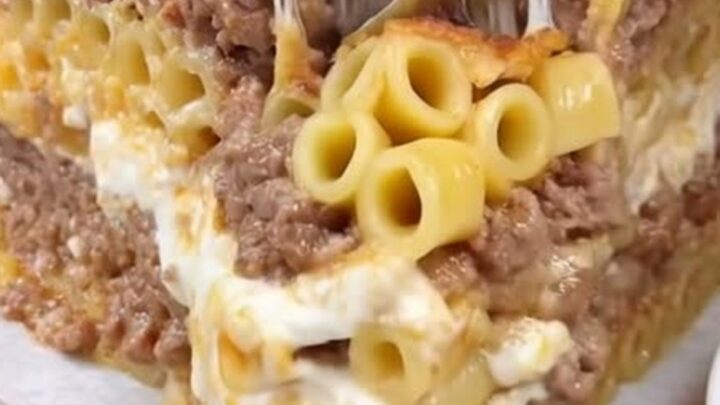
At this stage, the casserole is fully assembled in the baking dish. The pasta forms a neat, tightly packed bottom layer, topped by an even, compact blanket of the thick meat sauce. The velvety béchamel sauce is spread smoothly over the meat, and the grated cheese is sprinkled evenly across the top, ready for the oven.
Baking and Resting
- Bake Until Golden and BubblingPlace the baking dish in the preheated oven. Bake for forty to forty-five minutes until the top is deeply golden-brown and the edges are bubbling actively.Look for The top should have a beautiful browned crust and the edges should bubble.Tip Let the pastitsio bake on the middle rack for even browning.
- Rest and Slice the PastitsioRemove the pastitsio from the oven and place it on a wire rack. Let the casserole rest undisturbed for thirty minutes at room temperature before slicing. Slice into neat, tall squares and serve warm.Look for The layers should hold their shape perfectly when cut with a sharp knife.Tip Wiping the knife blade between cuts ensures clean, beautiful presentation.
After baking, the pastitsio emerges from the oven with a spectacular, deeply caramelized golden-brown top crust. The edges will be bubbling actively, and the entire casserole will have puffed up beautifully. As the dish rests on the counter, the steam will gently subside, and the layers will firm up, ready to be sliced into perfect, clean squares.
Common mistakes
One common mistake is slicing the pastitsio too soon after it comes out of the oven. While the bubbling cheese and fragrant steam are incredibly tempting, cutting into a hot casserole will cause the layers to collapse into a messy heap.
Another frequent error is using a watery tomato sauce. Take the time to simmer the beef and sauce until fully reduced, leaving a thick, rich mixture that supports the heavy béchamel layer.
How to tell it’s done
The pastitsio is perfectly cooked when the béchamel layer has puffed up slightly, developed a deep golden-brown crust, and the edges are bubbling vigorously.
To guarantee food safety, ensure the internal temperature of the center of the casserole reaches 160°F (71°C) on an instant-read thermometer, which indicates that the ground beef is fully cooked and safe to eat. The top should feel firm but yield slightly when pressed gently.
- Ground meat: 160°F (71°C) in the thickest part
Up next · Part 3 of 3
2 variations · storage & make-ahead · 4 answers · printable card
Tips, FAQ & printable recipe (Part 3)← Back to the ingredients (Part 1)