Dinner · Part 2 of 3: Instructions
White Truffle Mushroom Lasagna with Crispy Sage Step-by-step instructions
- Prep
- Cook
- Total
- Serves
- 8
Before you start
Set out all ingredients and equipment before the burner goes on: a large skillet, a medium saucepan, a whisk, a box grater for the Fontina, and a 9x13-inch baking dish. Slice the mixed mushrooms about a quarter inch thick so they brown evenly, mince the garlic, shred the cheese, and warm the truffle-infused milk in a small pot or the microwave until steaming. Pick the sage leaves and pat them dry — wet leaves spit in hot butter. Grate the nutmeg and stage the salt and pepper by the stove.
Ingredients at a glance (9)
- 4 tbsp unsalted butter, divided
- 1 1/2 lb mixed mushrooms (porcini and cremini), sliced
- 3 cloves garlic, minced
- 12 fresh sage leaves, plus extra for serving
- 1/3 cup all-purpose flour
- 3 cups whole milk, truffle-infused if available, warmed
- 7 oz Fontina cheese, shredded
- 1 lb fresh lasagna sheets
- black truffle, shaved, for serving (optional)
Instructions
Sauté and sauce
- Fry the sage leavesMelt 1 tablespoon of the butter in a large skillet over medium heat until it foams. Lay the sage leaves in a single layer and fry for 20 to 30 seconds per side, just until they turn deep green and crisp at the edges. Lift them onto a paper towel and salt lightly.Look for The leaves should stop sizzling loudly and look translucent-green, not brown.Tip Sage burns fast; pull the pan off the heat between batches if the butter darkens.
- Sauté the mushrooms and garlicAdd another tablespoon of butter to the same skillet and raise the heat to medium-high. Add the sliced mushrooms in an even layer and cook, stirring rarely at first, for 8 to 10 minutes, until they release their liquid and it evaporates. Stir in the garlic during the last minute, then season and scrape into a bowl.Look for The mushrooms should be deeply bronzed and dry, with no puddle of liquid in the pan.Tip Crowding steams the mushrooms; work in two batches if the skillet looks full.
- Build the béchamel baseMelt the remaining 2 tablespoons of butter in a medium saucepan over medium heat. Whisk in the flour and cook for 2 minutes, stirring constantly, until the paste smells faintly nutty and turns the color of pale sand. Do not let it take on color — a dark roux will dull the white sauce.Look for The roux should look smooth and glossy, pulling cleanly from the pan bottom.Tip Whisk in one direction so the flour hydrates evenly with no lumps.
- Whisk in the truffle milkPour in the warm truffle-infused milk a splash at a time, whisking until completely smooth before adding more. Once all the milk is in, bring the sauce to a gentle simmer and cook for 4 to 5 minutes, until it thickens enough to coat the back of a spoon. Season with salt, pepper, and nutmeg.Look for The sauce should ribbon off the whisk and hold the line for a second before melting back.Tip Warm milk incorporates without lumps; cold milk seizes the roux.
- Melt in the FontinaLower the heat to its minimum and add the shredded Fontina a handful at a time, whisking until each addition melts before the next goes in. Keep the sauce barely simmering — never boiling — until it looks glossy and velvety. Taste and adjust the salt, then set aside off the heat.Look for The béchamel should fall in thick folds with no visible strings of cheese.Tip High heat splits Fontina; patience here keeps the sauce silky.
At the end of this phase, the mushrooms are deeply bronzed, dry, and fragrant with garlic, and the béchamel coats the back of a spoon in thick ribbons with the Fontina fully melted in — glossy, velvety, and lump-free. Taste the sauce: it should be seasoned boldly enough to season the pasta as it bakes. The sage leaves are crisp, green, and draining on paper towels. If the sauce shows any graininess, keep it on the lowest heat and whisk gently for another minute.
Assemble and bake
- Layer the lasagnaHeat the oven to 385°F (195°C). Spread a thin veil of béchamel over the bottom of a 9x13-inch baking dish. Layer fresh pasta sheets, a third of the mushrooms, and a generous ladle of béchamel, repeating three times and finishing with sauce on top. Reserve a few spoonfuls of mushrooms for garnish.Look for The top layer should be fully covered in sauce with no exposed pasta corners.Tip Sauce under the first sheet stops the bottom from sticking.
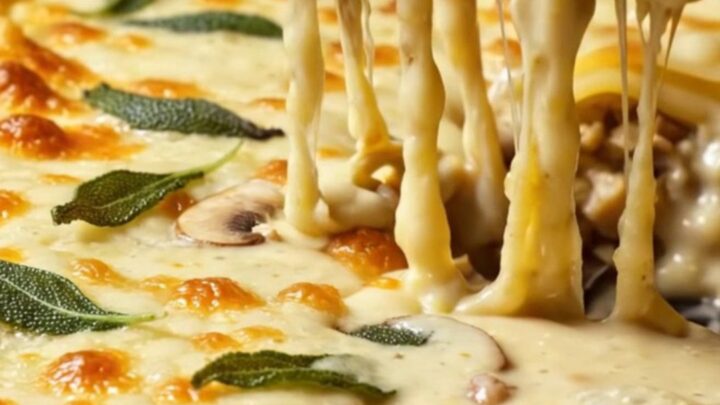
- Bake until blisteredBake on the middle rack for 30 minutes, until the top blisters into golden-brown peaks and the sauce bubbles at the edges of the dish. If the surface colors too quickly, lay a sheet of foil loosely over the pan for the final 10 minutes. The corners should look deeply caramelized.Look for Listen for a gentle bubbling sound and look for browned peaks across the whole surface.Tip A dark metal pan browns faster than glass; check 5 minutes early with glass.
- Rest before slicingTransfer the dish to a wire rack and let it rest for 10 minutes. The bubbling slows and the layers set enough to cut clean corners instead of sliding apart. Do not skip this — a lasagna cut straight from the oven pours rather than slices.Look for The surface should stop steaming visibly and the edges pull slightly from the dish.Tip Resting is when the flavors settle and the sauce thickens into the layers.
The assembled dish goes into a 385°F oven and comes out with a top that has blistered into golden-brown peaks, bubbling thickly at the edges, with caramelized corners. The aroma should be nutty, earthy, and rich.
After the 10-minute rest, the bubbling slows, the surface stops visibly steaming, and the edges pull slightly from the dish walls. Check the center with a knife — it should come out hot to the touch. If the top looks pale, give it 5 more minutes; if it browned early, foil was applied and the interior had time to heat through.
Finish and serve
- Garnish with truffle and sageScatter the reserved sautéed mushrooms over the top, then shave black truffle generously across the surface with a microplane or truffle shaver. Crown each future slice with a couple of the crispy sage leaves so they stay intact and shatter when served.Look for The truffle should fall as thin, translucent petals that melt on contact.Tip Shave the truffle just before serving; its aroma fades within minutes.
- Slice and serveCut the lasagna into 8 squares with a sharp knife, wiping the blade between cuts for clean edges. Lift each slice with a wide spatula so the creamy layers stay stacked. Serve hot, while the béchamel still moves slowly and the sage crackles on top.Look for The slice should hold its shape yet glisten, with sauce slowly welling at the base.Tip Corner slices deliver the most blistered, chewy edges — serve those to the crisp-lovers.
The finished lasagna is garnished with reserved mushrooms, thin translucent petals of shaved black truffle, and whole crispy sage leaves that stay intact until the table. Each cut square holds its shape with clean edges while the béchamel glistens and wells slowly at the base — creamy, not loose.
The sage should crackle when bitten, and the truffle aroma should rise the moment the slice is lifted. If the slices slide apart, the rest was cut short; if the sauce looks stiff, serve immediately before it cools further.
Common mistakes
The most common mistake is crowding the mushrooms, which steams them gray and floods the pan with liquid; cook in two batches and wait for the pan to go dry before stirring. The second is cold milk into a hot roux, which seizes into lumps that no amount of whisking fully rescues — always warm the milk first.
Melting Fontina over high heat splits the sauce into grainy strands; keep it at a bare simmer. Under-salting the béchamel is easy to do since pasta absorbs seasoning, so taste the sauce before assembly — it should taste just slightly bold.
How to tell it’s done
The lasagna is done when the top has blistered into golden-brown peaks across the entire surface and the sauce bubbles actively at the edges — a slow, thick bubbling, not a lazy shimmer. The corners should look deeply caramelized and pull slightly from the dish.
If the top colors before the 30 minutes are up, tent foil over it and continue. After the 10-minute rest, a knife inserted at the center should come out hot to the touch, and the slice should hold its shape while the béchamel still glistens and moves slowly.
Up next · Part 3 of 3
4 variations · storage & make-ahead · 5 answers · printable card
Tips, FAQ & printable recipe (Part 3)← Back to the ingredients (Part 1)