Desserts · Part 1 of 3: Ingredients
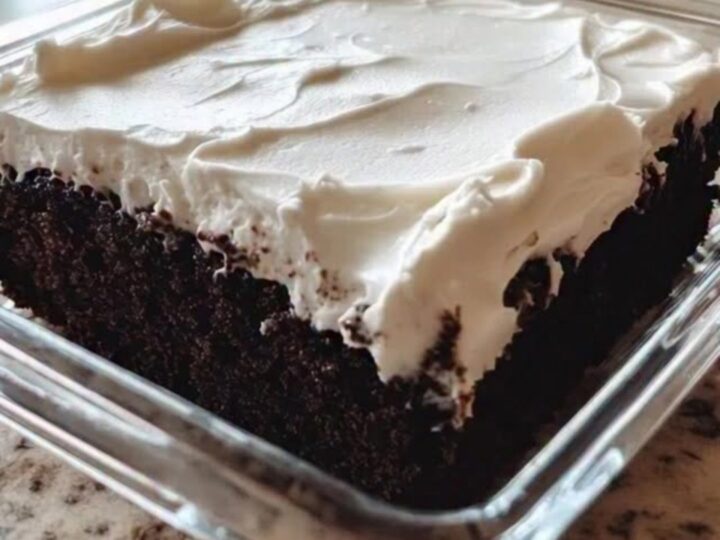
Wacky Cake — Fudgy One-Pan Chocolate Cake, No Eggs Needed
- Prep
- Cook
- Total
- Serves
- 9
A rich chocolate cake that needs no eggs, no butter and no mixer for the batter — just one pan, one spoon and a handful of pantry staples. The vinegar meets the baking soda and the batter foams up right in the dish, baking into a deep, fudgy crumb that stays moist for days. A fluffy vanilla buttercream finishes it. From shelf ingredients to frosted squares in about an hour, with almost no washing up.
Wacky cake comes out of Depression-era American kitchens, when eggs, butter and milk were scarce and home bakers learned to build a chocolate cake without them. The trick is the reaction between baking soda and vinegar: stirred into a simple mix of flour, sugar and cocoa, it foams the batter and lifts the crumb beautifully.
Everything goes into one dish, gets stirred with a spoon and bakes until the top springs back. Here the finished squares are crowned with a fluffy white vanilla buttercream, which turns a humble pantry cake into something worth slicing for company. No stand mixer is needed for the batter, only a bowl and a whisk, and the whole thing comes together in about fifteen minutes of hands-on time.
Ingredients
- 1 1/2 cups all-purpose flour
- 1 cup granulated sugar
- 1/4 cup unsweetened cocoa powder
- 1 tsp baking soda
- 1/2 tsp kosher salt
- 1 cup water, room temperature
- 1/3 cup vegetable oil
- 1 tbsp white vinegar
- 1 tsp vanilla extract
Vanilla buttercream
- 1/2 cup unsalted butter, softened to room temperature
- 2 cups confectioners' sugar, sifted if lumpy
- 2 tbsp whole milk
Why this recipe works
The magic sits in the pairing of baking soda and white vinegar. When water joins them, the acid and the alkali react on the spot, releasing carbon dioxide bubbles throughout the batter. Because the reaction begins the moment they meet, the batter goes straight into the hot oven, and those bubbles expand and set before they have a chance to escape.
Oil takes the place of butter in the crumb: it coats the flour proteins more completely than a solid fat would, which keeps the finished cake tender and remarkably moist for days. Cocoa powder contributes structure and a deep chocolate flavor without demanding eggs to hold it together, and the modest thirty-second stir is short enough that the gluten in the flour never has time to toughen.
Baking the cake in the same dish where it was mixed is more than a convenience. Mixing directly in the dish means no scraped bowl, no wasted batter clinging to a whisk and no extra washing up, and the shallow, even layer heats uniformly from edge to center. That even heat matters for an eggless batter, which sets through steam, reaction gas and flour starch rather than the coagulation of eggs.
A fully preheated oven is essential, since the leavening is fast and single-acting. Cooling the cake completely before frosting is the final structural step: the crumb firms as it cools, the buttercream stays exactly where it is spread, and each square lifts out with the sharp edges and fudgy interior the dish promises.
Notes and substitutions
Use natural unsweetened cocoa powder for the classic tangy, old-fashioned flavor; Dutch-processed also works and gives a darker, slightly smoother crumb. A neutral oil — vegetable, canola or light olive — keeps the chocolate in front, and its liquid form is exactly what makes the crumb so moist. White vinegar is traditional, and its flavor vanishes entirely in baking; apple cider vinegar or fresh lemon juice stands in perfectly.
Whole milk gives the buttercream its body, though 2 percent works in a pinch. Kosher salt sharpens the chocolate in both cake and frosting; if substituting fine table salt, use half the amount. Confectioners' sugar, never granulated, is what makes the frosting fluffy — its small cornstarch content also helps the buttercream hold its shape on the cake for days.
An 8x8-inch glass or metal baking dish is the ideal size here: deep enough for a generous layer, shallow enough to bake evenly in half an hour. A hand mixer or stand mixer handles the buttercream easily, though a sturdy whisk and some patience can do it too. A wire rack is essential for the cooling hour, and an offset spatula makes the frosting swirls effortless. If the dish is smaller than 8x8, expect a longer bake and a thicker cake; larger, and the squares will be thin. Check the substitutions noted below before shopping — every one of them keeps the same pan, the same timing and the same fudgy result.
- white vinegar: Apple cider vinegar or fresh lemon juice works in exactly the same amount; the flavor disappears once the cake bakes.
- vegetable oil: Canola, melted coconut oil or light olive oil can be used; choose a neutral-tasting oil so the chocolate stays in front.
- whole milk in the frosting: Heavy cream gives an even richer buttercream; use 1 to 2 tablespoons and beat briefly to avoid over-whipping.
- unsalted butter: Salted butter can be used in the buttercream; omit the pinch of salt and taste before adding any extra.
Equipment
- 8x8-inch glass or metal baking dish
- wire whisk
- electric hand mixer
- silicone spatula
- offset spatula
- wire cooling rack
- sharp knife or metal spatula
- parchment paper
Up next · Part 2 of 3
9 steps · 35 min of cooking · what to look for at each stage
Step-by-step instructions (Part 2)