Dinner · Part 2 of 3: Instructions
Viral Korean Tornado Omelette with Garlic Butter Rice Step-by-step instructions
- Prep
- Cook
- Total
- Serves
- 1
Before you start
Before beginning, ensure all ingredients are measured and ready, as the cooking process moves very quickly. Have your serving plate with the garlic butter rice already plated and warm. Set your chopsticks and a heat-resistant spatula nearby.
Verify that your non-stick pan is clean and free of any residue that could cause sticking. Having everything within reach is essential, as the egg will set in less than a minute once it hits the pan, leaving no time for last-minute prep.
Ingredients at a glance (7)
- 3 large eggs
- 15 ml whole milk
- 3 g kosher salt
- 5 ml mirin
- 1 tbsp neutral oil
- 150 g garlic butter rice, prepared
- 2 tbsp demi-glace sauce
Instructions
Mixing and Straining
- Prepare the Egg MixtureIn a medium bowl, whisk together the eggs, milk, salt, and mirin until fully combined. Pour the mixture through a fine-mesh sieve into a clean bowl or a pouring pitcher to ensure a perfectly smooth, lump-free texture for the omelette.Look for The mixture should be completely uniform and free of visible egg white strands.Tip Straining is the most important step to achieve the signature silky tornado effect.
The mixture must be completely smooth and homogeneous. Visually check that there are no visible strands of egg white floating in the bowl. The consistency should be thin and fluid, similar to heavy cream, which is necessary for the eggs to fold correctly without tearing during the subsequent swirling phase.
The Tornado Swirl
- Execute the Tornado SwirlHeat a non-stick pan over medium-high heat with a light coating of oil until the pan reaches 340°F (170°C). Pour the egg mixture into the center of the pan. Immediately place two wooden chopsticks into the pan at the 3-o'clock and 9-o'clock positions, touching the bottom. Gently pull the chopsticks toward the center while slowly rotating the pan in the opposite direction for 45 seconds.Look for The eggs should form a spiraling, tornado-like shape as they set against the pan surface.Safe temperature 160°F (71°C) internal temperature (egg dishes)Tip Maintain constant rotation to ensure the folds stay tight and uniform.
Observe the eggs as they begin to set. The movement should feel fluid, with the chopsticks creating clear, defined layers. The egg should look like a rotating, tightening vortex.
If the egg starts to look like a standard scramble, pull the chopsticks closer to the center and rotate the pan more steadily to encourage the spiral structure.
Final Assembly
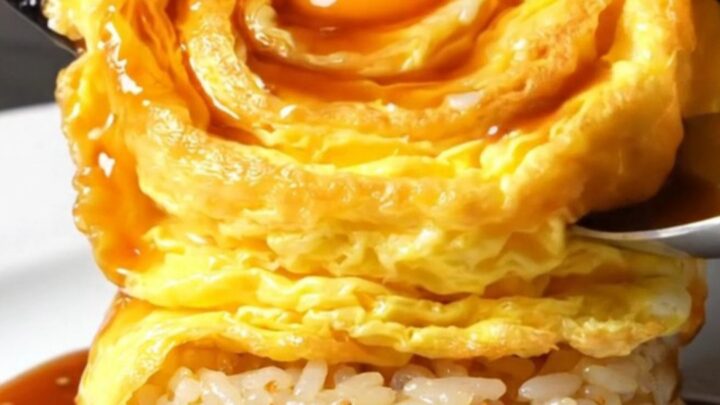
- Assemble and ServeCarefully slide the set egg tornado directly onto the bed of prepared garlic butter rice. Ladle the warm demi-glace sauce over the top of the egg. Serve immediately while the egg is warm and the texture remains delicate and silky.Look for The egg should drape elegantly over the rice like a soft, golden fabric.Tip Slide the omelette gently to avoid breaking the delicate spiral structure.
The omelette should slide off the pan in one cohesive piece. The spiral pattern should be clearly visible when it lands on the rice. If the sauce is added, it should pool gently around the base of the egg, creating an appealing contrast between the golden egg and the dark, glossy demi-glace sauce.
Common mistakes
A common mistake is failing to strain the egg mixture, which leads to lumps that interrupt the smooth flow of the swirl. Another frequent error is using a pan that is not sufficiently non-stick, causing the egg to adhere to the surface rather than rotating.
Additionally, if the pan is not hot enough, the egg will not set into the required structure, resulting in a flat omelette rather than a tornado. Always ensure the pan is at the correct temperature before pouring.
How to tell it’s done
The omelette is done when the eggs have formed a distinct, spiraled tornado shape and the surface is set but still glistening. The eggs should be soft and custardy, reaching a safe internal temperature of 160°F (71°C) throughout the folds.
The texture should be delicate and supple, not rubbery or overcooked. If the egg turns brown or develops a hard crust, it has been cooked for too long or at too high a temperature.
- Egg dishes: 160°F (71°C) in the thickest part
Up next · Part 3 of 3
2 variations · storage & make-ahead · 3 answers · printable card
Tips, FAQ & printable recipe (Part 3)← Back to the ingredients (Part 1)