Desserts · Part 2 of 3: Instructions
Vintage Impossible Coconut Custard Pie Step-by-step instructions
- Prep
- Cook
- Total
- Serves
- 8
Before you start
Before beginning the recipe, ensure all ingredients are at room temperature to facilitate a smooth, even custard base. Preheat the oven to the required temperature and position the oven rack in the center for uniform heat distribution.
Verify that the ceramic baking dish is clean and ready for assembly, and have the nutmeg measured and prepared in a small ramekin for easy application during the final stages of the assembly process.
Ingredients at a glance (3)
- 2 cups shredded coconut
- 2 cups custard batter
- 1/4 tsp ground nutmeg
Instructions
Layering the coconut
- Prepare the baking dishArrange the shredded coconut in an even layer across the bottom of the large ceramic baking dish. Ensure the coconut covers the entire surface area to form the base of the pie.Look for The bottom of the dish is fully covered with a uniform layer of shredded coconut.Tip Distribute the coconut evenly to ensure the base sets properly during the baking process.
At the end of this phase, the shredded coconut should cover the entire bottom of the ceramic dish in a uniform, even layer. Check that no bare patches remain on the surface of the dish, as these areas will not form the desired base. The coconut should be dry and loose before the liquid batter is introduced, ensuring the foundation is ready for the custard to be poured over it evenly.
Pouring the custard
- Add the custard batterSlowly pour the custard batter over the shredded coconut layer using a small pitcher. Continue pouring until the coconut begins to float, ensuring the batter is distributed evenly throughout the dish.Look for The coconut is floating in the custard batter and the dish is filled to the appropriate level.Tip Pour the batter slowly to avoid displacing the coconut layer too much.
The custard should be poured slowly and steadily over the coconut, causing it to rise and float on the surface of the liquid. The mixture should look homogeneous, with the batter completely surrounding the coconut shreds. Ensure the pitcher is used to distribute the liquid across the entire dish so that the coconut is evenly submerged or floating as intended without large clumps forming in one specific corner.
Final seasoning and baking
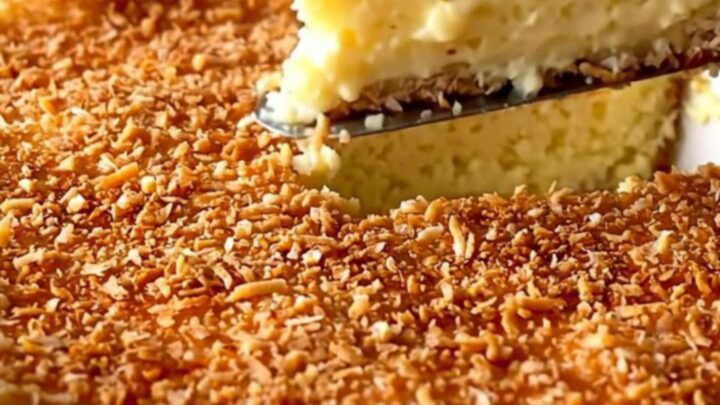
- Season and bakeSprinkle the ground nutmeg evenly over the top of the custard batter. Place the dish into the preheated oven and bake until the center reaches 160°F (71°C) and the top is golden brown.Look for The top is toasted golden brown and the custard is set in the center.Safe temperature 160°F (71°C) internal temperature (egg dishes)Tip Watch the coconut closely during the final minutes to prevent it from burning.
As the pie finishes baking, the top should transition from pale to a rich, toasted golden color. The nutmeg should be visible on the surface, adding a fragrant aroma to the kitchen.
The custard must be completely set throughout, showing no signs of liquid or excess movement in the center. Once the temperature reaches 160°F (71°C), remove the dish carefully to prevent the coconut from darkening further and becoming bitter.
Common mistakes
A common mistake is baking the pie at too high a temperature, which can lead to burnt coconut before the custard has properly set in the middle. Always monitor the oven closely during the final ten minutes of baking.
Another error is failing to let the pie rest sufficiently after removing it from the oven; skipping the resting period can cause the custard to lose its shape when sliced, making it difficult to serve into clean, neat squares.
How to tell it’s done
The pie is done when the custard has set firmly in the center and the top layer of shredded coconut is toasted to a deep, golden brown. Using a food thermometer, check the center of the pie to ensure it reaches a safe internal temperature of 160°F (71°C).
The edges should appear slightly puffed, and the custard should not wobble excessively when the dish is gently shaken, indicating that the egg-based structure is fully cooked and stable.
- Egg dishes: 160°F (71°C) in the thickest part
Up next · Part 3 of 3
2 variations · storage & make-ahead · 3 answers · printable card
Tips, FAQ & printable recipe (Part 3)← Back to the ingredients (Part 1)