Desserts · Part 2 of 3: Instructions
Turkish Şöbiyet Baklava with Clotted Cream & Pistachios Step-by-step instructions
- Prep
- Cook
- Total
- Serves
- 12
Before you start
Before starting, take the clotted cream out of the refrigerator to soften to room temperature. This makes it easier to mix with the pistachios and spread over the phyllo. Clarify the butter if you're using regular butter: melt it slowly, skim off the foam, and pour off the clear golden liquid, leaving the milk solids behind.
Have all your ingredients measured and your pan brushed with butter. Line a baking sheet with parchment paper to catch any drips during baking. Also, make the syrup before you begin assembling so it has time to cool completely—you can even make it a day ahead and refrigerate it.
Ingredients at a glance (7)
- 20 sheets phyllo dough (about 14x18 inches each)
- 2/3 cup clarified butter, melted (150g)
- 7 oz Turkish clotted cream (kaymak) or thick semolina pudding, at room temperature
- 1/2 cup raw pistachios, finely ground, plus more for garnish
- 1 cup granulated sugar
- 1/2 cup water
- 1 tbsp fresh lemon juice
Instructions
Layering and Filling
- Prepare the phyllo layersHeat the oven to 350°F (180°C). Brush a 9x13-inch baking pan with some of the clarified butter. Lay one sheet of phyllo in the pan, brush it evenly with butter. Repeat with 10 sheets, brushing each layer. Keep the remaining phyllo covered with a damp towel to prevent drying.Look for The phyllo stack is flat and evenly buttered, with no dry spots.Tip Work quickly but gently; phyllo tears easily. If it tears, patch it with a scrap.
- Add the creamy fillingIn a small bowl, mix the clotted cream (or semolina pudding) with the ground pistachios until well combined. Spread this filling evenly over the phyllo stack, leaving a 1/2-inch border on all sides.Look for The filling is smooth and spreadable, not too thick.Tip If the cream is very thick, soften it at room temperature for 30 minutes before mixing.
- Top with remaining phylloPlace the remaining 10 sheets of phyllo over the filling, brushing each sheet with clarified butter as before. Brush the top sheet generously with butter. Cover the pan with plastic wrap and refrigerate for 15 minutes to firm up the layers for easier cutting.Look for The top layer is glossy with butter and the stack is chilled.Tip Chilling prevents the phyllo from shifting while cutting.
You should have a neat stack of 10 buttered phyllo sheets, a smooth layer of creamy pistachio filling, and another 10 buttered sheets on top. The stack should be firm and even, with no dry edges or gaps. The butter should be absorbed into the layers, not pooling on the surface. This is the foundation for crisp, flaky baklava.
Cutting and Baking
- Cut into squaresUsing a sharp knife, cut the chilled phyllo stack into 3-inch squares. You should get about 12 squares. Cut all the way through to the bottom of the pan.Look for Clean, straight cuts with no dragging of the top layers.Tip Use a serrated knife and a gentle sawing motion to avoid crushing the layers.
- Fold into trianglesWorking with one square at a time, fold it diagonally to form a triangle, leaving one edge open so the creamy filling is exposed. Press the edges gently to seal the two closed sides. Place the triangles snugly in the pan, open edge facing up.Look for Each triangle holds its shape with the creamy edge visible.Tip Don't overfill; a heaping teaspoon per square is perfect.
- Bake until goldenBake the baklava in the preheated oven for 35 minutes, or until the phyllo is puffed and deep golden brown all over. The filling should be hot and bubbling slightly at the edges.Look for The top is amber-gold and the layers look crisp and flaky.Safe temperature 160°F (71°C) internal temperature (egg dishes)Tip Rotate the pan halfway through for even browning.
After cutting and folding, your pan should be filled with neat triangles, their open edges showing the creamy pistachio filling. As they bake, the kitchen will fill with the aroma of butter and nuts.
The phyllo will puff and turn a deep golden brown. The filling will bubble slightly at the edges. The pastries should look dry and crisp, not oily.
Syrup and Finish
- Make the syrupWhile the baklava bakes, combine the sugar, water, and lemon juice in a small saucepan. Bring to a boil over medium heat, stirring until the sugar dissolves. Reduce the heat and simmer for 5 minutes. Remove from heat and let cool completely.Look for The syrup is clear and slightly thickened, about the consistency of maple syrup.Tip Cooling the syrup is essential; hot syrup on hot baklava makes it soggy.
- Soak with syrupRemove the baklava from the oven and immediately ladle the cooled syrup evenly over the hot pastries. You'll hear a satisfying sizzle as the syrup hits the hot phyllo. Let the baklava absorb the syrup for at least 30 minutes before serving.Look for The syrup is absorbed and the top glistens without pooling.Tip Spoon any syrup that runs off the edges back over the top.
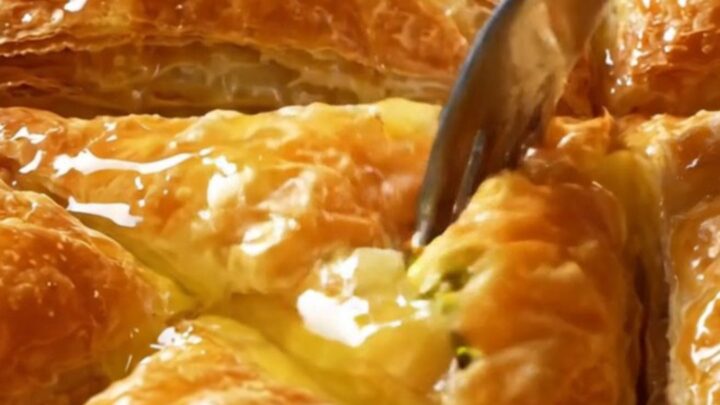
- Garnish and serveSprinkle the baklava with additional ground pistachios. Serve warm or at room temperature, with a fork to easily break through the crisp layers.Look for The pistachios add a vibrant green contrast against the golden phyllo.Tip For the best texture, serve within a few hours of baking.
The moment of truth: pouring the cool syrup over the hot baklava produces a satisfying sizzle. The syrup should be absorbed within a few minutes, leaving a glossy sheen. The triangles will look jewel-like, with the pistachio filling providing a green contrast. Let them rest until the syrup is fully absorbed, then serve.
Common mistakes
One common mistake is overworking the phyllo, which makes it tough. Handle each sheet gently and brush quickly. Another is using a syrup that's too hot; it will make the pastry soggy. Always cool the syrup completely. Cutting through the phyllo before baking is essential—if you try to cut after baking, the layers will shatter.
Use a very sharp knife and cut with a sawing motion. Also, don't overfill the triangles; too much cream will cause them to burst open during baking. Finally, bake until truly golden, not just pale blonde; underbaked phyllo will be doughy and chewy.
How to tell it’s done
The baklava is done when the top is a deep amber-gold and the layers look visibly puffed and flaky. You should be able to see the edges of the phyllo separating slightly. The filling should be hot and set, not runny. If you insert a toothpick into the center of a triangle, it should come out clean.
The internal temperature of the filling should reach 165°F (74°C) if using eggs or dairy. Let the syrup soak for at least 30 minutes; the pastries should be glossy but not swimming in liquid. A fork should easily break through the top with a crisp crackle.
- Egg dishes: 160°F (71°C) in the thickest part
Up next · Part 3 of 3
4 variations · storage & make-ahead · 5 answers · printable card
Tips, FAQ & printable recipe (Part 3)← Back to the ingredients (Part 1)