Desserts · Part 2 of 3: Instructions
Turkish Şambali Tatlısı: Street-Style Semolina Cake with Roasted Peanuts Step-by-step instructions
- Prep
- Cook
- Total
- Serves
- 12
Before you start
Before starting, make the lemon syrup so it has time to cool completely. You'll also want to measure all ingredients and have your baking pan ready. Lightly oil the pan to ensure easy removal.
Preheat the oven to 375°F (190°C) when you're ready to bake. The syrup can be made up to a day ahead and stored in the refrigerator; bring it to room temperature before using.
Ingredients at a glance (9)
- 3 cups coarse semolina
- 1 cup plain yogurt
- 1 cup granulated sugar
- 1 tsp baking soda
- 1 tsp fresh lemon juice
- 1/2 cup blanched split peanuts
- 2 cups water
- 2 cups granulated sugar
- 1 tbsp fresh lemon juice
Instructions
Prep and Assemble
- Make the Lemon SyrupIn a small saucepan, combine the water and sugar. Bring to a boil over medium heat, stirring until the sugar dissolves. Reduce the heat and simmer for 5 minutes. Stir in the lemon juice, then remove from heat and let cool completely. The syrup should be at room temperature when used.Look for Syrup is clear and slightly thickened, with a sweet-tart aroma.Tip Cooling the syrup is essential—hot syrup would make the cake soggy.
- Mix the Cake BatterIn a large bowl, combine the coarse semolina, yogurt, sugar, baking soda, and lemon juice. Stir until a thick, dense dough forms. Knead briefly with your hands to ensure everything is evenly moistened. The mixture will be stiff, not pourable.Look for Dough holds together when pressed and feels gritty but cohesive.Tip If the dough seems too dry, add a tablespoon of water at a time.
- Press into Pan and ScorePress the dough evenly into a lightly oiled 9x13-inch metal baking pan, smoothing the top with a spatula. Use a knife to score long rectangular lines across the dough, creating 12 equal pieces. Press the blanched split peanuts in neat vertical rows down each slice, pushing them gently into the dough.Look for Pan is evenly filled; peanut rows are visible and slightly embedded.Tip Scoring before baking makes slicing easier and ensures even syrup absorption.
The syrup is clear, sweet, and lemony. The dough is thick, slightly gritty, and holds together when pressed. The pan is evenly filled, scored into rectangles, and topped with neat rows of peanuts. Everything is ready for the oven.
Bake to Caramelization
- Bake Until Deeply CaramelizedPreheat the oven to 375°F (190°C). Bake the cake for 40 minutes, until the top is deeply caramelized and dark mahogany brown. The edges will be slightly darker and the surface crackly. A toothpick inserted into the center should come out clean.Look for Top is dark brown, glossy in spots, and the kitchen smells nutty and caramelized.Tip If the top browns too quickly, tent loosely with foil for the last 10 minutes.
The cake emerges from the oven with a deep mahogany crust, crackly to the touch, and a rich, nutty aroma.
The edges are slightly darker, and the top glistens with caramelized sugars. A toothpick inserted in the center comes out clean.
Soak and Rest
- Soak with SyrupRemove the hot cake from the oven and immediately ladle the cooled lemon syrup evenly over the entire surface. Listen for the sizzle as the cake absorbs the syrup. Let the cake rest for at least 30 minutes so the syrup fully penetrates.Look for Syrup pools briefly then is absorbed; cake glistens and darkens slightly.Tip Pour the syrup slowly, allowing each addition to soak in before adding more.
- Slice and ServeAfter resting, slice along the scored lines into 12 rectangles. Lift each piece with a fork or spatula—the texture should be dense, moist, and chewy. Serve at room temperature, with the peanuts intact on top.Look for Slices hold their shape, glistening with syrup, peanuts visible on top.Tip For clean cuts, use a sharp knife and wipe it between slices.
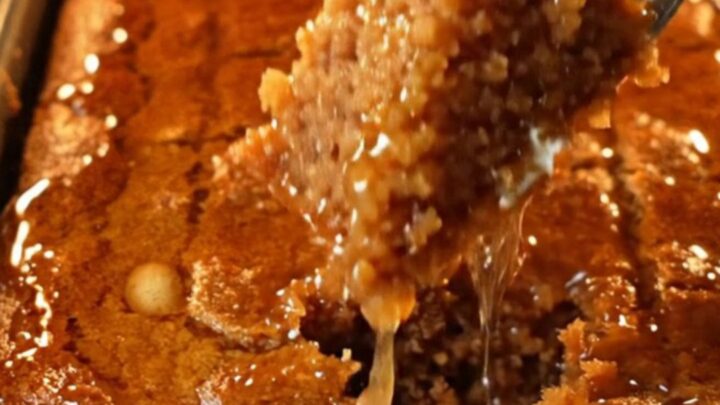
The cooled syrup sizzles as it hits the hot cake, and the surface darkens as it absorbs the liquid. After resting, the cake is glossy, moist, and fragrant with lemon. Slices lift out cleanly and hold their shape.
Common mistakes
One common mistake is using warm syrup, which can make the cake mushy and overly wet. Always cool the syrup completely before pouring. Another pitfall is overmixing the batter, which can make the cake tough; stir just until combined.
Pressing the dough too firmly into the pan can also result in a dense, hard cake—press it evenly but gently. Finally, don't skip the resting time after soaking; it's essential for the syrup to distribute evenly.
How to tell it’s done
The cake is done when the top is deeply caramelized and dark mahogany brown, with a slightly crackly surface. A toothpick inserted into the center should come out clean, with no wet batter clinging.
The edges will be a bit darker and may pull away from the pan slightly. Because there are no raw proteins in this recipe, there is no minimum internal temperature to check—just rely on the visual cues and the toothpick test.
Up next · Part 3 of 3
4 variations · storage & make-ahead · 5 answers · printable card
Tips, FAQ & printable recipe (Part 3)← Back to the ingredients (Part 1)