Desserts · Part 2 of 3: Instructions
Turkish Marble Swirl Loaf Cake: Golden, Moist, and Quick Step-by-step instructions
- Prep
- Cook
- Total
- Serves
- 10
Before you start
Before starting, bring the eggs to room temperature for the best volume. Preheat the oven to 350°F (175°C) and line a 9x5-inch loaf pan with parchment paper, leaving some overhang for easy lifting.
Measure all ingredients and have them ready. Chop the roasted hazelnuts if not already chopped. Set up your electric mixer and bowls. This prep ensures a smooth, efficient baking process.
Ingredients at a glance (10)
- 3 large eggs
- 1 cup granulated sugar
- 1/2 cup whole milk
- 1/2 cup vegetable oil
- 2 cups all-purpose flour
- 2 tsp baking powder
- 1/2 tsp salt
- 1 tsp vanilla extract
- 3 tbsp unsweetened cocoa powder
- 1/2 cup chopped roasted hazelnuts
Instructions
Mixing the Batter
- Beat Eggs and SugarIn a large mixing bowl, beat the eggs and granulated sugar with an electric mixer on medium-high speed for 3 minutes until the mixture is thick, pale, and foamy. The batter should form a ribbon when the beaters are lifted.Look for The mixture is pale yellow and doubled in volume, with ribbons that hold for a few seconds.Safe temperature 160°F (71°C) internal temperature (egg dishes)Tip Use room-temperature eggs for the best volume. Beat the full 3 minutes—this creates the cake's light texture.
- Add Wet IngredientsWith the mixer on low, pour in the milk, vegetable oil, and vanilla extract. Mix until just combined. The batter may look slightly separated—that is fine.Look for The mixture is uniform and slightly frothy.Tip Scrape the sides and bottom of the bowl to ensure even mixing.
- Mix Dry IngredientsIn a separate bowl, whisk together the all-purpose flour, baking powder, and salt. Gradually add the dry ingredients to the wet mixture, mixing on low until just smooth. Do not overmix.Look for The batter is smooth with no dry streaks.Tip Overmixing develops gluten and makes the cake tough. Stop as soon as it comes together.
- Divide and Chocolate the BatterDivide the batter evenly between two bowls. Into one bowl, sift the cocoa powder and gently fold it in until no streaks remain. Keep the other bowl vanilla.Look for One bowl is pale vanilla, the other deep chocolate.Tip Sifting the cocoa prevents lumps. Fold gently to keep the batter airy.
The batter is thick, pale, and foamy after beating. When you lift the beaters, the batter falls in a ribbon that holds its shape for a couple of seconds.
The wet and dry mixtures are just combined, with no dry streaks. The batter is divided into two bowls: one vanilla, one chocolate. The chocolate is smooth and dark, while the vanilla is pale and creamy.
Layering and Baking
- Layer the BattersLine a 9x5-inch loaf pan with parchment paper. Using a spoon, add alternating dollops of vanilla and chocolate batter into the pan, creating two or three layers. Tap the pan gently on the counter to settle the batter.Look for The pan has distinct blobs of vanilla and chocolate batter.Tip For a more defined zebra pattern, keep the dollops separate and don't spread them.
- Create the SwirlInsert a knife or skewer into the batter and draw S-curves through the pan, moving from one end to the other. This creates the marble swirl. Do not over-swirl or the pattern will blur.Look for The top shows a distinct zebra ripple pattern.Tip One or two passes is enough. Too much mixing ruins the contrast.
- Top with HazelnutsSprinkle the chopped roasted hazelnuts evenly over the top of the batter.Look for The nuts cover the surface in a single, even layer.Tip Use roasted hazelnuts for deeper flavor. Press them lightly into the batter so they stick.
- Bake the LoafBake in a preheated oven at 350°F (175°C) for 45 minutes, until the cake is domed, golden, and springy to the touch. A toothpick inserted into the center should come out clean.Look for The top is golden brown, the center crack is dry, and the loaf springs back when pressed.Safe temperature 160°F (71°C) internal temperature (egg dishes)Tip Oven temperatures vary—start checking at 40 minutes. If the top browns too quickly, tent with foil.
The loaf pan shows distinct dollops of vanilla and chocolate batter. The knife-drawn S-curves create a clear zebra pattern on the surface. The hazelnuts are evenly scattered. As it bakes, the cake rises into a dome, and the top turns golden. The kitchen smells of vanilla and toasted nuts. The cake is springy to the touch and a toothpick comes out clean.
Cooling and Slicing
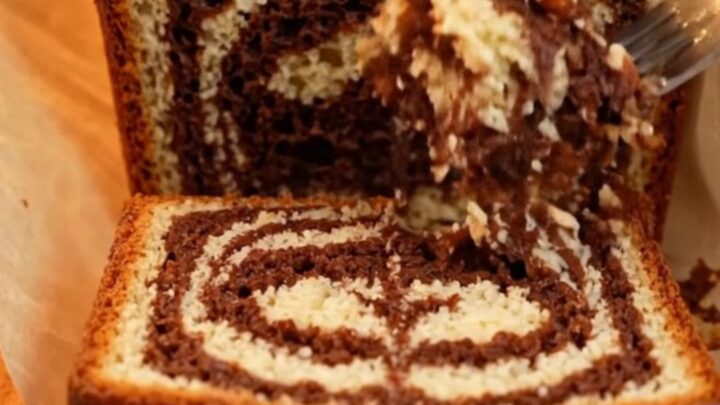
- Cool and SliceLet the cake cool in the pan for 10 minutes, then transfer to a wire rack to cool completely. Slice with a serrated knife to reveal the swirl pattern.Look for The loaf is firm and a slice shows distinct cocoa waves against the golden crumb.Tip Cooling on a rack prevents a soggy bottom. For clean slices, use a serrated knife and wipe it between cuts.
The cake has cooled completely on the wire rack. Slicing with a serrated knife reveals a beautiful swirl: dark cocoa waves against a golden, tender crumb. The texture is moist and inviting, with the hazelnuts adding a crunchy contrast on top. The slices hold together well and are ready to serve.
Common mistakes
Overmixing the batter after adding the flour is a common mistake that results in a tough, dense loaf. Mix only until the flour is incorporated. Not beating the eggs and sugar long enough—less than 3 minutes—can result in a flat cake that doesn't rise properly.
When swirling the batters, avoid overdoing it; too many passes will blend the colors into a muddy mess. Also, be sure to use a loaf pan that is not too small, as the cake needs room to rise.
How to tell it’s done
The cake is done when it is domed and golden brown on top. Press the center gently with a fingertip—it should spring back immediately. A toothpick inserted into the center should come out clean or with only a few moist crumbs attached.
The internal temperature of the cake should register at least 200°F (93°C) in the center. If the top browns too quickly, tent loosely with aluminum foil for the last 10 minutes. Let the cake cool in the pan for 10 minutes before transferring to a wire rack.
- Egg dishes: 160°F (71°C) in the thickest part
Up next · Part 3 of 3
4 variations · storage & make-ahead · 5 answers · printable card
Tips, FAQ & printable recipe (Part 3)← Back to the ingredients (Part 1)