Dinner · Part 1 of 3: Ingredients
Torta Ahogada: Guadalajara’s Drowned Pork Sandwich
- Prep
- Cook
- Total
- Serves
- 1
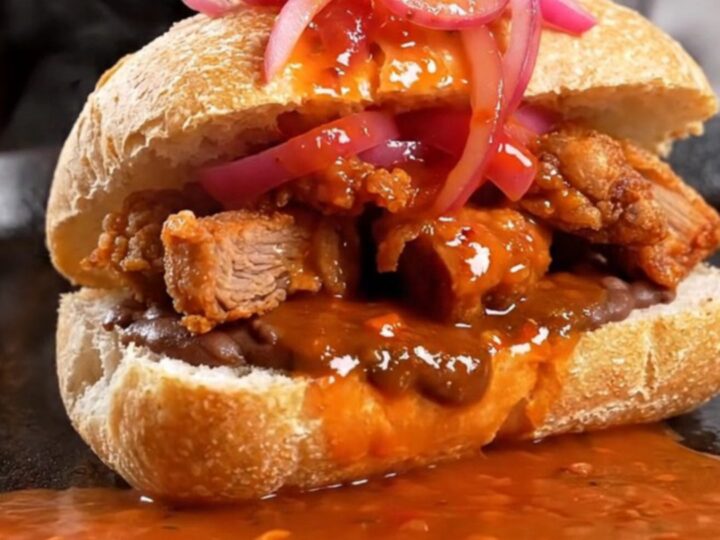
A crusty birote roll, stuffed with warm refried beans and crispy carnitas, gets submerged in a fiery red chile de árbol tomato sauce until every crack and crevice is soaked through. Known in Guadalajara as the drowned sandwich, the torta ahogada is messy by design: the bread holds just long enough, the sauce seeps in, and each bite delivers crisp pork, tangy pickled onion, and a slow-building heat that lingers pleasantly.
This recipe follows the classic Guadalajara build, step for step. A dense, crusty birote roll gets split, spread with warm refried beans, and packed with six ounces of crispy slow-cooked carnitas. The sandwich is then toasted on a hot comal at 375°F to set the crust, while a sauce of roasted Roma tomatoes and soaked chile de árbol peppers simmers on the stove.
Finally, a generous cup and a half of that bright red sauce is ladled straight over the top, and lime-pickled red onions go on last. The whole thing takes about forty minutes, most of it hands-off simmering and roasting, and one very large, very saucy sandwich. Have napkins ready before the sauce goes on; once the torta is drowned, there is no dignified way to eat it, and that is exactly as it should be.
Ingredients
- 1 birote roll (crusty bolillo), split open
- 1/3 cup warm refried beans
- 6 oz crispy pork carnitas, slow-cooked, store-bought or made ahead
Chile de árbol tomato sauce
- 4 Roma tomatoes, roasted
- 6 dried chile de árbol peppers, soaked
- 2 garlic cloves, roasted
- 1/2 tsp dried oregano
Topping
- Lime-pickled red onions, store-bought or made ahead, for serving
Why this recipe works
The sauce works because of two simple moves. Roasting the tomatoes on a dry comal concentrates their flavor and adds a light char that gives the sauce depth without any frying, while soaking the dried chile de árbols rehydrates them so they blend into a smooth, even purée rather than gritty flecks.
Simmering the blended sauce for ten minutes does the final job: it cooks out the raw tomato taste, deepens the color to a rich red-orange, and thickens the sauce just enough to cling to bread instead of running straight off.
The sandwich survives the drowning because of the bread and the beans. A birote roll has a thick, crackly crust and a dense crumb, so it resists the sauce for several bites instead of collapsing instantly.
Toasting the filled sandwich on a 375°F comal dries the crust even further and warms the filling through. The thin layer of refried beans under the carnitas acts as a barrier, slowing the soak on the cut surfaces so the structure holds until the last bite.
Notes and substitutions
Choose the bread with care, because it carries the dish. A true birote is ideal; a bolillo or a dense sourdough roll is a close second. Avoid soft sandwich rolls, which surrender to the sauce in seconds. The carnitas can come from a good deli counter or from a batch made ahead; they only need to be crisp and warm. Canned refried beans are perfectly acceptable here, warmed before spreading so they glide rather than tear the crumb.
On equipment: a comal or cast-iron skillet handles both the tomato roasting and the sandwich toasting, and a standard blender makes the sauce silky. The lime-pickled red onions are best made ahead, up to a week in advance, so their tang is fully developed; store-bought pickled onions work too.
If the sauce tastes sharper than expected after simmering, a longer simmer rounds it out; resist adding sugar, which flattens the chile's clean heat.
- birote roll: A crusty bolillo, sourdough roll, or dense French roll works; the key is a crust firm enough to stand up to the sauce for a few minutes.
- chile de árbol peppers: Use 3 chile de árbols plus 3 guajillo chiles for a softer, rounder heat; keep the total at 6 chiles so the sauce keeps its body.
- pork carnitas: Slow-roasted pork shoulder, shredded and crisped under the broiler, makes an excellent stand-in; pull it in big pieces so it stays juicy.
Equipment
- Comal or cast-iron skillet
- Blender
- Medium saucepan
- Serrated knife
- Shallow serving bowl
- Tongs or spatula
Up next · Part 2 of 3
9 steps · 20 min of cooking · what to look for at each stage
Step-by-step instructions (Part 2)