Dinner · Part 2 of 3: Instructions
Soft Buttery Turkish Potato Cheese Flatbreads Step-by-step instructions
- Prep
- Cook
- Total
- Serves
- 4
Before you start
Before starting, boil and peel the potatoes. They should be soft enough to mash easily. Measure out all the ingredients and have the cheese shredded, dill chopped, and butter melted.
Set a large dry skillet on the stove but don't heat it yet. Make sure you have a clean surface for shaping the dough and a clean kitchen towel to cover the flatbreads as they cook.
Ingredients at a glance (8)
- 4 boiled potatoes, peeled
- 1 1/2 cups shredded kaşar cheese
- 1 large egg
- 2 tbsp fresh chopped dill
- 1/2 tsp salt
- 1/4 tsp black pepper
- 1 1/2 cups all-purpose flour
- 3 tbsp unsalted butter, melted
Instructions
Make the Dough
- Mash the potatoesPlace the boiled potatoes in a large mixing bowl and mash them thoroughly with a potato masher until completely smooth and free of lumps. There should be no large chunks remaining, as this ensures a uniform dough.Look for The potatoes are smooth, creamy, and lump-free.Tip Pass the potatoes through a ricer for an even finer texture if you have one.
- Mix the doughAdd the shredded kaşar cheese, egg, fresh dill, salt, and black pepper to the mashed potatoes. Stir until well combined. Gradually add the flour, mixing with a spatula or your hands until a soft, pliable dough forms. The dough should be slightly sticky but hold together when pressed.Look for The dough is soft, slightly tacky, and holds together without cracking.Tip If the dough is too sticky, add a little more flour, a tablespoon at a time, until manageable.
- Divide and shapeTurn the dough out onto a lightly floured surface. Divide it into 4 equal portions. Roll each portion into a ball, then flatten it into a round about 1/2 inch thick. Keep the shaped flatbreads covered with a clean kitchen towel while you work.Look for The rounds are even and about 1/2 inch thick.Tip Use a light hand when shaping; overworking the dough can make the flatbreads tough.
The dough should be smooth, soft, and slightly sticky, with no lumps of potato or streaks of flour. It should hold together when pressed and be easy to shape into balls. If it cracks at the edges, add a tablespoon of water; if it's too sticky to handle, dust with a little flour. The mixture will smell buttery and herby from the dill.
Cook on the Skillet
- Heat the skilletPlace a large dry skillet or griddle over medium heat and let it heat for 2 to 3 minutes until a drop of water sizzles and evaporates immediately. Do not add any oil or butter to the pan.Look for The skillet is hot enough that a water droplet dances and evaporates quickly.Tip Use a heavy-bottomed skillet for even browning and to prevent hot spots.
- Cook the flatbreadsPlace one flatbread in the hot dry skillet. Cook for 3 minutes, or until the bottom is golden brown and blistered. Flip and cook for another 3 minutes, until the second side is equally browned and the flatbread puffs slightly. Repeat with the remaining flatbreads, adjusting the heat if needed to prevent burning.Look for The flatbread is golden with dark spots and puffs up slightly as it cooks.Safe temperature 160°F (71°C) internal temperature (egg dishes)Tip Do not press down on the flatbread while it cooks; let it puff naturally for the softest texture.
- Brush with butterAs soon as each flatbread comes off the skillet, brush the top generously with melted butter. The heat of the flatbread will melt the butter into the surface, creating a glossy, buttery finish. Stack the buttered flatbreads on a plate and cover loosely to keep warm.Look for The butter sizzles on contact and soaks into the warm crust.Tip Brush the butter on while the flatbread is still hot so it absorbs into the surface.
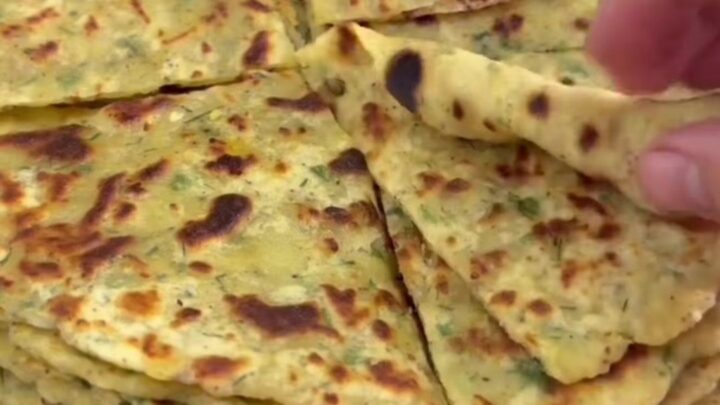
The flatbreads should be golden brown with dark blistered spots on both sides, and they should have puffed up in the center. The surface will look glossy from the butter, and the aroma will be toasty and buttery.
Tap the flatbread with a spatula—it should sound slightly hollow, indicating it's cooked through. The edges should be crisp but not hard.
Serve Warm
- Serve warmServe the flatbreads warm, stacked or on a platter. They are best eaten fresh, while the interior is soft and the cheese is still melty. Pull one apart to show the stretchy, cheesy center.Look for The flatbreads are warm, soft, and the cheese pulls in long strands.Tip If making ahead, reheat in a dry skillet or oven to restore the fresh texture.
The flatbreads should be warm, soft, and pliable, with a buttery sheen. When torn open, the interior should be moist and tender, with strands of melted cheese stretching between the pieces. The crust should have a slight crispness that gives way to a pillowy crumb. Serve immediately for the best texture.
Common mistakes
A common mistake is overworking the dough, which develops the gluten and makes the flatbreads tough. Mix just until the flour is incorporated. Another pitfall is cooking over too high heat, which burns the outside before the inside is cooked through.
Use medium heat and give the skillet time to heat evenly. If the flatbreads brown too quickly, lower the heat slightly. Finally, don't skip the butter brushing—it adds essential richness and moisture to the surface.
How to tell it’s done
The flatbreads are done when they are deeply golden brown on both sides with darker blistered spots, and they have puffed up slightly in the center. The interior should be cooked through and the cheese fully melted and stretchy.
If using a thermometer, the center of the flatbread should reach at least 160°F (71°C) to ensure the egg is fully set. Cut into one to check—the cheese should be molten and the crumb soft, not doughy.
- Egg dishes: 160°F (71°C) in the thickest part
Up next · Part 3 of 3
4 variations · storage & make-ahead · 5 answers · printable card
Tips, FAQ & printable recipe (Part 3)← Back to the ingredients (Part 1)