Dinner · Part 2 of 3: Instructions
Slow Cooker Salmon with Tomato Coulis and Herbes de Provence Step-by-step instructions
- Prep
- Cook
- Total
- Serves
- 4
Before you start
Before beginning, ensure your slow cooker is clean and positioned on a level, heat-resistant surface. Have all ingredients measured and ready to go. Thinly slice the yellow onion using a sharp knife to ensure it cooks through evenly.
Pat the salmon fillets dry with clean paper towels to help the herbs adhere better to the surface. Clear your workspace to allow for quick assembly, as the process is very efficient once the ingredients are ready for the slow cooker.
Ingredients at a glance (4)
- 4 fillets salmon fillets
- 1 medium yellow onion, thinly sliced
- 1 tbsp herbes de Provence
- 1 1/2 cups tomato coulis
Instructions
Assembly and Layering
- Prepare the Slow Cooker BasePlace the raw salmon fillets into the bottom of the slow cooker basin. Arrange the thinly sliced onions evenly over the top of the salmon fillets to ensure they soften during the cooking process.Look for Ensure the salmon is laid in a single layer for even cooking.Tip Pat the salmon dry with paper towels before placing it in the cooker to remove excess surface moisture.
The salmon fillets should be arranged in a single, even layer at the bottom of the slow cooker. The onion slices should be distributed uniformly over the fish. The workspace should be organized, and the ingredients ready for the seasoning phase. Ensure the slow cooker is plugged in and ready to be set to the low heat setting once the ingredients are fully layered.
Seasoning and Sauce Application
- Season and Add SauceSprinkle the herbes de Provence generously over the salmon and onions. Pour the tomato coulis over the entire mixture, ensuring the salmon is well-coated in the sauce.Look for The sauce should cover the majority of the fish fillets.Tip Use a gentle hand when pouring to keep the onion slices distributed evenly.
The herbes de Provence should be evenly distributed over the surface of the salmon and onions. The tomato coulis should be poured carefully to ensure it coats the ingredients without splashing. The slow cooker lid should be placed firmly on top, creating a seal that will trap the aromatic steam and moisture inside throughout the cooking duration.
Slow Cooking and Resting
- Slow Cook and ServeCover the slow cooker and cook on low heat for 2 hours. Once finished, ensure the salmon reaches an internal temperature of 145°F (63°C). Let the salmon rest for 5 minutes before serving.Look for The salmon should be opaque and flake easily with a fork.Safe temperature 145°F (63°C) internal temperature (fish)Tip Check the temperature at the thickest part of the fillet to ensure accuracy.
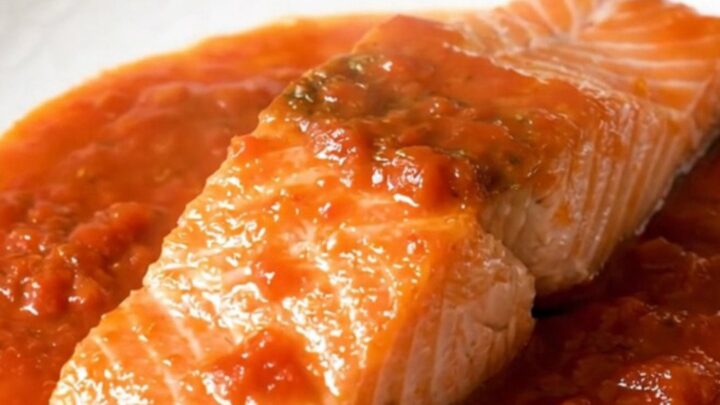
After 2 hours, the salmon should be fully cooked, tender, and coated in a thickened, flavorful tomato sauce. The onions should be soft and translucent.
Before serving, verify the internal temperature of 145°F (63°C) using a food thermometer. After ensuring the temperature is reached, allow the dish to rest covered for 5 minutes to settle the flavors before plating.
Common mistakes
A common mistake is overcrowding the slow cooker. Ensure the fillets are arranged in a single layer so that the heat circulates evenly. Another error is lifting the lid too frequently; every time the lid is opened, heat and moisture escape, which significantly increases the total cooking time and may result in uneven cooking.
Finally, avoid using high heat settings, as salmon is a delicate protein that requires the gentle, slow heat of the low setting to maintain its texture and flavor profile.
How to tell it’s done
The salmon is considered done when it reaches an internal temperature of 145°F (63°C) at its thickest point. Visually, the flesh should be opaque, slightly pink in the center, and flake easily when gently prodded with a fork.
If the fish still appears translucent or resists flaking, continue cooking for another few minutes. Allowing the fish to rest for 5 minutes after removing it from the heat source ensures the juices redistribute, resulting in a more succulent final texture.
- Fish: 145°F (63°C) in the thickest part
Up next · Part 3 of 3
2 variations · storage & make-ahead · 3 answers · printable card
Tips, FAQ & printable recipe (Part 3)← Back to the ingredients (Part 1)