Desserts · Part 2 of 3: Instructions
Slow-Cooker Lemon Curd Molten Butter Cake Step-by-step instructions
- Prep
- Cook
- Total
- Serves
- 8
Before you start
Before starting, make sure the butter is softened to room temperature and the eggs are separated, with the whites in a clean, dry bowl. Measure all ingredients and have the slow cooker ready. If using a liner, place it in the insert now.
The lemon curd should be at room temperature so it spreads easily. Have the electric mixer and rubber spatula nearby. The slow cooker does not need to be preheated; it will heat gradually during cooking.
Ingredients at a glance (12)
- 1 cup thick lemon curd, homemade or store-bought
- 1/2 cup unsalted butter, softened
- 3/4 cup granulated sugar
- 3 large eggs, separated
- 1 tbsp Meyer lemon zest
- 1 cup all-purpose flour
- 1 1/2 tsp baking powder
- 1/4 tsp kosher salt
- 1/2 cup heavy cream
- 2 tbsp granulated sugar
- Powdered sugar, for dusting, to taste
- Fresh berries, for serving
Instructions
Mixing the Batter
- Prepare the BatterIn a large bowl, beat the softened butter and 3/4 cup sugar until light and fluffy. Add the egg yolks one at a time, beating well after each. Stir in the Meyer lemon zest. In a separate bowl, whisk together the flour, baking powder, and salt. Gradually add the dry ingredients to the butter mixture, mixing just until combined.Look for The batter is thick and smooth, with a fragrant lemon aroma.Tip Make sure the butter is truly softened for a smooth, lump-free batter.
- Whip the Egg WhitesIn a clean bowl, beat the egg whites with an electric mixer on medium-high speed until stiff peaks form. The whites should look glossy and hold a firm peak when the beaters are lifted.Look for The egg whites are thick and hold a peak without sliding off the whisk.Tip Make sure no yolk gets into the whites, or they won't whip properly.
- Fold in the WhitesGently fold the whipped egg whites into the lemon batter in three additions. Use a rubber spatula to cut down through the center and sweep up the sides, turning the bowl as you go. Fold just until no white streaks remain; the batter should be light and airy.Look for The batter is fluffy and pale, with no visible streaks of egg white.Tip Fold gently to keep the air in the batter; overmixing will deflate it.
The batter is smooth and fragrant, with a pale yellow color. The whipped egg whites are glossy and hold a stiff peak. When folded in, the batter becomes light and airy, with no streaks of white. The texture should be fluffy and mousse-like, ready to be spooned into the slow cooker.
Layering and Slow-Cooking
- Layer the Batter and CurdSpoon the batter into the slow cooker and spread it into an even layer. Spoon the 1 cup of lemon curd across the center of the batter, leaving a border around the edges. The curd will sink and spread as it cooks.Look for The curd sits in a thick ribbon across the batter, not touching the sides.Tip Use a thick lemon curd so it doesn't sink too quickly into the batter.
- Add the Cream MixtureIn a small bowl, stir together the heavy cream and 2 tablespoons of sugar until the sugar dissolves. Pour this mixture gently over the batter and curd, trying not to disturb the layers.Look for The cream pools on top and begins to seep down around the batter.Tip Pour slowly and evenly to keep the batter from shifting.
The batter is spread evenly, with a thick ribbon of lemon curd across the center. The cream mixture is poured over, and the slow cooker is covered. After 2 hours, the top is golden and puffed, and the edges are set. The sauce bubbles around the sides, and the aroma of lemon fills the kitchen.
Serving the Cake
- Slow-Cook the CakeCover the slow cooker and cook on HIGH for 2 hours, until the top is golden and the edges are set. The center should look slightly glossy but not wet. The lemon curd and cream will form a bubbling sauce underneath the sponge.Look for The cake is puffed and golden, with a glossy, bubbling sauce around the edges.Safe temperature 160°F (71°C) internal temperature (egg dishes)Tip Do not lift the lid during cooking; the steam helps the cake rise.
- Check the TemperatureTo ensure the eggs are fully cooked, insert an instant-read thermometer into the center of the cake. It should read at least 160°F (71°C). If it hasn't reached that temperature, cook for another 10 to 15 minutes and check again.Look for The thermometer registers 160°F (71°C) or higher in the center.Safe temperature 160°F (71°C) internal temperature (egg dishes)Tip The cake will continue to set slightly as it rests, but the temperature is the key.
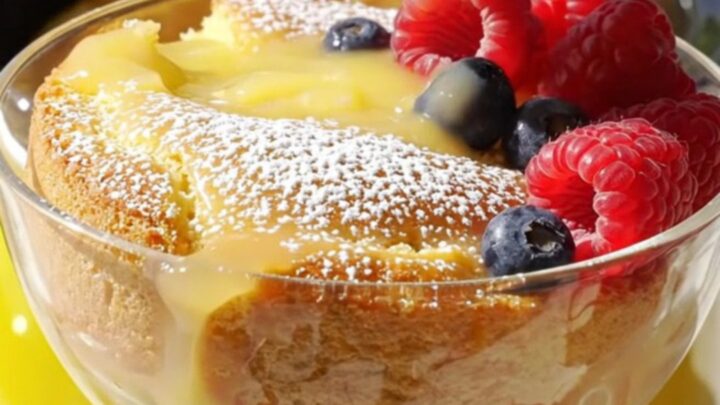
- Serve WarmSpoon the warm cake and lemon curd sauce into glass bowls. Dust generously with powdered sugar and top with fresh berries. Serve immediately while the cake is warm and the sauce is glossy.Look for The sponge is tender and the sauce pools around it, studded with berries.Tip For a prettier presentation, use a wide spoon to get both cake and sauce in each serving.
The cake is spooned into bowls, with the warm lemon sauce pooling around each serving. A dusting of powdered sugar and a handful of fresh berries add brightness and texture. The sponge is tender and moist, and the sauce is glossy and thick, with a perfect balance of sweet and tart.
Common mistakes
One common mistake is opening the slow cooker lid too often, which lets out steam and can prevent the cake from rising properly. Resist the urge to peek until the 2-hour mark.
Another is using a thin lemon curd; it will sink and create a messy layer. Stick to a thick curd. Overmixing the batter after folding in the egg whites can deflate it, resulting in a denser cake. Fold gently and stop as soon as no streaks remain.
How to tell it’s done
The cake is done when the top is golden brown and puffed, and the edges look set. The center may still look slightly glossy, but it should not be wet or jiggly.
To be sure the eggs are fully cooked, insert an instant-read thermometer into the center of the cake; it should read at least 160°F (71°C).
If the temperature is lower, continue cooking in 10-minute increments until it reaches that mark. The sauce underneath will be bubbling and thick, coating the back of a spoon.
- Egg dishes: 160°F (71°C) in the thickest part
Up next · Part 3 of 3
4 variations · storage & make-ahead · 5 answers · printable card
Tips, FAQ & printable recipe (Part 3)← Back to the ingredients (Part 1)