Dinner · Part 2 of 3: Instructions
Slow-Cooker Kakuni Japanese Sweet Soy Braised Pork Belly Step-by-step instructions
- Prep
- Cook
- Total
- Serves
- 6
Before you start
Before starting, cut the pork belly into 2-inch cubes if not already done. Slice the ginger into thin rounds.
Measure out the dashi, soy sauce, mirin, sake, and brown sugar. Have the slow cooker ready and a set of tongs nearby for stirring.
Ingredients at a glance (10)
- 3 lb pork belly, cut into 2-inch cubes
- 1 cup dashi stock
- 1/2 cup soy sauce
- 1/2 cup mirin
- 1/2 cup sake
- 1/3 cup brown sugar
- 1 piece fresh ginger root, sliced
- Steamed rice, for serving
- Blanched baby bok choy, for serving
- Karashi mustard, for serving
Instructions
Layer and Season
- Layer the pork belly in the slow cookerPlace the cubed pork belly in the slow cooker in a single layer if possible. Add the dashi stock, soy sauce, mirin, sake, brown sugar, and sliced ginger. Stir gently to combine and coat the pork evenly.Look for The liquid should come about halfway up the pork cubes; the pork does not need to be fully submerged.Tip For even cooking, arrange the pork in a single layer. If the cubes are stacked, stir once halfway through cooking.
- Set the slow cooker to lowCover the slow cooker with the lid and set it to LOW. Cook for 7.5 hours, or until the pork belly is fork-tender and the sauce has reduced to a glossy glaze. Let it rest for 3 minutes before slicing.Look for After 7 hours, the pork should be tender enough to shred with a fork, and the sauce should coat the back of a spoon.Safe temperature 145°F (63°C) internal temperature (steaks, chops and roasts)Tip Avoid lifting the lid during cooking to maintain a steady temperature and moisture level.
The pork belly is nestled in the slow cooker with the liquid mixture. The aroma of soy, ginger, and sake fills the kitchen as the cooker heats up.
The pork cubes are coated with the dark brown liquid, and the sugar is dissolved.
Slow Braise
- Check for donenessAfter 7.5 hours, test a piece of pork belly with a fork. It should pull apart easily and be very tender. If not, continue cooking for another 30 minutes and check again. Let it rest for 3 minutes before slicing.Look for The meat should be deeply browned and glossy, and the sauce should be thick enough to cling to the pork.Safe temperature 145°F (63°C) internal temperature (steaks, chops and roasts)Tip If the sauce is too thin, remove the pork and simmer the sauce on the stovetop to reduce.
- Rest the porkTurn off the slow cooker and let the pork rest in the warm sauce for at least 3 minutes before serving. This allows the juices to redistribute and the meat to firm up slightly.Look for The pork should be moist and tender, not falling apart completely.Tip Use a slotted spoon to lift the pork out of the sauce to keep the cubes intact.
After hours of gentle bubbling, the sauce has thickened and darkened. The pork cubes are shiny and lacquered, and a fork pierces them with ease. The kitchen smells richly of caramelized soy and ginger.
Serve and Garnish
- Blanch the baby bok choyBring a pot of water to a boil. Add the baby bok choy and cook for 1 to 2 minutes, until bright green and crisp-tender. Drain and set aside.Look for The bok choy should be vibrant green and still slightly crunchy.Tip Blanching keeps the bok choy bright and fresh-tasting.
- Serve the kakuniSpoon steamed rice into bowls. Top with the braised pork belly cubes, a few pieces of blanched bok choy, and a small dab of karashi mustard on the side. Spoon a little of the braising glaze over the top.Look for The pork should be glistening and tender, the bok choy crisp, and the rice hot and fluffy.Tip Serve immediately while warm for the best texture and flavor.
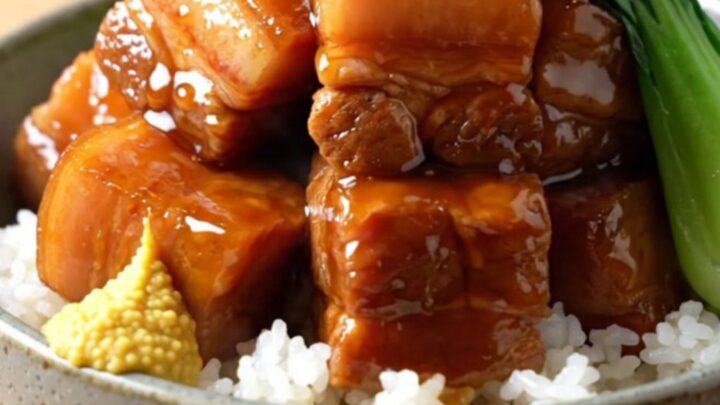
The kakuni is plated over steaming rice with bright green bok choy and a small dab of yellow karashi mustard. The pork glistens, and the sauce pools around the rice, inviting you to take a bite.
Common mistakes
One common mistake is lifting the lid too often, which lets out heat and extends cooking time. Another is cutting the pork too small, which can cause it to dry out.
Also, avoid overcooking to the point where the cubes disintegrate; they should be tender but still hold their shape.
How to tell it’s done
The kakuni is done when the pork belly is fork-tender and the sauce has reduced to a glossy glaze that coats the meat. Insert a fork into a cube; it should slide in easily and the meat should begin to pull apart.
The internal temperature of the pork should reach at least 145°F (63°C) for food safety, but the long cooking time ensures it is well beyond that.
- Steaks, chops and roasts: 145°F (63°C) in the thickest part, then a 3-minute rest
Up next · Part 3 of 3
4 variations · storage & make-ahead · 5 answers · printable card
Tips, FAQ & printable recipe (Part 3)← Back to the ingredients (Part 1)