Dinner · Part 2 of 3: Instructions
Slow-Cooker Guinness Onion Garlic Butter Pork Shoulder Step-by-step instructions
- Prep
- Cook
- Total
- Serves
- 8
Before you start
Before starting, pat the pork shoulder dry with paper towels and let it sit at room temperature for up to 30 minutes. Peel the pearl onions if using fresh, or thaw frozen ones. Cut the cowboy butter into four thick medallions if it's not already shaped.
Have the slow cooker ready and the stout opened. No need to sear the meat—the slow cooker does all the work. Measure all ingredients and place them near the cooker for easy layering.
Ingredients at a glance (4)
- 4 lb boneless pork shoulder roast (Boston butt)
- 1 cup peeled white pearl onions
- 1 bottle (12 oz) Guinness draught stout
- 4 oz cowboy garlic butter, cut into 4 medallions
Instructions
Layer and Set
- Layer the RoastPlace the pork shoulder roast in the center of a 7-quart slow cooker. Scatter the pearl onions around the roast. Pour the Guinness stout over and around the pork, letting it pool in the bottom.Look for The stout should come about halfway up the sides of the roast.Tip If the roast is larger than the cooker, trim it to fit, but keep the fat cap intact.
- Top with ButterPlace the four medallions of cowboy garlic butter evenly across the top of the pork roast. No need to rub or spread; they will melt as the cooker heats.Look for The butter sits in thick discs on the meat.Tip Use cold butter so it melts slowly and bastes the meat.
At the end of this phase, the pork roast sits in the center of the slow cooker with pearl onions scattered around and stout pooled around the base. The butter medallions rest on top, still firm. The raw meat should look fresh and well-marbled. This is the moment to ensure everything is arranged evenly so the roast cooks uniformly. The onions should be in a single layer around the meat, not piled on top.
Slow Simmer
- Cook Low and SlowCover the slow cooker and cook on LOW for 8 hours, or until the pork is fork-tender and shreds easily. Do not lift the lid during the first 6 hours. Let it rest for 3 minutes before slicing.Look for The meat will be deeply browned and the liquid bubbling gently.Safe temperature 145°F (63°C) internal temperature (steaks, chops and roasts)Tip If time is short, cook on HIGH for 5–6 hours, but low is best for tenderness.
- Rest the MeatTurn off the slow cooker. Remove the roast to a cutting board and let it rest for at least 10 minutes. During this time, the internal temperature will continue to rise and the juices will redistribute.Look for The roast is steaming and the surface is glistening.Tip Resting makes the meat easier to shred and keeps it moist.
After 8 hours, the kitchen smells deeply savory with notes of roasted barley and garlic. The liquid is gently bubbling around the edges, and the meat has pulled back from the sides of the cooker.
The surface is bronzed and glistening with melted butter. The onions are soft and have absorbed the stout, turning a deep mahogany. A fork inserted into the thickest part of the roast should twist easily with little resistance.
Shred and Finish
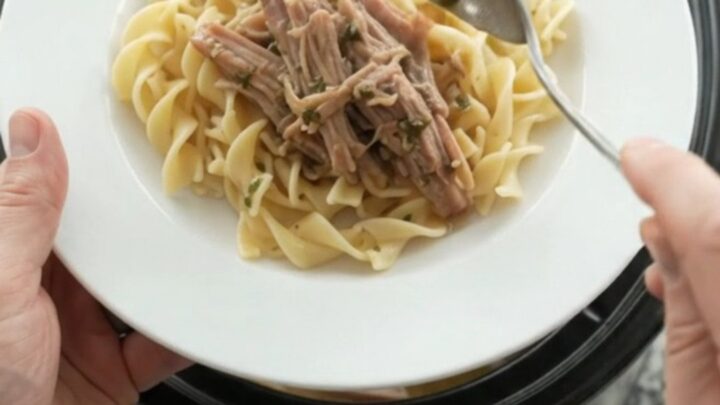
- Shred and ServeUsing two forks, shred the pork into bite-sized ribbons. Return the shredded meat to the slow cooker and stir it into the cooking liquid, onions, and melted butter. Serve warm, spooned over buttered egg noodles or on its own.Look for The pork pulls apart with little resistance.Tip Skim excess fat from the surface before serving if desired.
The shredded pork is glossy and coated with a rich, dark gravy. The onions are tender and sweet, and the sauce has a velvety texture from the melted butter and collagen. The meat piles high on the plate, steaming and fragrant. The final dish should be moist, not dry, with the sauce clinging to every strand. Taste and adjust seasoning with salt and pepper if needed before serving.
Common mistakes
One common mistake is lifting the lid too often, which lets heat escape and extends cooking time. Avoid opening the slow cooker during the first 6 hours. Another is using a lean cut like pork loin, which will dry out; stick with pork shoulder.
If the sauce seems thin at the end, remove the meat and simmer the liquid on the stovetop for a few minutes to reduce. Overcooking on high can toughen the meat, so always use low when possible.
How to tell it’s done
The pork is done when it is fork-tender and shreds easily with little resistance. The internal temperature should read at least 145°F (63°C) when measured with an instant-read thermometer, but for optimal tenderness, it will likely reach 190°F (88°C) or higher, which allows the collagen to fully break down.
The meat should be moist and pull apart into long, juicy strands. The onions will be soft and translucent, and the sauce will have darkened and thickened slightly.
- Steaks, chops and roasts: 145°F (63°C) in the thickest part, then a 3-minute rest
Up next · Part 3 of 3
4 variations · storage & make-ahead · 5 answers · printable card
Tips, FAQ & printable recipe (Part 3)← Back to the ingredients (Part 1)