Dinner · Part 2 of 3: Instructions
Slow Cooker Four-Ingredient Hash Brown Potato Soup Step-by-step instructions
- Prep
- Cook
- Total
- Serves
- 6
Before you start
Before beginning, ensure your slow cooker is clean and positioned on a stable, heat-resistant surface. Gather all four ingredients so they are ready for immediate assembly.
Because this recipe uses frozen potatoes, there is no need for peeling, chopping, or washing fresh vegetables, which significantly reduces your prep time.
Simply clear enough counter space to open your cans and unwrap the cream cheese block before you start the layering process.
Ingredients at a glance (4)
- 30 oz frozen diced hash browns
- 1 can condensed cream of chicken soup
- 3 cups chicken broth
- 8 oz block cream cheese
Instructions
Layering the ingredients
- Combine Base IngredientsPlace the frozen diced hash browns into the bowl of a slow cooker. Add the condensed cream of chicken soup and the chicken broth to the potatoes.Look for ensure all frozen potatoes are evenly distributedTip do not thaw the potatoes beforehand
The bowl of the slow cooker should be filled with the frozen potatoes, soup, and broth, with the block of cream cheese sitting right in the center. The ingredients should look layered and ready for the long, slow heating process.
Slow cooking process
- Add Cream Cheese and CookPlace the block of cream cheese in the center of the slow cooker on top of the other ingredients. Cover and cook on low for 4 hours until the potatoes are tender and the poultry components in the soup base reach 165°F (74°C).Look for the cream cheese should be softened and ready to incorporateSafe temperature 165°F (74°C) internal temperature (poultry)Tip avoid lifting the lid frequently to maintain heat
During the cooking phase, the slow cooker will be quiet and steady. You may notice a slight aroma of savory chicken and dairy as the ingredients heat through. The contents will gradually settle as the potatoes soften and the cream cheese begins to lose its firm structure.
Final incorporation
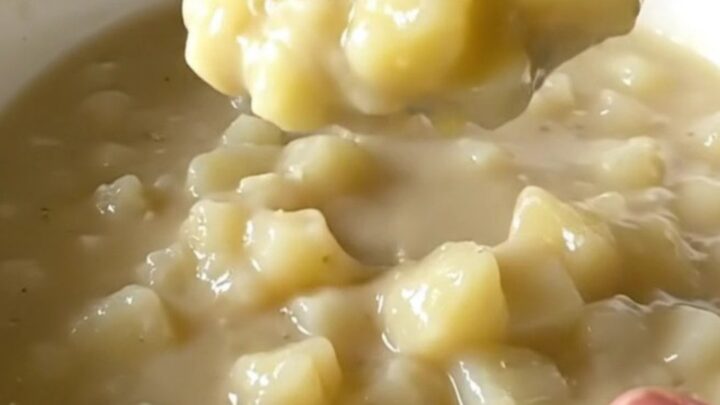
- Stir and ServeOnce the cooking time is complete, stir the soup vigorously until the cream cheese is fully melted and incorporated into the broth, creating a smooth and creamy consistency.Look for the soup should be thick, creamy, and uniform in colorTip use a whisk if necessary to smooth out any small lumps
The final phase involves stirring the softened cream cheese into the soup. The texture will shift from a layered appearance to a cohesive, uniform, and creamy consistency. The soup will look thick, velvety, and ready for serving in individual bowls.
Common mistakes
A common mistake is over-stirring the soup before it has finished cooking. Keep the lid on for the duration of the cooking time to ensure consistent heat distribution.
Another error is using too much broth initially, which can result in a soup that is too thin; start with the recommended amount and only adjust the consistency after the cream cheese has been fully incorporated at the end.
How to tell it’s done
The soup is ready when the diced potatoes are fork-tender and the cream cheese has completely melted into the broth. When you stir the mixture, the consistency should be thick and creamy, with no white streaks of cream cheese remaining.
The potatoes should be soft enough to break apart easily with a spoon, and the entire mixture should be steaming hot throughout, reaching an internal temperature of at least 165°F (74°C).
- Poultry: 165°F (74°C) in the thickest part
Up next · Part 3 of 3
2 variations · storage & make-ahead · 3 answers · printable card
Tips, FAQ & printable recipe (Part 3)← Back to the ingredients (Part 1)