Dinner · Part 2 of 3: Instructions
Slow Cooker Cranberry Barbecue Baby Back Ribs Step-by-step instructions
- Prep
- Cook
- Total
- Serves
- 4
Before you start
Before you begin, ensure your slow cooker insert is clean and dry. Prepare the ingredients by dicing the red onion into uniform pieces, which helps them soften evenly during the cooking process. If your rib rack is large, cut it into manageable portions that fit comfortably in your slow cooker.
Have all your ingredients measured and ready to go, as this will make the assembly process efficient and straightforward. Check your slow cooker settings to ensure you are ready to start the low-temperature cycle.
Ingredients at a glance (4)
- 2 lb baby back ribs, halved
- 1/2 cup red onion, diced
- 1 packet onion herb seasoning
- 1 cup cranberry barbecue sauce
Instructions
Initial Assembly
- Assemble IngredientsPlace the halved baby back ribs into the base of the slow cooker, ensuring they are arranged in an even layer to promote consistent cooking throughout the process.Look for The ribs should fit snugly inside the cooker without excessive overlapping.Tip If the ribs are too long for the slow cooker, cut them into smaller sections.
The ribs should be placed in the cooker in a single, even layer. The red onion and seasoning should be distributed evenly over the top, ensuring every piece of meat is adequately covered.
Before closing the lid, verify that the pieces are not overlapping excessively to ensure even heat distribution throughout the cooking process.
Cooking Process
- Season and SauceScatter the diced red onion over the ribs, sprinkle the onion herb seasoning packet evenly across the meat, and pour the cranberry barbecue sauce over the top to coat.Look for Ensure the sauce covers the ribs thoroughly for a glossy finish.Tip Use a spatula to spread the sauce if it does not flow easily into the crevices.
During the cooking phase, the slow cooker will release a savory, aromatic scent as the onions and herbs meld with the barbecue sauce. The ribs will gradually soften, and the sauce will begin to reduce and coat the meat. Check the progress only after the recommended time has passed to maintain a consistent temperature.
Finishing and Serving
- Cook and ServeCover and cook on low for 6 hours until the meat is tender, reaching an internal temperature of at least 145°F (63°C). Allow the ribs to rest for 10 minutes before serving.Look for The meat should pull away easily from the bone when pierced with a fork.Safe temperature 145°F (63°C) internal temperature (steaks, chops and roasts)Tip The resting period allows the juices to redistribute for a better texture.
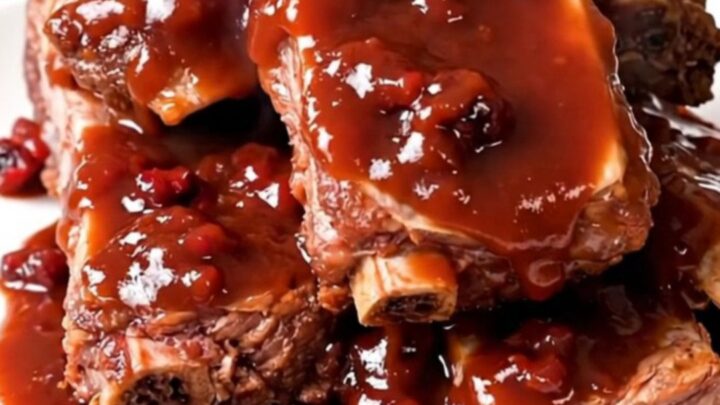
At the end of the cooking time, the ribs should look dark, glossy, and tender. The sauce should have a thick consistency that adheres well to the ribs. After resting, the meat should be easy to separate from the bone, indicating it is perfectly cooked and ready to be transferred to a serving plate.
Common mistakes
A common mistake is overcrowding the slow cooker, which can prevent the heat from circulating properly and lead to unevenly cooked meat. Ensure there is enough space for the sauce to bubble around the ribs.
Another error is checking the ribs too frequently; opening the lid lets out steam and heat, which significantly increases the cooking time. Avoid using a high heat setting, as it can cause the sauce to burn or the meat to become tough instead of tender.
How to tell it’s done
The ribs are done when the meat is extremely tender and begins to pull away from the bones. Use a meat thermometer to check the thickest part of the meat, ensuring it reaches an internal temperature of at least 145°F (63°C).
The sauce should be thickened and glossy, clinging to the ribs. If the meat still feels tough or resistant when pierced with a fork, continue cooking for an additional 30 minutes before checking again.
- Steaks, chops and roasts: 145°F (63°C) in the thickest part, then a 3-minute rest
Up next · Part 3 of 3
2 variations · storage & make-ahead · 3 answers · printable card
Tips, FAQ & printable recipe (Part 3)← Back to the ingredients (Part 1)