Dinner · Part 2 of 3: Instructions
Queso Chicken Enchiladas with Creamy Cheese Pull Step-by-step instructions
- Prep
- Cook
- Total
- Serves
- 6
Before you start
Read the dish through once, then set up. Preheat the oven to 375°F (190°C) and position a rack in the center with the broiler in reach. Drain the can of diced tomatoes with green chiles thoroughly and set it beside the stove.
Ingredients at a glance (13)
- 1 1/2 lb boneless skinless chicken breasts
- 1 tbsp olive oil
- 1 tbsp chili powder
- 2 tsp ground cumin
- 1 tsp garlic powder
- 1 tsp kosher salt
- 2 tbsp butter
- 2 tbsp all-purpose flour
- 1 1/2 cups chicken broth
- 1 cup whole milk
- 2 cups shredded Mexican blend cheese, divided
- 1 can (10 oz) diced tomatoes with green chiles, drained and divided
- 8 8-inch flour tortillas
Instructions
Season, cook and shred
- Season the chickenPat the chicken breasts dry with paper towels and rub them all over with olive oil. Combine the chili powder, cumin, garlic powder and kosher salt in a small bowl, then sprinkle the mixture evenly over both sides of each breast, pressing gently so the spices adhere. Even coverage now means every shred of chicken carries flavor, not just the surface.Look for Each breast should be evenly coated in rust-red spice with no pale patches showing through.Tip Dry chicken first; wet meat makes the spices slide off instead of forming a seasoned crust.
- Cook the chicken throughSet a large skillet over medium heat and lay the chicken in a single layer. Cook 5 to 6 minutes per side, turning once, until the thickest part reaches 165°F (74°C) on an instant-read thermometer; that temperature is what makes the poultry safe to eat. Transfer the chicken to a cutting board and let it sit while a splash of steam escapes.Look for Deep golden spice crust outside, and juices running clear when the breast is pierced at its thickest point.Safe temperature 165°F (74°C) internal temperature (poultry)Tip Pull the chicken the moment it hits 165°F (74°C); going further dries out the shreds.
- Shred the chickenOnce the chicken is cool enough to handle, hold one breast steady with a fork and pull the fibers apart with a second fork, working along the grain. Continue until all the meat is shredded into bite-size strands. Pile the shreds in a bowl and pour over any juices left on the board so nothing flavorful is wasted.Look for Long, tender strands of spiced chicken with no large unshredded chunks remaining.Tip Shredding along the grain keeps longer strands, which gives the filling a better bite inside the tortillas.
At the end of this phase the chicken should be fully cooked, resting on a cutting board with a deep golden spice crust, and shredded into long, tender strands piled in a bowl.
Juices that ran onto the board should be poured back over the shreds. The internal temperature was verified at 165°F (74°C) at the thickest point, and the meat pulls apart with almost no resistance.
Make the queso and assemble
- Start the queso rouxMelt the butter in a medium saucepan over medium heat. Sprinkle in the flour and whisk constantly for about 1 minute, until the mixture smells faintly nutty and looks like wet sand. This short cook removes the raw flour taste while keeping enough thickening power to build a sauce that clings to the enchiladas instead of pooling at the bottom of the dish.Look for A pale-gold paste that bubbles gently around the whisk and smells toasty, not acrid.Tip Keep the whisk moving; flour in hot butter catches fast in the pan's hot spots.
- Build the sauce basePour in the chicken broth a little at a time, whisking until smooth after each addition, then add the milk the same way. Raise the heat slightly and simmer, whisking often, for 3 to 4 minutes, until the sauce thickens enough to coat the back of a spoon. Adding the liquids gradually is what keeps the queso silky instead of lumpy.Look for A smooth, pourable sauce that leaves a clean trail when the whisk is dragged across the pan bottom.Tip Whisk into the corners of the pan, where flour hides and can scorch or go lumpy later.
- Melt in the cheeseLower the heat to its minimum and add 1 1/2 cups of the shredded cheese a handful at a time, stirring until each addition fully melts before adding the next. Stir in half of the drained diced tomatoes. Keep the pan off a hard boil; gentle heat is what keeps the queso creamy and glossy rather than grainy or oily.Look for A thick, glossy orange sauce that drips slowly off a spoon, with tomatoes evenly flecked through.Tip Off the boil is the rule: high heat makes cheese tighten and turn stringy in the sauce.
- Fill and roll the tortillasSpoon a generous line of shredded chicken down the center of each tortilla, top with a little of the remaining shredded cheese, then roll each one snugly. Arrange them seam-side down in the baking dish, packing them side by side so they hold their shape. Work in batches if the tortillas cool and stiffen between rolls.Look for Eight snug rolls sitting seam-side down, filling visible only at the ends.Tip Warm the tortillas 15 seconds in the microwave first so they roll without cracking.
- Sauce and top the dishPour the warm queso sauce evenly over the rolled tortillas, nudging it into the gaps with a spatula so every roll is coated. Scatter the remaining shredded cheese over the top, then spoon the rest of the diced tomatoes across the surface. An even layer now means an even melt and an even cheese pull on every serving.Look for No dry tortilla patches showing; the whole dish sits under a level blanket of sauce and cheese.Tip Sauce the rolls while the queso is still hot so it settles into the seams before baking.
The queso should now be thick, glossy and pourable, dripping slowly off a spoon with flecks of tomato distributed throughout, and the eight rolled tortillas should sit seam-side down in the dish, packed snugly side by side.
The sauce should blanket the rolls completely with no dry tortilla showing, and the remaining cheese and diced tomatoes should form an even layer on top.
Bake, broil and pull
- Bake until bubblingBake in a preheated 375°F (190°C) oven for 18 to 20 minutes, until the sauce bubbles at the edges and the cheese on top has fully melted and merged with the queso. The edges should look lively and the center should be hot all the way through, since the dish only needs heating through, not further cooking.Look for Bubbles breaking slowly at the edges and cheese melted into one uniform, glossy layer.Tip Set the dish on a sheet pan to catch any sauce that bubbles over the rim.
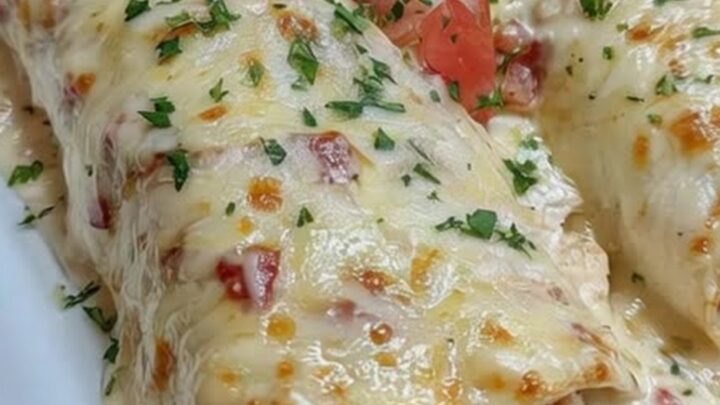
- Broil, rest and serveSlide the dish under the broiler for 1 to 2 minutes, watching constantly, until the top blisters with golden-brown spots. Let the enchiladas rest 5 minutes so the sauce settles, then lift one out with a spatula, plate it and pull it apart for that long, creamy cheese pull before serving hot.Look for Deep golden freckles across the top and thick strands of cheese stretching as a piece is lifted.Tip Broil on the upper rack but keep the door ajar and never walk away; broilers go from golden to burnt fast.
Straight from the oven the sauce should bubble at the edges; after the broiler, the top should carry golden-brown blistered spots and the cheese should stretch in long strands when a piece is lifted.
Give the dish 5 minutes of rest so the queso settles and thickens slightly, then lift one enchilada with a spatula and plate it. The pull should be creamy and continuous, the tomatoes bright against the golden cheese, and the filling steaming hot.
Common mistakes
The three common failures all have easy fixes. A grainy or oily queso comes from melting cheese over high heat or adding it all at once—keep the pan on low and add the cheese in handfuls, stirring until each melts.
A lumpy sauce comes from pouring the broth and milk in too fast; add them gradually and whisk smooth after each addition, reaching the pan corners.
How to tell it’s done
The dish is done when the sauce bubbles steadily at the edges, the top cheese has melted into one glossy layer with golden-brown broiled spots, and the center is hot all the way through when a knife tip is inserted for a few seconds.
- Poultry: 165°F (74°C) in the thickest part
Up next · Part 3 of 3
4 variations · storage & make-ahead · 5 answers · printable card
Tips, FAQ & printable recipe (Part 3)← Back to the ingredients (Part 1)