Desserts · Part 2 of 3: Instructions
Pistachio Orange Blossom Crème Brûlée Step-by-step instructions
- Prep
- Cook
- Total
- Serves
- 5
Before you start
Before you begin, ensure that all your ingredients are measured and ready to go. Preheat your oven to 320°F (160°C). Prepare your terra-cotta cazuelas or ramekins by placing them into a deep-sided baking pan that can hold enough water to reach halfway up the sides of the ramekins.
Having a kettle of hot water ready will expedite the process when you are ready to prepare the water bath. Ensure your workspace is clean and you have a kitchen torch ready for the final step.
Ingredients at a glance (8)
- 120 g roasted Sicilian pistachio paste
- 500 ml heavy cream
- 5 egg yolks
- 80 g granulated sugar
- 5 ml orange blossom water
- 5 tbsp superfine sugar
- crushed green pistachios for serving
- dried rose petals for serving
Instructions
Custard Preparation
- Prepare the custard baseIn a large mixing bowl, whisk together the roasted Sicilian pistachio paste, granulated sugar, and egg yolks until smooth and well combined. Gradually pour in the warm heavy cream while whisking constantly to temper the yolks. Stir in the orange blossom water until fully incorporated into the mixture.Look for The mixture should be smooth, homogenous, and aromatic.Tip Ensure the cream is warm but not boiling to prevent curdling the egg yolks during mixing.
The mixture should look like a smooth, vibrant green liquid. It should be free of any large lumps and smell intensely of roasted pistachios with a subtle floral hint from the orange blossom water. Check that the sugar is fully dissolved and the pistachio paste is evenly distributed throughout the cream and egg base before you move on to straining it.
The Baking Process
- Bake in a water bathStrain the custard mixture through a fine-mesh sieve into your terra-cotta cazuelas or ramekins to ensure a silky texture. Place the ramekins in a deep baking dish and fill the dish with hot water until it reaches halfway up the sides of the ramekins. Bake at 320°F (160°C) for 35 minutes until the edges are set but the center still jiggles slightly, reaching 160°F (71°C).Look for The custard should be set around the edges but maintain a gentle wobble in the center.Safe temperature 160°F (71°C) internal temperature (egg dishes)Tip Using a water bath, or bain-marie, provides gentle, even heat that prevents the eggs from scrambling.
The custards are ready when they have a uniform, matte appearance on the surface. When you gently shake the baking pan, the centers of the custards should wobble slightly, like a thick pudding, while the edges remain stable.
If they appear liquid or splash significantly, they require a few more minutes in the oven. Ensure the water bath remains at a steady, gentle temperature.
Finishing the Brûlée
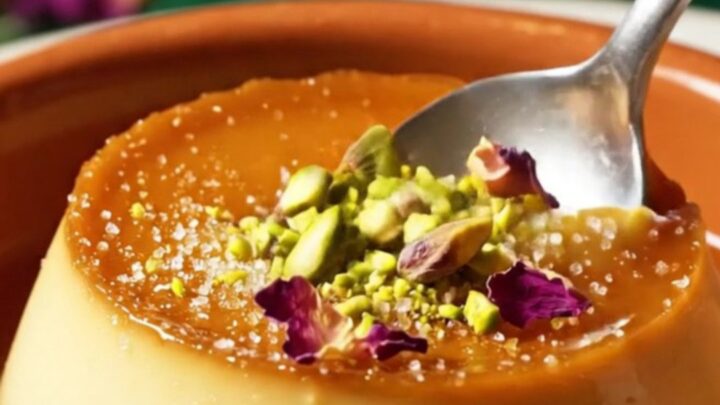
- Chill and torch the sugar crustRemove the ramekins from the water bath and allow them to cool to room temperature. Transfer to the refrigerator for at least 4 hours to chill completely. Before serving, sprinkle an even layer of superfine sugar over the top of each custard. Use a kitchen torch to melt and caramelize the sugar until it forms a deep golden, glassy crust. Garnish with crushed green pistachios and dried rose petals.Look for The sugar should bubble, melt, and turn into a hard, amber-colored shell.Tip Work quickly with the torch to achieve an even caramelization without heating the custard underneath too much.
The final stage is all about the crust. Once the sugar has been torched, it should look like a smooth, amber-colored mirror. The contrast between the cold custard and the warm, brittle sugar is the hallmark of a successful crème brûlée. Check that the sugar has completely melted and fused into a single, hard layer that cracks with a satisfying sound when tapped with a spoon.
Common mistakes
A common mistake is failing to strain the custard mixture, which can result in a grainy texture due to bits of egg or pistachio solids. Another frequent error is using boiling water for the water bath, which can cause the custard to bake too quickly and curdle; stick to hot water.
Finally, do not rush the chilling process. A minimum of 4 hours in the refrigerator is essential for the custard to set properly; skipping this will result in a runny, disappointing dessert.
How to tell it’s done
The custard is done when the edges are set and firm to the touch, but the center still jiggles like gelatin when the ramekin is gently shaken. The internal temperature of the custard should reach 160°F (71°C) at the center to ensure the eggs are fully cooked and safe.
The sugar crust is done when it has been melted by the torch into an even, deep golden-brown layer that hardens into a crisp, glassy surface upon cooling for a few seconds.
- Egg dishes: 160°F (71°C) in the thickest part
Up next · Part 3 of 3
2 variations · storage & make-ahead · 3 answers · printable card
Tips, FAQ & printable recipe (Part 3)← Back to the ingredients (Part 1)