Dinner · Part 2 of 3: Instructions
Pan-Seared Ribeye Steak with a Golden Crust in 20 Minutes Step-by-step instructions
- Prep
- Cook
- Total
- Serves
- 2
Before you start
Before the pan goes on the stove, set up the whole station. Take the ribeye out of its packaging, pat it dry on every surface with paper towels, and let it stand on a plate at room temperature for 20 to 30 minutes, never longer. Measure out the salt and pepper so seasoning takes seconds, and set the oil next to the stove with the tongs within reach.
Place a wooden cutting board by the stove for the rest, warm a serving plate in a low oven or under hot water, and have the instant-read thermometer ready. A sharp chef's knife should be waiting on the board, because slicing a crusty steak with a dull blade crushes the crust and squeezes out the juices you worked to keep inside.
Ingredients at a glance (4)
- 1 lb boneless ribeye steak, about 1 1/2 inches thick
- 1 1/2 tsp kosher salt
- 1 tsp coarsely ground black pepper
- 1 tbsp high-heat neutral oil, such as avocado or canola
Instructions
Prep and heat
- Dry and temper the steakPat the ribeye completely dry on every surface with paper towels, pressing firmly to lift away surface moisture. Set the steak on a plate and leave it on the counter for 20 to 30 minutes, no longer, so the chill eases off before it meets the pan.Look for The paper towels come away dry and the surface feels tacky rather than slick.Tip A dry surface is what browns; moisture steams instead. Do not skip this step.
- Season generouslySprinkle the kosher salt and coarsely ground black pepper evenly over both faces and the edges of the steak, pressing gently so the seasoning adheres. Season right before cooking so the salt draws out little moisture while the steak waits.Look for Both faces are evenly flecked with salt and pepper, with no bare patches.Tip Coarse pepper resists burning better than fine ground during a hard sear.
- Heat the pan until it shimmersPlace a 12-inch cast-iron skillet over high heat and let it sit empty for 4 to 5 minutes. Add the oil, tilt the pan to coat, and wait until the oil shimmers and just begins to loosen, wisping lightly but never smoking hard.Look for A drop of water flicked into the pan skitters and evaporates instantly.Tip Cast iron holds heat steadily, which is exactly what a thick steak needs.
By the end of the first phase the steak is dry to the touch, evenly seasoned on both faces and the edges, and no longer cold from the refrigerator. The cast-iron pan sits over high heat for at least 4 minutes, and the oil shimmers across the surface with a light wisp but no harsh smoke.
Flick a drop of water into the pan: it should skitter and vanish on contact. If the oil smokes aggressively, lift the pan off the heat for half a minute before the steak goes in. Everything, including the thermometer, knife and serving plate, should be within arm's reach before moving on.
Sear and check
- Sear the first side hardLay the steak in the pan away from you so any splatter moves the other way. Press it flat with the tongs for a few seconds, then leave it completely alone for 3 to 4 minutes while the crust builds underneath.Look for Deep golden brown edges creep up the sides and the steak releases freely from the pan.Tip Moving the steak too early tears the crust before it sets. Trust the timer.
- Flip and sear the second sideTurn the steak with tongs and sear the second face for another 3 to 4 minutes, then set it on each narrow edge for about 30 seconds to render and brown the fat rim all the way around.Look for The second face matches the first: mahogany, blistered in spots, glossy with rendered fat.Tip Tongs give better control than a fork, which punctures the meat and leaks juices.
- Check the temperatureInsert an instant-read thermometer into the thickest part of the steak, angled from the side. Pull the steak at 130°F when it reads a few degrees below the target, because the temperature climbs as it rests toward a safe 145°F (63°C), followed by a rest of at least 3 minutes.Look for The probe slides in easily and the reading sits a few degrees under target.Safe temperature 145°F (63°C) internal temperature (steaks, chops and roasts)Tip Check from the side, not the top, so the juices stay sealed inside the steak.
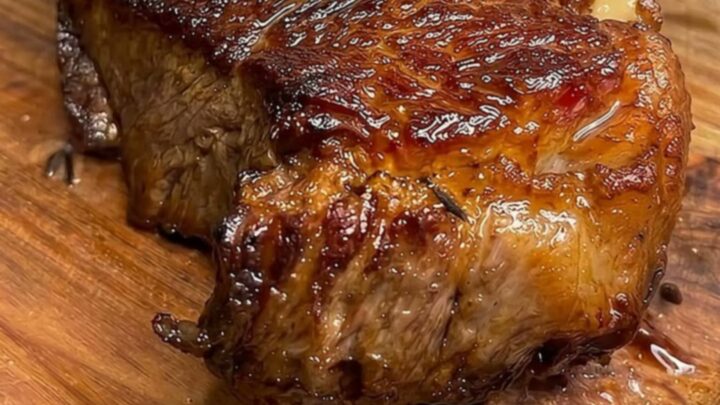
The searing phase ends when both faces of the steak are deep golden brown with darker blistered spots, the fat rim along the edge is rendered and browned, and the steak releases from the pan without sticking. The kitchen should smell richly of browned beef and cracked pepper.
Slide the thermometer in from the side into the thickest part: the reading should sit around 130°F, a few degrees below the final target of 145°F (63°C), because the temperature keeps climbing as the steak rests. If the crust is dark but the reading is low, drop the heat slightly and continue; if the crust lags, raise it.
Rest, slice, plate
- Rest the steakTransfer the steak to a wooden cutting board or warm plate and let it rest at least 3 minutes, and closer to 10 for a cut this thick, loosely tented. The muscle fibers relax and the juices redistribute evenly through the meat instead of pooling on the board.Look for Only a light shimmer of juice, not a flood, appears where the steak was lifted.Tip Resting is not optional; a steak cut immediately loses its juiciest bite.
- Slice and plateSlice the steak against the grain into thick pieces, about half an inch each, with a long sharp knife, letting the steam rise as the pink interior shows. Arrange the slices on a warm plate and bring them to the table right away.Look for The interior is an even, tender pink from edge to edge with a dark crust outside.Tip Cutting against the grain shortens the muscle fibers, so every bite feels tender.
The final phase is quiet on purpose. After at least 3 minutes of resting, and closer to 10 for a steak this thick, the surface no longer steams aggressively and only a light shimmer of juice marks the cutting board. Slicing against the grain should meet slight, pleasant resistance and reveal an even pink interior framed by the dark crust, with steam rising from each piece. The juices stay mostly inside the meat rather than pooling out. Arrange the thick slices on the warm plate and serve immediately, while the crust still crackles faintly when the fork presses into it.
Common mistakes
The most common failures all trace back to heat and moisture. A wet steak steams instead of searing, so pat it dry without mercy. A pan that is not hot enough produces gray, boiled-looking surfaces, so preheat the cast iron a full 4 to 5 minutes. Moving the steak too soon tears the crust before it releases; wait until it lifts freely.
Skipping the thermometer invites overcooking, and cutting straight off the heat spills the juices onto the board instead of keeping them in the meat. Finally, crowding a small pan drops the temperature fast, so give the steak room and cook in batches if needed.
How to tell it’s done
A properly cooked ribeye shows a deep mahogany crust with blistered, glossy edges and an interior that is an even, tender pink from edge to edge. The reliable measure is internal temperature: for food safety, whole cuts of beef should reach 145°F (63°C) as measured with an instant-read thermometer, followed by a rest of at least 3 minutes. Pull the steak at about 130°F and let the carryover cooking bring it up during the rest. The meat should feel firm with a slight spring when pressed, release clear juices rather than a flood, and fill the kitchen with a rich, roasted aroma.
- Steaks, chops and roasts: 145°F (63°C) in the thickest part, then a 3-minute rest
Up next · Part 3 of 3
4 variations · storage & make-ahead · 5 answers · printable card
Tips, FAQ & printable recipe (Part 3)← Back to the ingredients (Part 1)