Dinner · Part 2 of 3: Instructions
One-Pan Honey Garlic Salmon with Roasted Vegetables Step-by-step instructions
- Prep
- Cook
- Total
- Serves
- 4
Before you start
Before starting, gather all the ingredients and ensure the salmon fillets are patted completely dry with paper towels, which helps the glaze adhere and promotes better browning.
Chop the fresh rosemary, mince the garlic cloves, and cut the baby potatoes and carrots into uniform pieces. Preheat the oven to 400°F (204°C) and line a large, rimmed baking sheet with parchment paper so everything is ready for seamless assembly without any unnecessary delays.
Ingredients at a glance (7)
- 4 skin-on salmon fillets
- 1/3 cup honey
- 4 garlic cloves, minced
- 2 sprigs fresh rosemary, finely chopped
- 1 lb baby potatoes, halved
- 3 medium carrots, sliced into batons
- 1 bunch asparagus, trimmed
Instructions
Vegetable Roasting
- Prepare the Root VegetablesPreheat the oven to 400°F (204°C). Place the halved baby potatoes and sliced carrots onto a large parchment-lined baking sheet, spreading them out evenly.Look for The vegetables should be arranged in a single layer.Tip Arrange the potatoes cut-side down on the baking sheet for maximum browning.
- Initial Vegetable RoastRoast the potatoes and carrots in the preheated oven for 15 minutes, leaving space on one side of the baking sheet for the salmon and asparagus.Look for The potatoes and carrots should start to soften and sizzle.Tip Do not crowd the pan to ensure the vegetables roast instead of steam.
At the end of this initial roasting phase, the baby potatoes and carrots should begin to soften and develop a light golden color around the edges.
You will hear a gentle sizzling sound from the baking sheet, and the kitchen will fill with the comforting aroma of roasted root vegetables, indicating they are ready for the salmon to be added to the pan.
Glazing and Adding Salmon
- Prepare the Honey Garlic GlazeWhile the vegetables roast, prepare the glaze. In a small bowl, whisk together the honey and minced garlic until the mixture is fully combined and smooth.Look for The glaze should be smooth and well blended.Tip Warm the honey slightly if it is too thick to whisk easily.
- Arrange and GlazeCarefully remove the baking sheet from the oven. Arrange the salmon fillets and trimmed asparagus on the empty side of the pan. Use a pastry brush to coat the salmon generously with the honey garlic glaze.Look for The glaze should fully coat the top of the salmon fillets.Tip Keep the salmon skin-on to help the fillets stay intact during roasting.
After brushing the glaze over the salmon, the honey and garlic mixture will melt and bubble gently under the oven heat. The salmon will transition from translucent pink to an opaque, light pink color, and the savory scent of roasting garlic and sweet honey will become highly pronounced, indicating the glaze is starting to set beautifully on the fish.
Caramelization and Final Roast
- Roast the Salmon and AsparagusReturn the baking sheet to the oven. Roast for 12 to 15 minutes, or until the salmon is opaque and flakes easily. Ensure the fish reaches a safe internal temperature of 145°F (63°C) when measured with a food thermometer.Look for The salmon should be flaky and the glaze bubbly.Safe temperature 145°F (63°C) internal temperature (fish)Tip Broil for the last 2 minutes if you prefer a deeper caramelized crust.
- Garnish and ServeRemove the baking sheet from the oven. Sprinkle the finely chopped fresh rosemary over the salmon and vegetables. Plate the glazed salmon alongside the roasted potatoes, carrots, and asparagus.Look for The dish is ready to serve immediately while hot.Tip Serve with fresh lemon wedges to cut through the sweetness of the glaze.
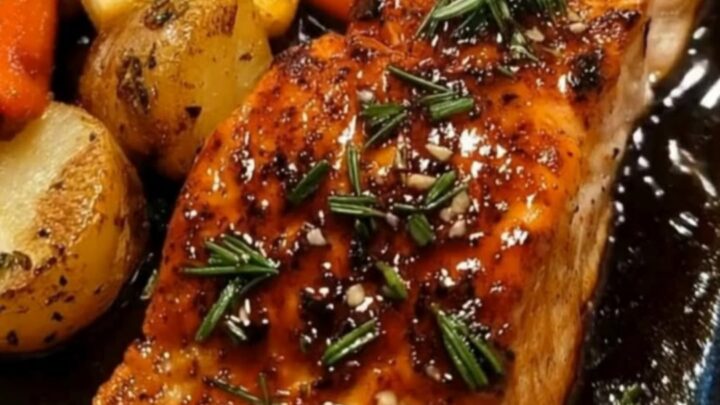
At the final checkpoint, the honey garlic glaze on the salmon will look thick, glossy, and beautifully caramelized with deep golden-brown edges. The potatoes and carrots will be tender and browned, the asparagus will be vibrant green and tender-crisp, and the salmon will flake easily with a fork, showing it is fully cooked to perfection.
Common mistakes
One common mistake is overcrowding the baking sheet, which traps steam and causes the vegetables to boil rather than roast and crisp. Ensure there is sufficient space between the salmon fillets and the vegetables to allow hot air to circulate freely.
Another mistake is applying the glaze too early in the vegetable roasting process, which can cause the honey to burn before the potatoes are fully tender and cooked through.
How to tell it’s done
Salmon is perfectly cooked when the flesh becomes opaque and flakes easily with a gentle press of a fork. To guarantee food safety and optimal texture, insert an instant-read digital thermometer into the thickest part of the salmon fillet; it must register an internal temperature of 145°F (63°C).
The vegetables should be easily pierced with a fork but still retain a pleasant, tender-crisp bite, ensuring they are not mushy.
- Fish: 145°F (63°C) in the thickest part
Up next · Part 3 of 3
2 variations · storage & make-ahead · 3 answers · printable card
Tips, FAQ & printable recipe (Part 3)← Back to the ingredients (Part 1)