Dinner · Part 2 of 3: Instructions
Oklahoma Onion Smash Burger with Crispy Lace Edges Step-by-step instructions
- Prep
- Cook
- Total
- Serves
- 1
Before you start
Get everything staged before the griddle gets hot, because the cooking itself moves fast. Shape the two 4-ounce beef balls and put them back in the refrigerator so they stay cold. Slice the onion paper-thin and separate the shreds into loose half-moons.
Unwrap the cheese slices, split the potato bun, melt the butter and set out the burger sauce with a spoon. Fit the cast-iron press within reach, position a stiff metal spatula beside it, and have an instant-read thermometer ready. Turn the range hood on high, since a proper smash at 450°F (230°C) smokes hard for the first minute.
Ingredients at a glance (6)
- 8 oz 80/20 ground beef, shaped into two 4-ounce balls
- 1 cup yellow onion, sliced paper-thin on a mandoline
- 2 slices yellow American cheese
- 1 potato bun, split
- Unsalted butter, melted, to taste, for brushing the top bun
- 2 tbsp burger sauce, store-bought or made ahead
Instructions
Prep the beef and onions
- Shape the beef ballsDivide the cold ground beef into two 4-ounce portions and roll each into a loose ball with your palms. Do not compact the meat — round it just enough to hold together. Return the balls to the refrigerator while the griddle heats; cold beef sears harder and smashes cleaner than meat that has warmed up.Look for The balls should feel pliable but chilly, holding their shape without cracking apart.Tip Even portions matter more than exact weight — two equal balls will cook at the same rate.
- Slice the onions razor-thinPeel the yellow onion and slice it paper-thin on a mandoline, about 1/16 inch, until you have a loosely packed cup. Separate the slices into shaggy half-moons so they drape over the meat instead of clumping into rings. Thin, even slices are what caramelize into the beef rather than staying raw and watery on top.Look for The slices should be translucent enough to read a word through when held up to the light.Tip Use the mandoline guard and steady, slow strokes; the last thin sliver is not worth a nicked finger.
- Heat the griddle to 450°FSet a cast-iron griddle or heavy skillet over medium-high heat and let it climb to about 450°F (230°C); a drop of water should skitter and vanish on contact. Keep the cooking surface dry — the beef brings all the fat the pan needs. Lay the cheese, bun, butter and sauce within arm's reach before anything touches the steel.Look for A flicked water droplet dances and evaporates within two seconds instead of sitting and steaming.Tip Turn on the range hood; a proper smash at this temperature throws serious smoke for a minute.
Before any heat, everything should be staged and cold where it counts. The two beef balls are equal in size, loosely rolled and back in the refrigerator, still chilly to the touch. The onion is sliced translucent-thin, separated into shaggy half-moons and mounded into a loosely packed cup — no thick rings hiding in the pile. The cheese is unwrapped, the bun is split, the butter is melted and the sauce is sitting beside the stove with a spoon. The griddle or skillet is dry and climbing toward 450°F (230°C), confirmed by a water droplet that skitters and vanishes.
Smash, sear and melt
- Smash the onions into the beefPlace both beef balls on the hot griddle at least 3 inches apart, then pile a generous handful of onions over each. Smash down firmly with the press for about 10 seconds so the onions press into the meat and each patty spreads to roughly 4 1/2 inches wide. Season the tops with salt and pepper.Look for The patty should spread fast and thin, with onions visible across the entire top surface.Tip Smash once, hard, in the first 10 seconds — pressing again later squeezes out the juices.
- Build the crispy lace crustLeave the patties completely alone for about 2 minutes. The onions will char into the beef and crispy brown lace will creep out past the edges — that crackle is the Maillard crust forming. Slide a stiff spatula under each patty, scraping the crust cleanly off the steel, and flip in one confident motion.Look for Edges look dark brown and frilly; the onion side smells sweet and toasty, never acrid or burnt.Tip If the crust sticks, give it 20 more seconds — it releases on its own once properly browned.
- Cook through and melt the cheeseCook the flipped patties 1 to 2 minutes more, until the beef is cooked through and an instant-read thermometer reads 160°F (71°C) in the center. Drape a slice of American cheese over each patty immediately so it melts against the hot surface. Slide the finished patties onto a waiting plate while the bun toasts.Look for The center reads 160°F (71°C) and juices run clear with no pink pooling on the griddle.Safe temperature 160°F (71°C) internal temperature (ground meat)Tip Stack the cheese slice folded in half for extra melt coverage across the thin patty.
By the end of this phase, both patties should carry a deep brown, frilly crust with onions charred into the beef and lace creeping past the edges. The centers read 160°F (71°C) on an instant-read thermometer — the temperature ground beef must reach — and the juices run clear with no pink pooling on the steel. Each patty wears a slice of American cheese, fully melted and glossy, and rests on a waiting plate. The griddle still smells sweet and toasty, not acrid.
Build and serve the burger
- Steam-toast and butter the bunSet the potato bun cut side down on the still-hot griddle for about 45 seconds to steam-toast it soft and golden. Brush the top bun with melted butter, then let it sit cut side down for a few seconds more so the butter soaks in. The surface should turn glossy and tender, never hard or dry.Look for The cut faces turn pale gold with faint toast spots and the kitchen smells like warm bread.Tip Wipe the griddle with a dry paper towel first so stray onions do not scorch onto the bun.
- Sauce, stack and serveSpread the burger sauce over the bottom bun, stack the two cheesy patties with their crispy onion edges facing outward, and crown with the buttered top bun. Press down very gently, wait 30 seconds so the steam settles, then cut the burger in half and serve right away while the cheese is still molten.Look for Sauce and a little melted cheese gush at the cross-section; the onion edges audibly crackle.Tip Angle the patties so the lacy edges peek past the bun — that is the best-looking bite.
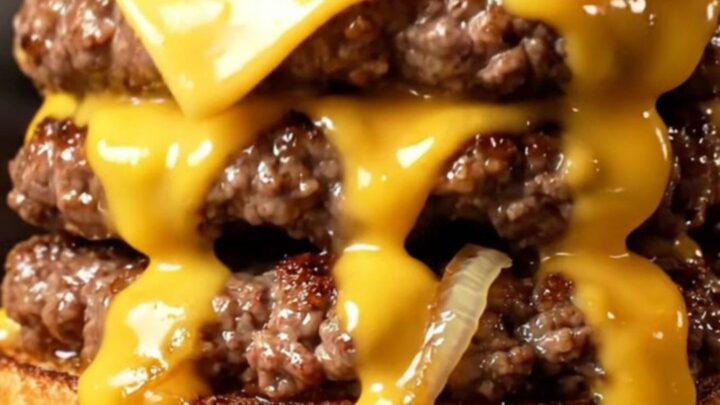
The finished burger should look glossy and slightly compressed, with the lacy onion edges peeking past the bun on both sides. The cut faces of the potato bun are pale gold and tender, and the top shines with melted butter.
At the cross-section, the burger sauce and a little molten cheese gush immediately, the onions look caramelized rather than raw, and the first bite crackles audibly. The stack should feel juicy and spring back under a light press, never firm or dry. Serve it within a minute or two of assembly — the contrast between crisp edges and molten cheese is the whole point, and it fades fast.
Common mistakes
The most common failure is a timid smash — press hard for a full 10 seconds in the first moments on the griddle, or the patty stays thick and steams instead of searing. Slicing the onions too thick is the second mistake; anything over 1/16 inch stays raw and watery while the beef overcooks.
Do not move or press the patties during the 2-minute sear, or the crust tears and sticks. Never add oil to the griddle — the beef fat is the frying medium, and extra oil makes the onions fry unevenly. Finally, do not walk away: at this temperature, two minutes is the difference between caramelized and carbonized.
How to tell it’s done
The burger is done when the beef reads 160°F (71°C) in the center of the thinner stack point — check the middle of one patty with an instant-read thermometer, since ground meat must reach that temperature with no exceptions.
Visually, look for deep brown, frilly lace edges on both patties, onions charred at their tips but still sweet-smelling, and cheese fully melted and glossy. The bun should be pale gold, soft at the cut faces and shiny on top from the butter. When pressed very lightly with a spatula, the stack should feel juicy and spring back, never firm and dry.
- Ground meat: 160°F (71°C) in the thickest part
Up next · Part 3 of 3
4 variations · storage & make-ahead · 5 answers · printable card
Tips, FAQ & printable recipe (Part 3)← Back to the ingredients (Part 1)