Dinner · Part 1 of 3: Ingredients
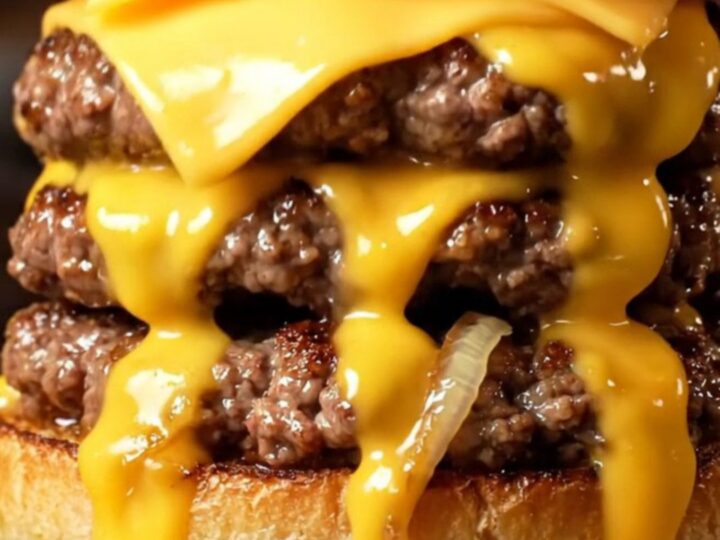
Oklahoma Onion Smash Burger with Crispy Lace Edges
- Prep
- Cook
- Total
- Serves
- 1
A great smash burger is all about the edges — thin, frilly, deeply browned beef lace that snaps when you bite it. This Oklahoma-style version goes one better: paper-thin onions are smashed right into the patty so they char and caramelize against the hot steel, turning sweet and crisp at the same time. Two four-ounce chuck balls, two slices of American cheese and a buttered potato bun. Twenty minutes, one griddle, no shortcuts worth taking.
The Oklahoma onion burger is a Depression-era classic that stretched cheap beef with piles of onion, and the technique still produces one of the best burgers anywhere. The trick is sequencing: the onions go on top of the beef balls before the smash, so the press drives them into direct contact with the meat and the griddle at the same time.
At 450°F (230°C), the onion sugars brown in about two minutes while the beef beneath forms a thin, crackling crust. A slice of American cheese melts over each patty, the potato bun gets steam-toasted and brushed with melted butter, and a spoonful of burger sauce ties the whole stack together. Everything happens on one cooking surface, in roughly ten minutes of actual heat.
Ingredients
- 8 oz 80/20 ground beef, shaped into two 4-ounce balls
- 1 cup yellow onion, sliced paper-thin on a mandoline
- 2 slices yellow American cheese
- 1 potato bun, split
- Unsalted butter, melted, to taste, for brushing the top bun
- 2 tbsp burger sauce, store-bought or made ahead
Why this recipe works
Smashing works because contact, not heat alone, builds flavor. When a ball of 80/20 ground beef is pressed thin against screaming-hot steel, every strand of meat touches the metal at once, and the Maillard reaction races across the full surface instead of creeping inward.
The patty stays thin enough that it cooks through in about three minutes total, so the interior remains juicy while the outside develops those frilly, crisped edges that are the whole point of a smash burger.
Adding the onions before the smash is what makes this an Oklahoma burger. Pressing the slices into the raw beef traps them against the griddle, where their moisture flashes off and their sugars caramelize directly into the crust.
They char slightly at the edges, soften where they touch the meat, and season every bite. The potato bun, steam-toasted and buttered, is soft enough to compress around the stack but sturdy enough to hold the sauce without falling apart.
Notes and substitutions
Choose 80/20 ground beef — the fat renders onto the griddle and fries the onion edges, so no oil is needed and none should be added. Slice the onion on a mandoline at about 1/16 inch; a knife works if the slices are consistently thin, but thick rings will stay raw and watery. Yellow American cheese is the melting standard here; it turns completely glossy in seconds. The burger sauce can be store-bought or made ahead, since it only gets spread on at the end.
Equipment is simple but specific. A cast-iron griddle or a heavy cast-iron skillet holds the 450°F (230°C) temperature that a thin nonstick pan cannot, and a heavy cast-iron press gives the flat, even smash a spatula alone struggles to deliver.
A stiff metal spatula is essential for scraping the crust off the steel in one motion at the flip. An instant-read thermometer takes the guesswork out of the doneness check, and a pastry brush makes the buttered top bun quick and even.
- 80/20 ground beef: Any 80/20 ground beef works; the fat ratio matters more than the cut, since it renders into the griddle and fries the onion edges.
- potato bun: A soft brioche bun holds up just as well; toast it the same way so it stays sturdy under the saucy patties.
- yellow American cheese: White American cheese melts identically and tastes nearly the same; avoid aged cheddar, which does not melt as smoothly.
- cast-iron press: Press with a heavy flat spatula and push down through a folded kitchen towel, or use the bottom of a small heavy skillet.
Equipment
- Cast-iron griddle or heavy cast-iron skillet
- Heavy cast-iron press or sturdy flat spatula
- Mandoline
- Stiff metal spatula
- Instant-read thermometer
- Pastry brush
Up next · Part 2 of 3
8 steps · 10 min of cooking · what to look for at each stage
Step-by-step instructions (Part 2)