Dinner · Part 2 of 3: Instructions
Nashville Hot Chicken Street Tacos with Crunchy Slaw Step-by-step instructions
- Prep
- Cook
- Total
- Serves
- 4
Before you start
Before the oil goes on the stove, set up the whole line. Put the tenders into their buttermilk marinade first so they gain seasoning time while everything else comes together — they need at least 20 minutes in the refrigerator, and they can stay there up to overnight.
Shred the purple cabbage and toss the slaw, then chill it so the flavors settle and the cabbage softens slightly. Whisk the flour, cornstarch, salt, pepper and garlic powder into a shaggy dredge.
Ingredients at a glance (19)
- 1 lb chicken tenders
- 1 cup buttermilk
- 1 tsp kosher salt
- 1 1/2 cups all-purpose flour
- 1 tbsp cornstarch
- 1 tsp kosher salt
- 1 tsp coarsely ground black pepper
- 1 tsp garlic powder
- 4 cups neutral frying oil, such as peanut or canola
- 1/3 cup hot fryer oil, ladled from the pot
- 2 tbsp cayenne pepper
- 1 tbsp brown sugar
- 8 small flour tortillas, charred
- 4 cups shredded purple cabbage
- 1/2 cup mayonnaise
- 1 tbsp apple cider vinegar
- 1/4 tsp kosher salt
- Crinkle-cut dill pickles, for serving
- Ranch dressing, for serving
Instructions
Marinate, slaw, dredge
- Soak the tenders in buttermilkPlace the chicken tenders in a bowl and pour the buttermilk over them, tossing so every piece is coated. Stir in the kosher salt. Cover and refrigerate for at least 20 minutes while the slaw and glaze are prepared, or up to overnight for deeper seasoning.Look for Every tender sits fully coated in thick white buttermilk with no dry spots.Tip Keep the chicken in the refrigerator the whole time; only the last 30 minutes before frying should it sit out.
- Toss the creamy cabbage slawShred the purple cabbage as finely as practical and place it in a large bowl. Add the mayonnaise, apple cider vinegar and salt, then toss until every shred is glossy and coated. Taste and adjust salt, then refrigerate so the cabbage softens slightly and the flavors settle.Look for The slaw turns a vivid magenta, moist but not pooling with dressing.Tip Salting the slaw now draws out a little moisture, so it stays creamy rather than watery on the taco.
- Build the seasoned dredgeIn a wide, shallow dish, whisk the all-purpose flour with the cornstarch, salt, black pepper and garlic powder. Drizzle 2 tablespoons of the buttermilk marinade over the flour and rub it in with your fingertips to create small, shaggy clumps — those clumps become the craggly crust.Look for The seasoned flour holds visible pebble-sized clumps when squeezed.Tip The cornstarch is the crunch insurance; it keeps the crust crisp even under the wet glaze.
At the end of this phase the kitchen line is fully set. The tenders have soaked in buttermilk long enough that the surface feels plump and seasoned, and they go back into the refrigerator until frying.
The slaw is a vivid magenta, every shred glossy with dressing but not pooling at the bottom of the bowl, and it tastes balanced — creamy, tangy, lightly salted. The dredge holds visible pebble-sized clumps when squeezed in a fist, thanks to the cornstarch and the splash of marinade rubbed in by hand.
Fry and glaze hot
- Heat the oil to 360°FPour the frying oil into a Dutch oven to a depth of about 1 1/2 inches and set it over medium-high heat. Bring it to 360°F, checking with an instant-read or deep-fry thermometer. Adjust the flame to hold that temperature steady before anything goes in.Look for The oil shimmers and a pinch of flour dropped in fizzes instantly and floats.Tip A cube of bread browns in about 40 seconds at 360°F if no thermometer is available.
- Dredge the tenders thickLift one tender from the buttermilk, let the excess drip off, then press it hard into the seasoned flour, turning to coat every side. Squeeze gently so clumps of flour adhere, then shake off the loose excess. Dredge all the tenders before frying begins.Look for Each tender wears a thick, uneven, craggy coat with no wet patches showing.Tip Press the flour in twice — back into the marinade briefly, then into flour again — for an extra-heavy crust.
- Fry until golden and cooked throughLower three or four tenders into the 360°F oil, never crowding the pot. Fry for about 4 minutes, turning once, until deeply golden and craggly. Check the thickest piece with an instant-read thermometer: it must reach 165°F (74°C) at the center. Transfer to the wire rack and repeat with the rest.Look for The breading crackles audibly, deep golden brown, with steady bubbles around each piece.Safe temperature 165°F (74°C) internal temperature (poultry)Tip Let the oil come back to 360°F between batches so the crust stays crisp instead of turning greasy.
- Whisk the cayenne glazeCarefully ladle 1/3 cup of the hot frying oil into a heatproof bowl. Add the cayenne pepper and brown sugar and whisk for about 30 seconds until the sugar dissolves and the glaze turns a brilliant red and glossy. It will smell toasted, bright and sharply spicy.Look for The glaze flows like warm syrup, deep red, with the sugar fully dissolved.Tip Whisk again just before brushing so the cayenne stays suspended instead of settling.
- Brush the glaze on hotWhile the fried tenders are still hot from the rack, brush them generously on all sides with the cayenne glaze, using every drop. The hot breading drinks the spiced oil in, turning the crust a glistening orange-red. Add a second coat for the boldest heat.Look for The crust glistens wet-red and drips slowly when lifted.Tip Brush while the chicken is hot; on cold breading the glaze sits on top instead of soaking in.
This phase ends with the signature moment. The tenders come out of the 360°F oil deep golden, blistered and craggly, draining on the wire rack with an audible crackle when tapped with tongs, and the thickest piece reads 165°F (74°C) inside.
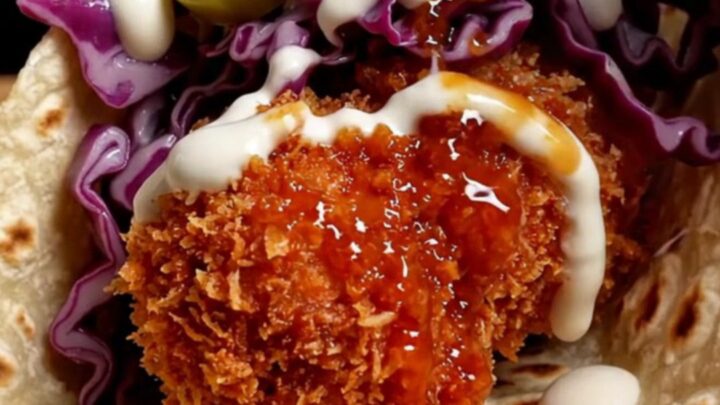
The glaze in the heatproof bowl is a brilliant, glossy red — the cayenne fully bloomed, the brown sugar dissolved, no graininess at the bottom. Brushed on hot, it soaks into the crust, which turns wet-looking orange-red and drips in slow threads.
Char and assemble
- Char the tortillasSet a dry skillet or the tortillas directly over a medium flame and warm each flour tortilla for about 20 seconds per side, until blistered with dark spots and pliable. Stack them under a clean towel so they stay soft and steaming until assembly.Look for Dark freckles blister across each tortilla and it folds without cracking.Tip A damp towel over the stack keeps the charred tortillas pliable for several minutes.
- Build and drizzle the tacosNestle a glazed tender into each charred tortilla. Pile on the creamy purple cabbage slaw, tuck in crinkle-cut dill pickles, then drizzle ranch dressing over the top. Serve immediately, while the crust still crackles against the cool slaw.Look for Each taco drips a thread of red glaze and the first bite crunches loudly.Tip Two tenders per tortilla makes a heartier taco; one keeps it neat and street-style.
The final phase is fast, so have everything within arm's reach. The tortillas come off the heat pliable and freckled with dark blisters, folding cleanly without cracking, and stacked under a towel they stay soft and steaming. Each taco gets a glazed tender, a generous pile of creamy purple slaw, crinkle-cut pickle slices and a cool white ribbon of ranch across the top.
Common mistakes
The most common failure is frying too cool: below 340°F the dredge drinks oil and goes soft, so wait for a steady 360°F and fry in small batches. Crowding the pot drops the temperature and glues the pieces together — three or four tenders at a time, no more. Skipping the thermometer for the chicken is the second mistake; color is not a safe guide, and the thickest tender needs to hit 165°F (74°C) inside.
How to tell it’s done
Two readings tell the story. First, the oil: hold it at 360°F throughout, lowering the heat after each batch goes in, because a falling temperature means a greasy crust and a rising one means dark breading around raw centers.
Second, the chicken: after about four minutes the tenders should be deep golden and audibly crackly, and the thickest piece must register 165°F (74°C) at its center on an instant-read thermometer. The crust should look blistered and craggy, with clumps fried hard.
- Poultry: 165°F (74°C) in the thickest part
Up next · Part 3 of 3
4 variations · storage & make-ahead · 5 answers · printable card
Tips, FAQ & printable recipe (Part 3)← Back to the ingredients (Part 1)