Dinner · Part 2 of 3: Instructions
Montreal Duck-Fat Poutine with Bone-Marrow Gravy Step-by-step instructions
- Prep
- Cook
- Total
- Serves
- 4
Before you start
Before any heat goes on, get the mise in order. Peel the Russets and cut them into 1 cm batons, dropping each into cold water as it is cut.
Measure the duck fat, flour, butter, stock, Worcestershire and cracked pepper, and pull the cheese curds out of the refrigerator so they come to room temperature — this genuinely changes how they behave under the gravy. Set up a draining station: a rimmed baking sheet with a wire rack on top, paper towels within reach, and a spider for lifting fries.
Ingredients at a glance (9)
- 1 3/4 lb Russet potatoes, cut into 1 cm batons
- 1 1/2 cups duck fat, for frying
- 8 cups cold water, for blanching the potatoes
- 3 tbsp unsalted butter
- 1/4 cup all-purpose flour
- 2 cups beef-and-veal stock
- 1 tsp cracked black peppercorns
- 2 tsp Worcestershire sauce
- 8 oz white cheddar cheese curds, at room temperature
Instructions
Phase 1 — The Peppercorn Gravy
- Build the dark rouxMelt the butter in a saucepan over medium heat. Whisk in the flour and keep it moving for 4 to 5 minutes, until it turns deep brown and smells toasty, like toasted hazelnuts. This color is the backbone of the gravy — pale roux tastes raw, so be patient and let it darken slowly without burning.Look for The roux should be the color of dark caramel with a nutty, toasted aroma.Tip If dark specks appear, start over — burnt roux cannot be saved.
- Simmer the peppercorn gravyPour in the beef-and-veal stock a little at a time, whisking hard after each addition so no lumps form. Add the cracked black peppercorns and Worcestershire sauce, then simmer gently for 10 to 15 minutes, stirring now and then, until the gravy coats the back of a spoon, reads glossy and dark brown, and registers at least 145°F (63°C). Let it rest off the heat for at least 3 minutes before holding it warm.Look for A spoon dipped in the gravy should come out evenly coated, not watery.Safe temperature 145°F (63°C) internal temperature (steaks, chops and roasts)Tip Whisk once more before holding; a resting gravy settles as it sits.
- Hold the gravy warmLower the heat to its minimum and cover the pan. The gravy should stay hot, around 200°F, while the fries cook — hot enough to soften the curds on contact but not boiling, which would thin it back out and dull the flavor.Look for Steam should rise lazily from the surface, with no bubbling.Tip Give it a stir every few minutes so a skin never forms on top.
At the end of this phase the gravy should be deep, glossy brown and smooth, with no lumps anywhere in it — the slow whisking of stock into the dark roux guarantees that. It should coat a spoon evenly and hold the line a finger draws across it for a second before closing.
The aroma is toasted, savory and sharply peppery, with a faint tang from the Worcestershire underneath. Check the consistency before moving on: if it reads thin and watery, simmer it 5 more minutes uncovered; if it has gone past coat-the-spoon into paste, whisk in a splash of stock.
Phase 2 — Triple-Cooked Duck-Fat Fries
- Cut the potato batonsPeel the Russet potatoes and cut them into batons about 1 cm thick, keeping every piece the same size so they cook evenly. Drop them into a bowl of cold water as each one is cut to rinse off surface starch, which is what makes fries clump and go limp later.Look for Each baton should look square-sided and roughly finger-thick.Tip A mandoline with a thick blade setting speeds this up safely.
- Blanch and dry thoroughlyBring a pot of water to a boil, add the batons, and blanch for 5 minutes until the edges look just tender. Drain well, spread them on a rack, and pat every piece completely dry with towels. Any surface water left now will splatter violently when the potatoes hit hot fat.Look for The batons should bend slightly without snapping in half.Tip Air-dry 10 minutes on the rack after patting for extra insurance.
- Par-fry at 300°FHeat the duck fat in a deep saucepan to 300°F. Fry the dried batons in batches for 6 to 8 minutes, until they look pale, blistered and floppy but take on no color. Lift them out with a spider and spread them on the rack to cool and rest for 10 minutes.Look for Pale, wrinkled fries with no browning whatsoever at this stage.Tip Let the fat return to 300°F between batches for even cooking.
- Rest the par-fried friesLet the par-fried fries sit at room temperature for 10 minutes while the fat heats toward the finishing temperature. This pause lets steam escape from the centers and sets up the crust, so the second fry turns them glass-crisp instead of just golden.Look for The surface should feel dry and slightly tacky, not moist.Tip Do not stack them; trapped steam softens the crust you just built.
This phase ends with pale, blistered, fully cooked fries resting on a rack, and the check matters as much as the cooking. After the blanch, the batons should bend slightly without snapping — if they break clean, they went too far; if they stay rigid, give them another minute or two. After the par-fry at 300°F they should look wrinkled and floppy with absolutely no golden color; color now means the fat was too hot. After the 10-minute rest, the surfaces should feel dry and faintly tacky.
Phase 3 — Assembly and the Gravy Pour
- Crisp at 385°FRaise the duck fat to 385°F (196°C). Fry the rested batons for about 3 minutes, in batches, until deep golden and glass-crisp, rattling against the spider. Transfer them straight to the rack the moment each batch leaves the fat so the crust stays hard and hot for assembly.Look for A sharp rattle when stirred and a deep, even golden color.Tip Watch closely past 2 minutes — the jump from golden to dark is fast.
- Pile the skilletTransfer the hot fries to a cast-iron skillet and scatter the room-temperature cheese curds evenly over the top. Piling them while everything is hot is what makes the curds soften on their edges and turn stretchy, while their centers keep that signature squeak.Look for Curds should sit in an even layer, not buried in one corner.Tip Room-temperature curds melt more readily than cold ones.
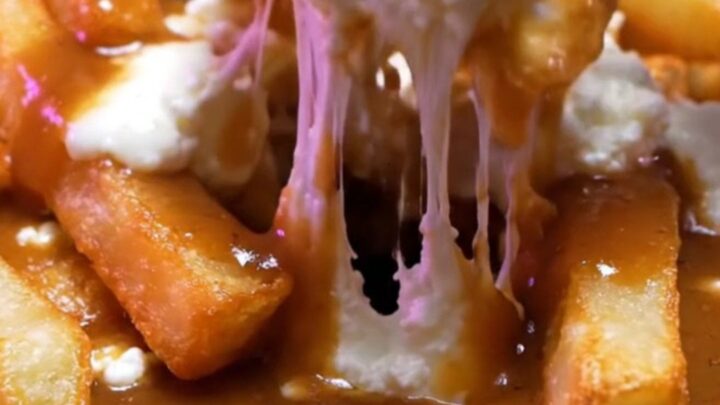
- Flood with hot gravy and serveBring the skillet to the table and pour the hot gravy over everything in a slow, steady stream so it soaks between the fries and melts the curds. Serve immediately with forks — poutine waits for no one, and the contrast of crisp fries and soft curds fades fast.Look for Curds should soften at the edges within seconds of the pour.Tip Set extra warm gravy on the table for anyone who wants more.
The finish is fast and loud. In 385°F (196°C) fat, the rested batons go glass-crisp in about 3 minutes — deep, even golden, rattling against the spider when stirred. Move them straight to the rack.
Pile them into the hot cast-iron skillet, scatter the room-temperature curds over top, and pour the gravy in a slow stream at the table. Within seconds the curds should soften at their edges and turn stretchy while their centers keep the squeak, and the fries underneath should still crackle when the fork finds them.
Common mistakes
The most common failure is rushing the roux: pulled at pale beige, it tastes starchy and raw, and the whole gravy suffers for it. Give it the full 4 to 5 minutes and let it go deep brown.
The second trap is wet potatoes meeting hot fat — even a little surface water causes violent splattering and a soggy crust, so pat the blanched batons thoroughly dry. Skipping the 10-minute rest after par-frying is another quiet killer: without it, steam stays trapped inside and the finish fry puffs unevenly.
How to tell it’s done
The gravy is done when it coats the back of a spoon in an even, glossy film and a finger drawn across leaves a clean trail; it should be deep brown, distinctly peppery, and just thick enough to cling without sliding off instantly. The fries are done when the second fry leaves them deep golden, audibly crisp, and light for their size — a finished fry should rattle when stirred and sound hollow when tapped against the spider.
- Steaks, chops and roasts: 145°F (63°C) in the thickest part, then a 3-minute rest
Up next · Part 3 of 3
4 variations · storage & make-ahead · 5 answers · printable card
Tips, FAQ & printable recipe (Part 3)← Back to the ingredients (Part 1)