Desserts · Part 2 of 3: Instructions
Molten Dark Chocolate Espresso Basque Cheesecake Step-by-step instructions
- Prep
- Cook
- Total
- Serves
- 10
Before you start
Before starting, take the cream cheese and eggs out of the refrigerator to bring them to room temperature. This ensures a smooth, lump-free batter.
Preheat the oven to 450°F (230°C) and line a 9-inch springform pan with parchment paper, pressing it into the corners and letting the edges overhang. Chop the dark chocolate and brew a small amount of espresso. Have all ingredients measured and ready, as the batter comes together quickly.
Ingredients at a glance (7)
- 250 g 70% dark chocolate, chopped
- 30 ml hot espresso
- 650 g cream cheese, at room temperature
- 200 g granulated sugar
- 4 large eggs, at room temperature
- 300 ml heavy cream
- Flaky sea salt, for sprinkling, to taste
Instructions
Melt and Mix
- Prepare the Pan and Melt ChocolateHeat the oven to 450°F (230°C). Line a 9-inch springform pan with a large sheet of parchment paper, pressing it into the corners and letting the edges overhang. Place the chopped dark chocolate in a heatproof bowl. Pour the hot espresso over the chocolate and let stand for 1 minute, then stir until smooth and glossy. If needed, melt gently over a double boiler, stirring constantly.Look for The chocolate should be completely melted and smooth, with no lumps.Tip Ensure the espresso is very hot to melt the chocolate without extra heat. Stir slowly to keep the chocolate silky.
- Make the Cream Cheese BatterIn a large bowl, beat the cream cheese and sugar together until smooth and creamy, scraping down the sides as needed. Add the eggs one at a time, beating well after each addition. With the mixer on low, gradually pour in the heavy cream and the melted chocolate-espresso mixture, mixing just until combined. Do not overmix.Look for The batter should be smooth and homogeneous, with no streaks of cream cheese or chocolate.Tip Room-temperature ingredients blend more easily and create a silkier texture. Overmixing can incorporate too much air, causing cracks.
The chocolate and espresso mixture should be smooth and glossy. When combined with the cream cheese, sugar, eggs, and cream, the batter should be silky and uniform, with no streaks. The batter will be thick but pourable. Take a moment to scrape the bottom and sides of the bowl to ensure everything is fully incorporated. The mixture should smell intensely of chocolate and coffee.
Bake and Set
- Bake at High HeatPour the batter into the prepared pan. Smooth the top with a spatula. Bake in the preheated oven for 25 minutes, until the edges are puffed and deeply browned, and the center is still set but slightly wobbly when the pan is gently shaken. The center should remain molten.Look for The edges will be tall and dark, while the center will look slightly underdone and jiggle softly.Safe temperature 160°F (71°C) internal temperature (egg dishes)Tip Do not overbake; the center should remain soft to achieve the molten fudge effect. Use a timer and trust the visual cues.
After 25 minutes in the oven, the cheesecake will be dramatically puffed, with a deeply caramelized, crackled top. The center will jiggle slightly when the pan is shaken.
The kitchen will be filled with the aroma of toasted sugar and chocolate. Let it cool for 15 minutes; the center will sink slightly, creating a dramatic molten pool. The internal temperature should be at least 160°F (71°C).
Finish and Serve
- Cool and SetRemove the cheesecake from the oven and let it cool in the pan on a wire rack for 15 minutes. The residual heat will continue to set the edges while the center stays molten. After cooling, carefully lift the cheesecake out using the parchment paper. Transfer to a serving plate.Look for The cheesecake will be slightly puffed and crackled on top; the center will settle as it cools.Tip Allow the cheesecake to cool completely before slicing if you prefer a firmer texture, but for the molten effect, serve warm.
- Finish and ServeSprinkle the flaky sea salt over the top of the cheesecake. Slice with a sharp knife, wiping the blade between cuts for clean edges. Serve warm to showcase the liquid fudge center, or at room temperature for a slightly firmer texture.Look for The sea salt adds a crunchy, salty contrast to the bittersweet chocolate.Tip For the most dramatic presentation, slice while the center is still warm and molten.
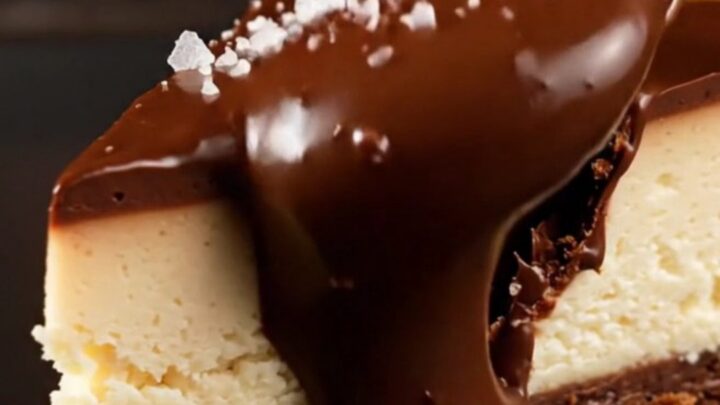
The cheesecake should be cool enough to handle but still warm in the center. The top will be crackled and rustic, with the parchment paper peeling away to reveal the dark, almost burnt crust. When sliced, the molten fudge center should flow out slowly. The flaky sea salt adds a final crunchy, salty contrast. Serve warm for the full effect.
Common mistakes
The most common mistake is overbaking the cheesecake, which results in a firm, dry center instead of a molten one. Trust the visual cues: the edges should be high and dark, while the center should look slightly underdone.
Another mistake is overmixing the batter, which incorporates too much air and can cause cracks. Mix just until combined. Also, be sure to use room-temperature ingredients; cold cream cheese creates lumps that won't smooth out.
How to tell it’s done
The cheesecake is done when the edges are puffed and deeply browned, and the center is set but still slightly wobbly when the pan is gently shaken. The internal temperature of the center should reach at least 160°F (71°C) to ensure the eggs are safe to eat.
If using a thermometer, insert it into the center; it should read 160°F (71°C) or higher. The center will continue to set as it cools, but for the molten effect, it should remain soft and liquid.
- Egg dishes: 160°F (71°C) in the thickest part
Up next · Part 3 of 3
4 variations · storage & make-ahead · 5 answers · printable card
Tips, FAQ & printable recipe (Part 3)← Back to the ingredients (Part 1)