Desserts · Part 2 of 3: Instructions
Creamy Burnt Basque Cheesecake with Molten Center Step-by-step instructions
- Prep
- Cook
- Total
- Serves
- 12
Before you start
Before starting, take the cream cheese out of the refrigerator and let it soften at room temperature for about 30 minutes. This ensures a smooth, lump-free batter. Preheat the oven to 425°F (220°C) and position a rack in the center.
Line a 9-inch springform pan with two large sheets of parchment paper, crumpling them first to create wrinkles. The paper should extend at least 2 inches above the rim of the pan. Gather all ingredients and equipment so everything is within reach.
Ingredients at a glance (4)
- 2 lb cream cheese, softened
- 1 1/2 cups caster sugar
- 5 large eggs
- 2 cups heavy cream
Instructions
Phase 1: Prepare the Batter
- Prepare the BatterHeat the oven to 425°F (220°C). Line a 9-inch springform pan with two large sheets of parchment paper, crumpling them first so they wrinkle and extend above the rim. In a stand mixer with the paddle attachment, beat the softened cream cheese and caster sugar on medium speed until smooth and glossy, about 2 minutes. Add the eggs one at a time, beating well after each addition. With the mixer on low, slowly pour in the heavy cream and mix just until combined into a satin ribbon.Look for The batter looks smooth, glossy, and forms a ribbon when the paddle is lifted.Tip Make sure the cream cheese is truly softened to avoid lumps. Scrape the bowl often.
At the end of this phase, the batter should be smooth, glossy, and have a satin ribbon consistency when the paddle is lifted. The cream cheese and sugar should be fully incorporated with no lumps.
The eggs and cream should be evenly distributed, creating a uniform pale yellow mixture. The batter should be pourable but thick enough to hold its shape briefly. If the batter looks curdled or grainy, continue beating on low speed until smooth.
Phase 2: Bake Until Caramelized
- Bake Until CaramelizedPour the batter into the prepared parchment-lined pan. Smooth the top gently with a spatula. Place the pan on a baking sheet and transfer to the oven. Bake for 28 minutes, until the top is deeply caramelized to a dark amber color and the edges are set while the center still trembles slightly. The cheesecake will puff up like a soufflé during baking and may crack—this is expected and desirable.Look for The top is dark amber, the edges are set, and the center has a gentle wobble.Safe temperature 160°F (71°C) internal temperature (egg dishes)Tip Do not open the oven during baking. The high heat creates the signature burnt top.
After 28 minutes, the top of the cheesecake should be deeply caramelized to a dark amber color, with some areas possibly darker. The edges will be set and slightly puffed, while the center will still wobble gently when the pan is tapped. The aroma will be rich and toasty, with notes of caramelized sugar and cream. The cheesecake may have cracks on the surface—this is normal and desirable for a Basque cheesecake.
Phase 3: Cool and Serve
- Cool and ServeRemove the cheesecake from the oven and let it cool in the pan on a wire rack for at least 1 hour. The center will continue to set as it cools, but it will remain creamy and soft. Once cool, carefully lift the cheesecake out of the pan using the parchment paper. Slice with a sharp knife, wiping the blade between cuts for clean pieces. Serve warm or at room temperature.Look for The cheesecake is set around the edges, creamy in the center, and slices cleanly.Tip For the cleanest slices, dip the knife in hot water and wipe it dry before each cut.
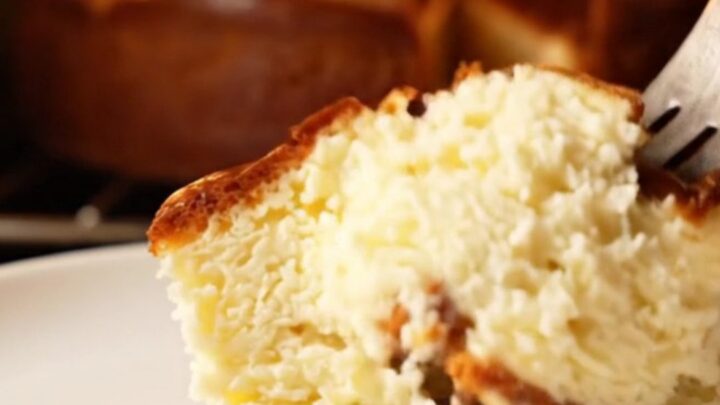
After cooling for at least 1 hour, the cheesecake should be set around the edges but still soft and creamy in the center. The top will have settled slightly, and the parchment paper will be easy to peel away. When sliced, the interior should be pale, smooth, and creamy, with a texture similar to a soft custard. The cheesecake should hold its shape when cut but yield easily to a fork.
Common mistakes
One common mistake is overmixing the batter, which incorporates too much air and can cause the cheesecake to crack excessively. Mix just until the ingredients are combined and the batter is smooth.
Another mistake is opening the oven door during baking, which lets out heat and disrupts the caramelization process. Trust the baking time and resist the urge to peek. Finally, do not skip the parchment paper—it is crucial for creating the rustic look and for easy removal.
How to tell it’s done
The cheesecake is done when the top is deeply caramelized to a dark amber color, and the edges are set while the center still has a gentle wobble. The internal temperature of the cheesecake should reach at least 160°F (71°C) in the center to ensure the eggs are fully cooked.
If using an instant-read thermometer, insert it into the center of the cheesecake; it should read 160°F (71°C) or higher. The cheesecake will continue to set as it cools, so do not overbake.
- Egg dishes: 160°F (71°C) in the thickest part
Up next · Part 3 of 3
4 variations · storage & make-ahead · 5 answers · printable card
Tips, FAQ & printable recipe (Part 3)← Back to the ingredients (Part 1)