Desserts · Part 2 of 3: Instructions
Moistest Turkish Wet Chocolate Cake with Hot Fudge Sauce Step-by-step instructions
- Prep
- Cook
- Total
- Serves
- 12
Before you start
Preheat the oven to 350°F (175°C). Butter a 9x13-inch glass baking dish. Gather all ingredients. Ensure the eggs are at room temperature for better volume when whipping.
Measure out the flour and baking powder, and have the milk, oil, and cocoa ready. For the sauce, measure the milk, sugar, cocoa, and butter into a saucepan. Prepare the wooden skewer and have the chocolate pearls ready for the final topping.
Ingredients at a glance (12)
- 4 large eggs
- 1 cup granulated sugar
- 1 cup whole milk
- 1 cup vegetable oil
- 3 tbsp dark cocoa powder
- 2 cups all-purpose flour
- 1 tbsp baking powder
- 2 cups whole milk
- 1/2 cup granulated sugar
- 3 tbsp dark cocoa powder
- 2 tbsp unsalted butter
- 1/2 cup crispy chocolate pearls
Instructions
Batter and Bake
- Make the Cake BatterPreheat the oven to 350°F (175°C). In a large bowl, whip the eggs with the sugar until pale and thick. Whisk in the milk, oil, and cocoa powder until smooth. Add the flour and baking powder, and whisk until the batter is silky and free of lumps.Look for The batter should be smooth and slightly runny, with no flour streaks.Tip Whisk vigorously for a minute to ensure the eggs are well aerated.
- Bake the CakePour the batter into a buttered glass baking dish. Bake at 350°F (175°C) for 25 minutes, or until a toothpick inserted in the center comes out with a few moist crumbs. Remove from the oven and let cool for 5 minutes.Look for The cake should be set and spring back when lightly pressed.Safe temperature 160°F (71°C) internal temperature (egg dishes)Tip Do not overbake; the cake should remain moist.
The batter should be silky and smooth, with a slightly thick but pourable consistency. After baking, the cake should be risen, golden on the edges, and fragrant with chocolate. A toothpick inserted should come out with a few moist crumbs, not wet batter. The cake will be slightly puffed and spring back when touched.
Soak and Glaze
- Poke Deep HolesWhile the cake is still warm, use a wooden skewer to poke dozens of deep holes across the entire surface. These holes allow the fudge sauce to soak deep into the sponge.Look for The cake should be riddled with holes, but not falling apart.Tip Poke all the way to the bottom for maximum soaking.
- Simmer the Fudge SauceIn a saucepan, combine the milk, sugar, cocoa powder, and butter. Bring to a simmer over medium heat, stirring constantly, until the sugar dissolves and the sauce thickens slightly, about 5 minutes.Look for The sauce should be smooth, glossy, and slightly thickened.Tip Stir frequently to prevent scorching on the bottom.
The fudge sauce should be smooth, glossy, and slightly thickened, with a rich chocolate aroma. When poured over the cake, it should sizzle gently and be absorbed quickly.
After 10 minutes, the top should look wet and shiny, with the sauce fully soaked into the sponge. The cake will have darkened and become more dense.
Finish and Serve
- Soak the CakePour the steaming hot fudge sauce evenly over the warm cake, making sure to fill every hole. Let the cake absorb the sauce for at least 10 minutes, until the top looks glossy and wet.Look for The sauce should be fully absorbed, leaving a moist, fudgy surface.Tip Use a spatula to spread the sauce into any dry spots.
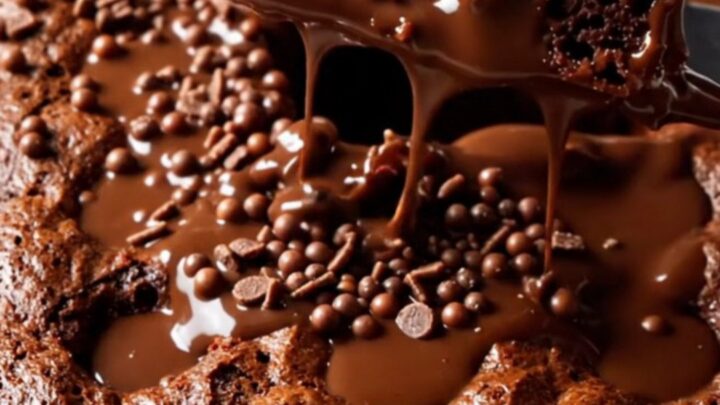
- Top and ServeSprinkle the crispy chocolate pearls generously over the top. Cut into squares and lift out with a spatula, showing the deeply soaked sponge. Serve warm or at room temperature.Look for The cake should be dark, glossy, and glistening with chocolate.Tip For extra indulgence, serve with a scoop of vanilla ice cream.
The cake should be deeply chocolatey, moist, and glistening. The chocolate pearls add a contrasting crunch. When cut, the interior should be uniformly dark and fudgy, with no dry spots. The cake should hold its shape when lifted but be tender enough to cut with a fork.
Common mistakes
One common mistake is overbaking the cake, which results in a dry sponge that won't absorb the sauce well. Another is not poking enough holes—be generous to allow the sauce to penetrate deeply.
Pouring the sauce too slowly can cause it to pool on top instead of being absorbed; pour it evenly and quickly. Also, avoid using a metal pan, which can over-brown the cake; glass is preferable for even baking.
How to tell it’s done
The cake is done when a toothpick inserted into the center comes out with a few moist crumbs, and the top springs back when lightly pressed. The internal temperature should reach 160°F (71°C) to ensure the eggs are fully cooked.
The sauce is ready when it has thickened slightly and coats the back of a spoon. After soaking, the cake should look glossy and wet, with no dry patches on the surface.
- Egg dishes: 160°F (71°C) in the thickest part
Up next · Part 3 of 3
4 variations · storage & make-ahead · 5 answers · printable card
Tips, FAQ & printable recipe (Part 3)← Back to the ingredients (Part 1)