Breakfast · Part 2 of 3: Instructions
Korean Flat Smash Croissant: Crispy Caramelized in 10 Minutes Step-by-step instructions
- Prep
- Cook
- Total
- Serves
- 1
Before you start
Everything comes together fast once the pan is hot, so set up before turning on the heat. Soften the butter until it spreads without tearing the pastry, measure the cane sugar onto a plate wide enough for pressing, and have the honey and flaky salt staged beside the serving plate.
Slice the croissant just before cooking so the layers stay crisp, and check that the press or second skillet is completely flat and clean. A serrated knife and an offset spatula make the two trickiest moments, slicing and flipping, much easier.
Ingredients at a glance (5)
- 1 large butter croissant, fresh and flaky
- 2 tbsp salted butter, softened
- 3 tbsp raw cane sugar
- Wildflower honey, for serving
- Flaky sea salt, to taste
Instructions
Slice, butter and coat
- Halve the croissantSet the croissant on a cutting board and slice it horizontally through the middle with a serrated knife, using a gentle sawing motion so the flaky layers stay intact. Aim for two even halves of similar thickness, since uneven halves press and caramelize at different rates on the griddle.Look for Two flat, even halves with visible honeycomb crumb inside.Tip Chill the croissant for 10 minutes first if it feels too delicate to slice cleanly.
- Butter both sidesSpread the softened salted butter evenly over the cut side and the outside of each half with a pastry brush, about half a tablespoon per surface. Cover every ridge of the flaky exterior, because the butter carries the sugar and builds the caramelized crust on the outside of the pastry.Look for Each surface glistening evenly, with no dry, pale patches of dough showing.Tip Softened butter spreads without tearing; melted butter soaks in and makes the crust greasy.
- Coat in cane sugarSprinkle the raw cane sugar over a small plate and press each buttered surface firmly into it, turning to coat thickly. Pat the sugar gently so it clings in an even layer; this sugar is what melts and bubbles into the glassy, lacy crust under the press.Look for Both sides of both halves coated in an even, sandy layer of sugar.Tip Coat over the plate to catch stray sugar and return it to the dish.
By the end of this phase both halves sit coated on the plate, cut side and crust side glistening with butter and covered in an even, sandy layer of sugar. No dry patches should show, and the coating should cling when the pastry is tilted.
The skillet should already be shimmering over medium heat at about 350°F (175°C). If the sugar slides off the buttered surface, the butter was applied too thickly; blot lightly and press on more sugar before the halves go to the pan.
Press and caramelize
- Heat the skilletPlace a cast iron skillet or griddle over medium heat and let it preheat for about 3 minutes, until a pinch of sugar or a drop of water dances and evaporates on contact. A properly hot surface starts the caramel within seconds; a cold one lets the butter soak in instead of searing.Look for Faint shimmer on the surface and a light hiss when a water drop lands.Tip Cast iron holds heat best under a heavy press; a lighter pan needs slightly lower heat.
- Press the first sideLay both halves cut side down if cooking two, or work with one half at a time, then set the cast iron press on top. Cook at 350°F (175°C) for 4 minutes, keeping the press in place the whole time so the pastry stays flat and the sugar makes full contact with the hot metal.Look for Deep amber edges and sugar bubbling out around the press like glassy lace.Tip Resist lifting the press early; the crust forms only under steady, even weight.
- Flip and press againSlide an offset spatula under each half and flip carefully, then replace the press. Cook another 4 minutes until the second side matches the first: flat, amber and glassy, with a thin caramel crust that has spread slightly beyond the edges of the pastry. Lower the heat if the sugar darkens too fast.Look for Both faces deep amber and glossy, with bubbling caramel lacing the edges.Tip If the sugar darkens before 4 minutes, reduce the heat and give the second side less time.
This is where the transformation happens. Under steady weight, the halves flatten to roughly half their height and the kitchen fills with a toasty, caramel smell. After four minutes on the first side and four on the second, both faces should be deep amber and glassy, with bubbling caramel lacing the edges.
Lift one corner with the spatula: the crust should release cleanly and feel hard, not sticky. If it bends or the sugar still crunches between the teeth as grains, keep pressing for another minute.
Honey, salt and serve
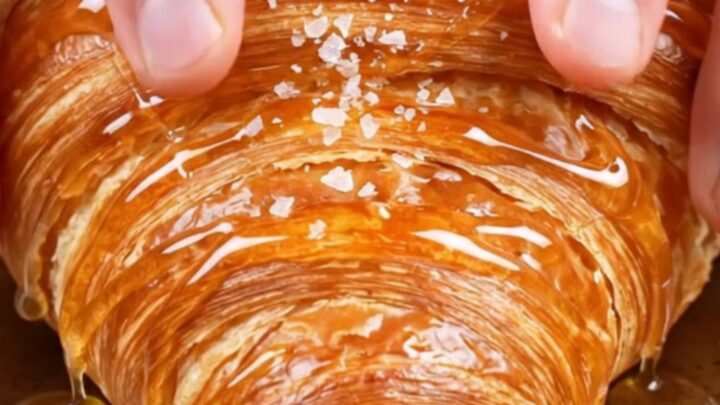
- Drizzle with honeyTransfer the smashed croissant to a plate and let it sit for about 1 minute so the caramel crust firms and stops being stretchy. Drizzle wildflower honey in thin lines across the top; a light hand keeps the crust crisp, since too much honey softens the surface it touches.Look for Thin honey threads catching the light over a firm, glassy crust.Tip Warm the honey for a few seconds if it drizzles in thick ropes.
- Salt, cut and serveFinish with a few flakes of sea salt scattered over the honey, then cut the croissant in half to show the compressed, caramelized interior. Serve immediately while the crust is at its loudest; the snap fades as the pastry sits and picks up moisture from the air.Look for An audible crack when the knife or bite breaks through the crust.Tip Cut with a sharp knife in one firm press rather than sawing, to keep the crust from shattering.
Off the heat, the caramel firms within a minute, turning from stretchy to snappy. The honey goes on in thin threads and the flaky salt in a light scatter, both visible against the amber surface. Cut the croissant in half and the interior should look compressed and layered, moist rather than doughy, with a clean crack through the crust. Serve at once; the signature snap is at its peak in the first few minutes and softens as the pastry sits.
Common mistakes
The most common error is a pan that is not hot enough, which lets the butter soak into the pastry and leaves the sugar undissolved and gritty. The second is lifting the press early to check progress: every peek breaks the contact the crust depends on. Overloading the honey softens the crust within minutes, so drizzle in thin lines only. Finally, cooking both halves crowded together in a small pan drops the temperature and steams the pastry instead of caramelizing it.
How to tell it’s done
The croissant is done when both faces are a deep, even amber and the surface looks glassy rather than sandy, with thin caramel lace extending just past the edges. Tapping the crust with a spatula should produce a dry, hard sound rather than a dull knock.
The pastry should feel noticeably flat and dense, about half its original height. If the sugar still looks granular, give it another minute under the press; if it smells bittersweet rather than toasty, pull it immediately.
Up next · Part 3 of 3
4 variations · storage & make-ahead · 5 answers · printable card
Tips, FAQ & printable recipe (Part 3)← Back to the ingredients (Part 1)