Dinner · Part 2 of 3: Instructions
Japanese Crispy Pork Gyoza with Golden Lace Skirt Step-by-step instructions
- Prep
- Cook
- Total
- Serves
- 4
Before you start
Before you start, set out all the ingredients and equipment. If using fresh cabbage, shred it finely, sprinkle with salt, let sit for 10 minutes, then squeeze out as much liquid as possible. Mince the green onions, ginger, and garlic. Measure the soy sauce and sesame oil.
Have the gyoza wrappers ready and covered with a damp towel to prevent drying. Prepare the flour-water slurry by whisking the flour and water until smooth—this can be done just before cooking. Make sure your skillet and lid are clean and ready to go.
Ingredients at a glance (11)
- 16 gyoza wrappers
- 250 g ground pork
- 1 cup finely shredded cabbage, salted and squeezed
- 2 green onions, minced
- 1 tbsp soy sauce
- 1 tsp sesame oil
- 1 tsp minced ginger
- 1 clove garlic, grated
- 1 tbsp all-purpose flour
- 100 ml water
- gyoza dipping sauce, for serving
Instructions
Prep and Pleat
- Make the FillingIn a mixing bowl, combine the ground pork, squeezed cabbage, minced green onions, soy sauce, sesame oil, minced ginger, and grated garlic. Mix with your hands or a spoon until the mixture is well combined and slightly sticky. The filling should hold together when pressed.Look for The filling is cohesive and aromatic, with the cabbage evenly distributed.Tip Squeeze the cabbage thoroughly after salting to remove excess moisture—this keeps the filling firm and prevents soggy dumplings.
- Pleat the GyozaPlace a gyoza wrapper in the palm of one hand. Add about 1 tablespoon of filling to the center. Moisten the edge of the wrapper with a little water. Fold the wrapper in half and pinch the edges together, creating five neat pleats along one side. Press firmly to seal. Repeat with the remaining wrappers and filling.Look for Each gyoza is a half-moon shape with five tight pleats and no gaps.Tip Keep the pleats small and even. If the wrapper dries out, cover with a damp cloth to prevent cracking.
At this stage, the filling should be well-combined and slightly sticky, with the cabbage evenly distributed. The gyoza are pleated into neat half-moons with five folds each, sealed tightly to prevent leakage during cooking.
The wrappers should be moist but not sticky, and the dumplings should stand upright on their flat bottoms. If any filling is exposed, press the edges to seal. The pleats should be uniform, giving the gyoza a professional appearance.
Sear and Steam
- Pan-Sear the GyozaHeat a large non-stick skillet over medium-high heat and add a little oil. Arrange the gyoza in a circular spiral pattern, starting from the center and working outward, so they touch slightly. Cook undisturbed for 2 minutes, until the bottoms are golden brown and crispy.Look for The bottoms are deep golden and the gyoza release easily from the pan.Tip Don't move the gyoza during searing; this allows a crisp crust to form.
- Steam with the Skirt SlurryIn a small bowl, whisk the flour and water together until the flour is fully dissolved. Pour the slurry evenly over the gyoza in the pan. Immediately cover with a lid and reduce the heat to medium. Steam for 4 minutes, allowing the dumplings to cook through and the liquid to reduce.Look for The pan is steamy, and the slurry is bubbling and starting to thicken.Safe temperature 160°F (71°C) internal temperature (ground meat)Tip Use a lid that fits snugly to trap the steam. Don't peek during steaming—this ensures even cooking.
- Crisp the Lace SkirtRemove the lid and continue cooking over medium heat until all the liquid has evaporated and a thin, golden lace skirt forms around and between the gyoza. This takes about 1 to 2 minutes. The skirt should be crisp and lightly browned, not burnt.Look for The skirt is golden, lacy, and crisp to the touch, with a nutty aroma.Safe temperature 160°F (71°C) internal temperature (ground meat)Tip If the skirt is browning unevenly, rotate the pan gently. Keep a close eye to prevent burning.
The gyoza bottoms are golden brown and crisp after the initial sear. When the slurry is added, the pan sizzles loudly, and steam rises as the lid goes on. After steaming, the gyoza are tender and cooked through, with the slurry reduced to a bubbly, starchy liquid. The pan should smell nutty and savory. The gyoza should be easily released from the pan, and the skirt is beginning to form at the edges.
Crisp and Invert
- Invert and ServePlace a serving platter over the skillet and carefully invert the pan to release the gyoza onto the platter, with the lace skirt on top. The skirt should be intact and shatter-crisp. Serve immediately with gyoza dipping sauce on the side.Look for The gyoza are connected by a golden, paper-thin lace that crackles when broken.Safe temperature 160°F (71°C) internal temperature (ground meat)Tip Invert confidently in one swift motion. If any pieces stick, gently loosen with a spatula first.
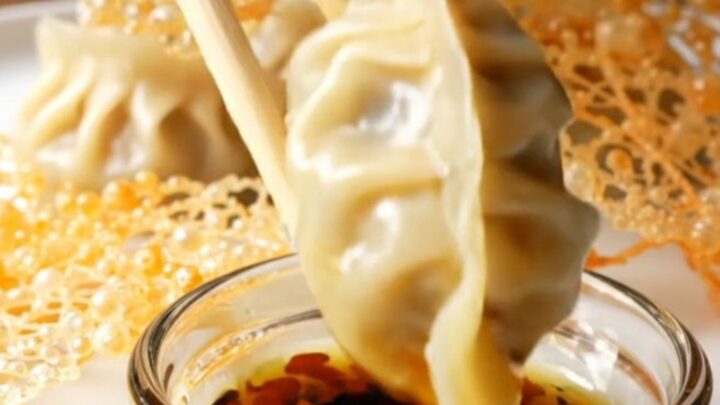
The lace skirt is now fully formed—crisp, golden, and lacy, connecting all the gyoza in a single piece. When you tilt the pan, the skirt holds its shape and crackles. The gyoza are juicy and cooked through, and the skirt shatters when broken. The final presentation is a dramatic, Instagram-worthy platter of dumplings with a delicate, glass-like crust.
Common mistakes
One common mistake is not squeezing the cabbage well enough, which makes the filling watery and causes the gyoza to steam instead of fry. Another is overcrowding the pan—make sure the gyoza fit in a single layer without overlapping.
Also, resist the urge to move the gyoza during the initial sear; they need to stay still to develop a golden crust. When making the skirt, ensure the slurry is well mixed with no lumps, and pour it evenly over the gyoza. Finally, don't skip the resting time after steaming—this allows the skirt to crisp up properly.
How to tell it’s done
The gyoza are done when the filling reaches an internal temperature of 160°F (71°C) as measured with an instant-read thermometer inserted into the center of a dumpling. The bottoms should be deep golden brown and crispy, and the lace skirt should be entirely dry, crisp, and golden—no wet spots should remain.
The wrapper should be tender and slightly translucent, and the filling should be juicy and cooked through. When you invert the pan, the skirt should hold together and crackle when broken.
- Ground meat: 160°F (71°C) in the thickest part
Up next · Part 3 of 3
4 variations · storage & make-ahead · 5 answers · printable card
Tips, FAQ & printable recipe (Part 3)← Back to the ingredients (Part 1)