Desserts · Part 2 of 3: Instructions
Hazelnut Praline Chocolate Cheesecake with Caramel Swirl Step-by-step instructions
- Prep
- Cook
- Total
- Serves
- 12
Before you start
Gather all the ingredients and equipment before you start, so the timing is smooth. Roast or buy whole hazelnuts and chill the milk chocolate block for 10 minutes so it grates cleanly. Let the cream cheese, sour cream and eggs sit at room temperature for at least 1 hour, which helps the filling mix without lumps. Preheat the oven to 325°F (163°C) and set a kettle of water to heat. Line the outside of the springform pan with foil, and set a larger roasting pan nearby. Have a thin knife, a warm towel and a clean board ready for the final cuts.
Ingredients at a glance (13)
- 1 cup whole roasted hazelnuts, finely chopped in coarse pieces and crumbs
- 4 oz milk chocolate bars, broken into chunks
- 2 oz milk chocolate block, for grating into fine curls
- 8 oz graham cracker or biscuit crumbs
- 5 tbsp unsalted butter, melted
- 32 oz cream cheese, softened to room temperature
- 3/4 cup granulated sugar
- 3 large eggs, at room temperature
- 1/2 cup sour cream
- 1 tsp vanilla extract
- 1/2 cup chocolate hazelnut spread
- 1/3 cup heavy cream
- caramel sauce, store-bought or made ahead, for swirling, to taste
Instructions
Chopped praline and crust
- Chop the hazelnutsChop the roasted hazelnuts on a wooden board with a large chef's knife until they form coarse pieces and fine crumbs. Set aside half of the chopped pieces for the topping, and break the milk chocolate bars into chunks beside the nuts.Look for The nuts should be a mix of coarse pieces and fine crumbs, with no whole nuts left.Tip Keep the knife tip on the board and rock the blade for even pieces.
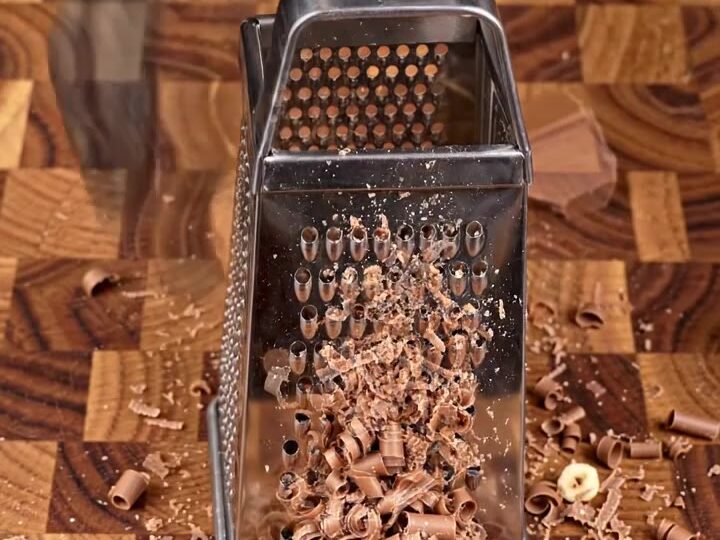
- Grate the chocolate curlsGrate the milk chocolate block over a box grater so that fine curls fall onto the board. Scatter the curls among the halved hazelnuts and set them aside for decorating the top of the cheesecake.Look for Fine, feathery curls should cover the board with no large shavings.Tip Chill the chocolate block for 10 minutes first so it grates cleanly.
- Make the biscuit crustPreheat the oven to 325°F (163°C). Mix the biscuit crumbs with the melted butter and press the mixture firmly over the bottom and 1 inch up the sides of a 9-inch springform pan. Bake for 10 minutes, then cool.Look for The crust should look set, dry at the edges and smell lightly toasted.Tip Press the crumbs with the flat bottom of a glass for an even base.
The hazelnuts should be a mix of coarse pieces and fine crumbs, with no whole nuts left on the board. The milk chocolate should be broken into chunks and the grated curls should be fine and feathery. The biscuit crust should look set, dry at the edges and smell lightly toasted when you take it out of the oven.
Let it cool completely before you pour the filling, so the warm crust does not soften the cream cheese. Check that the crust sits level on the base of the pan and that the sides are even, because any gap will show when you slice. Set the crust on a rack and move on only when it is cool to the touch and firm under the fingertips.
Filling and ganache layers
- Beat the cheesecake fillingBeat the softened cream cheese and sugar in a mixer until smooth. Add the eggs one at a time, then the sour cream and vanilla, mixing on low speed until just combined. Stir in the melted chocolate from the bars if desired.Look for The filling should be smooth, glossy and free of lumps.Tip Scrape the bowl often so no cream cheese hides at the bottom.
- Spread the filling and ganachePour the filling over the cooled crust and spread it evenly. Warm the chocolate hazelnut spread with the heavy cream until smooth, then spoon this glossy ganache over the filling and smooth the top.Look for The ganache should be smooth and spreadable, with an even layer on the filling.Tip Warm the ganache for 20 seconds at a time so it does not overheat.
- Bake the cheesecakeSet the springform pan in a larger pan with hot water halfway up its sides, wrap the base in foil, and bake at 325°F (163°C) for about 55 minutes until the edges are set and the center is moist and tender. Turn off the oven and leave the door ajar for 30 minutes, then chill for at least 6 hours.Look for The edges should be firm while the center still trembles slightly.Safe temperature 160°F (71°C) internal temperature (egg dishes)Tip Let the cheesecake cool gradually so the surface does not crack.
The cheesecake filling should be smooth, glossy and free of lumps when you finish mixing. Pour it over the crust and tap the pan gently on the counter to settle the batter. The ganache should be warm, smooth and easy to spread, with no grainy streaks from overheating.
Spoon it over the filling and smooth it into an even layer that reaches the edges. Check that the two layers are level and that no bare spots show. Set the pan in the water bath and move it into the oven only when the surface is even and free of air bubbles, so the top bakes evenly and keeps a clean, glossy finish.
Chill, top and decorate
- Top with praline and chocolateSprinkle the chopped praline hazelnut pieces and the chocolate curls over the top, pressing them lightly into the ganache so they stay in place. Chill again until firm before unmolding.Look for The topping should look even, with no bare spots of ganache.Tip Use a warm, dry knife to smooth any uneven spots.
- Unmold and decorateRun a thin knife around the edge, release the springform ring, and move the cheesecake to a serving plate. Drizzle caramel sauce in a swirl over the top, arrange whole hazelnuts around the rim, and sprinkle crushed praline.Look for The caramel should sit in a glossy swirl without running down the sides.Tip Warm the caramel slightly so it pours in smooth ribbons.
- Slice to show the layersSlice the cheesecake in half with a thin knife, cleaning the blade between cuts, to reveal the layered interior. Cut the halves into 12 wedges and serve chilled.Look for Each slice should show the crust, filling and ganache layers clearly.Tip Dip the knife in hot water and wipe it dry before every cut.
The baked cheesecake should look set at the edges, with a center that still trembles slightly when the pan is nudged. Let it cool in the turned-off oven for 30 minutes, then chill it fully for at least 6 hours until firm. Sprinkle the praline and chocolate curls over the top and press them lightly so they stay in place. Unmold the cheesecake onto a plate and check that the sides are clean and the top is firm. Drizzle the caramel in a swirl only once the surface is cold and steady, so it holds its shape. Arrange the whole hazelnuts around the rim before you slice.
Common mistakes
The most common problem is a cracked or sunken top, which usually comes from baking at too high a temperature or cooling the cheesecake too quickly. Keep the oven at 325°F (163°C), use the water bath, and let the cheesecake rest in the turned-off oven with the door ajar.
Another mistake is overmixing the filling after the eggs go in, which adds air and can make the texture grainy. Mix on low speed and stop as soon as the batter is smooth. A ganache that is too hot can split or turn oily, so warm it gently in short bursts. Finally, do not skip the chill: slicing a cheesecake that is not fully set will smear the layers.
How to tell it’s done
The cheesecake is done when the edges are set and firm and the center moves only slightly when the pan is shaken gently. It should look moist and tender, not dry, and the top should have a smooth, even color. Because this recipe contains eggs, the filling is baked only until set, and it is served chilled.
For the cheesecake to be cooked through, the filling should reach an internal temperature of 160°F (71°C) in the center. Use an instant-read thermometer to check the middle of the filling, then chill the cheesecake fully before slicing. The final texture should be creamy and firm enough to hold clean wedges.
- Egg dishes: 160°F (71°C) in the thickest part
Up next · Part 3 of 3
4 variations · storage & make-ahead · 5 answers · printable card
Tips, FAQ & printable recipe (Part 3)← Back to the ingredients (Part 1)