Dinner · Part 2 of 3: Instructions
Guinness Onion Brown Gravy Pork Sirloin Roast: Slow-Cooker Comfort Step-by-step instructions
- Prep
- Cook
- Total
- Serves
- 6
Before you start
Before you start, make sure your slow cooker is clean and dry. If you’re making homemade brown gravy, prepare it ahead of time so it’s ready to pour. Peel the pearl onions — a quick trick is to blanch them in boiling water for 30 seconds, then slip off the skins.
Cut the butter into small pats so they melt evenly. Have all your ingredients measured and within reach. The prep is minimal: just layer the roast, onions, stout, gravy, and butter, then cover and set the timer.
Ingredients at a glance (6)
- 3 1/2 lb boneless pork sirloin roast
- 1 lb pearl onions, peeled
- 1 bottle (12 oz) Guinness stout
- 2 cups rich brown gravy
- 4 tbsp unsalted butter, cut into pats
- 12 toasted brioche slider buns
Instructions
Layer and Set
- Layer the Roast and AromaticsPlace the boneless pork sirloin roast in the center of a 6-quart slow cooker. Scatter the peeled pearl onions around the roast, tucking some underneath for even cooking. Pour the Guinness stout over the meat and onions, letting it pool in the bottom of the pot.Look for The roast sits in the center with onions nestled around; the stout creates a dark, foamy liquid at the base.Tip If the roast is larger than the pot, trim it slightly to fit, but keep the fat cap on for moisture.
- Add Gravy and ButterPour the rich brown gravy evenly over the roast and onions. Dot the top of the roast with the pats of unsalted butter. Do not stir; the butter will melt and baste the meat as it cooks.Look for The gravy forms a glossy brown layer over the meat; butter pats sit on top, ready to melt.Tip Using cold butter straight from the fridge helps it melt slowly, enriching the sauce as it goes.
At the end of this phase, your slow cooker holds a raw roast surrounded by pearl onions, with stout and gravy pooling around it and butter pats on top.
The scene is rustic and promising — the dark stout contrasts with the pale pink meat, and the onions peek out from the liquid. Everything is ready to cook with no further attention needed.
Slow-Cook and Shred
- Slow-Cook Until Fork-TenderCover the slow cooker and cook on low for 8 hours, or on high for 4-5 hours, until the pork is fork-tender and easily shreds. The internal temperature of the roast should reach at least 145°F (63°C) for food safety, but cooking longer will make it even more tender. Let it rest for 3 minutes before slicing.Look for After 8 hours, the roast is deeply browned and the liquid is bubbling gently; a fork pierces the meat with no resistance.Safe temperature 145°F (63°C) internal temperature (steaks, chops and roasts)Tip Resist the urge to lift the lid during cooking; each peek releases heat and adds 20 minutes of cook time.
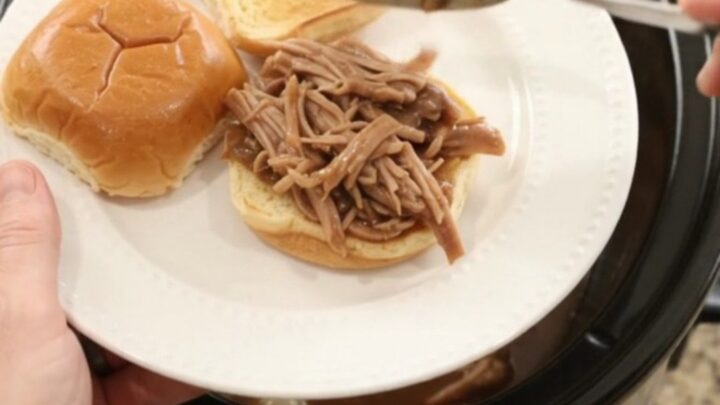
- Shred the PorkOnce the roast is tender, remove it to a cutting board. Let it rest for at least 3 minutes, then use two forks to shred the meat into bite-sized pieces, discarding any large fat chunks. Return the shredded pork to the slow cooker and stir it into the onion-gravy mixture.Look for The meat pulls apart into long, moist strands; the gravy is thick and glossy, coating the onions.Safe temperature 145°F (63°C) internal temperature (steaks, chops and roasts)Tip Shred while the meat is still warm; it will absorb more of the gravy and stay juicier.
After 8 hours on low, the kitchen smells of roasted meat and malty stout. The roast is deeply browned, and the liquid is bubbling gently at the edges. The meat is fork-tender, and when you lift it, it falls apart into moist strands. The onions are soft and caramelized, and the gravy is thick and glossy. This is the moment of triumph.
Toast and Serve
- Toast the Buns and ServeToast the brioche slider buns until golden and crisp. Pile the shredded pork and onions onto the bottom buns, spoon extra gravy over the top, and close with the top buns. Serve immediately.Look for The buns are warm and toasted; the pork is steaming and coated in mahogany gravy.Tip For extra richness, spread the buns with a little softened butter before toasting.
The brioche buns are toasted to a golden crisp, and the shredded pork is piled high, glistening with gravy. The onions are scattered throughout, adding sweet bites. The first slider is a messy, delicious handful — the bread soaks up the sauce, and the pork is impossibly tender. This is comfort food at its finest.
Common mistakes
One common mistake is lifting the lid too often to check on the roast. Every time you open the slow cooker, you release heat and add 20 minutes to the cooking time. Another is using a lean cut like pork tenderloin, which will dry out and become tough after 8 hours.
Stick with sirloin or shoulder. Don’t skip the rest time after shredding — it allows the juices to redistribute. Finally, be generous with the gravy; the pork needs it to stay moist.
How to tell it’s done
The pork is done when it reaches an internal temperature of at least 145°F (63°C) for safety, but for the best texture you’ll want to cook it longer — until a fork inserted into the thickest part twists easily and the meat pulls apart into shreds.
The sauce should be thickened and glossy, and the onions should be soft and translucent. If the sauce seems thin at the end, you can simmer it on the stovetop to reduce, or thicken with a slurry of cornstarch and water.
- Steaks, chops and roasts: 145°F (63°C) in the thickest part, then a 3-minute rest
Up next · Part 3 of 3
4 variations · storage & make-ahead · 5 answers · printable card
Tips, FAQ & printable recipe (Part 3)← Back to the ingredients (Part 1)