Desserts · Part 2 of 3: Instructions
Giant S’mores Skillet Cookie with Toasted Marshmallows Step-by-step instructions
- Prep
- Cook
- Total
- Serves
- 8
Before you start
Before starting, remove the butter from the refrigerator and let it melt gently in the microwave or on the stovetop. Measure all ingredients and crush the graham crackers into fine crumbs using a food processor or a rolling pin. Heat the oven to 350°F (175°C) and position a rack in the center.
Butter the 8-inch cast iron skillet or coat it lightly with nonstick spray. Have the chocolate bars and mini marshmallows ready to go when the cookie comes out of the oven, as the topping needs to be added quickly while the cookie is hot.
Ingredients at a glance (10)
- 1/2 cup unsalted butter, melted
- 1/2 cup packed brown sugar
- 1/4 cup granulated sugar
- 1 large egg
- 1 tsp vanilla extract
- 1 1/4 cups all-purpose flour
- 1/2 tsp baking soda
- 6 whole graham crackers, crushed
- 6 oz milk chocolate bars, broken into rectangles
- 2 cups mini marshmallows
Instructions
Mix and Bake the Cookie Base
- Mix the Cookie DoughIn a medium bowl, whisk the melted butter with the brown sugar and granulated sugar until smooth. Beat in the egg and vanilla extract. Stir in the flour, baking soda, and crushed graham cracker crumbs until a thick dough forms. The dough will be slightly sticky but should hold together when pressed.Look for The dough is thick, cohesive, and slightly glossy from the melted butter.Tip Crush the graham crackers finely so they blend evenly into the dough without large chunks.
- Press into SkilletButter an 8-inch cast iron skillet or coat it with nonstick spray. Press the cookie dough evenly into the skillet, smoothing the top with a spatula or your fingers. The dough should reach the edges but not go up the sides.Look for The dough is evenly spread and covers the bottom of the skillet completely.Tip Wet your fingers slightly to press the dough without it sticking to your hands.
- Bake the Cookie BaseHeat the oven to 350°F (175°C). Bake the skillet cookie for 15 minutes, until the edges are set and lightly golden but the center is still soft and slightly gooey. The cookie will continue to cook slightly after you add the toppings.Look for Edges are firm and golden; the center looks moist and slightly underdone.Safe temperature 160°F (71°C) internal temperature (egg dishes)Tip Do not overbake the base—it will bake more under the broiler.
At the end of this phase, the cookie dough is mixed and pressed into the skillet, then baked for 15 minutes. The edges should be golden and set, while the center remains soft and slightly gooey.
The kitchen smells of butter and brown sugar, and the cookie is just beginning to brown. The dough should be evenly spread and not too thick in the middle.
Top and Toast
- Top with ChocolateRemove the skillet from the oven and immediately arrange the milk chocolate rectangles over the hot cookie, covering the surface. The heat from the cookie will begin to melt the chocolate.Look for Chocolate pieces are slightly softened and beginning to melt on contact.Tip Break the chocolate bars into rectangles along the scored lines for even coverage.
- Add MarshmallowsScatter the mini marshmallows evenly over the chocolate, covering as much surface as possible. Press them down gently so they stick to the melting chocolate.Look for Marshmallows cover the chocolate layer in a single, even layer.Tip For a more even toast, keep the marshmallows in a single layer rather than piling them.
- Broil to ToastSwitch the oven to broil. Place the skillet under the broiler for 2 minutes, watching closely, until the marshmallows are puffed and golden brown on top. Rotate the skillet halfway through if needed for even browning.Look for Marshmallows are golden brown and puffy, with some charred spots for flavor.Tip Broilers vary—check at 1 minute to avoid burning.
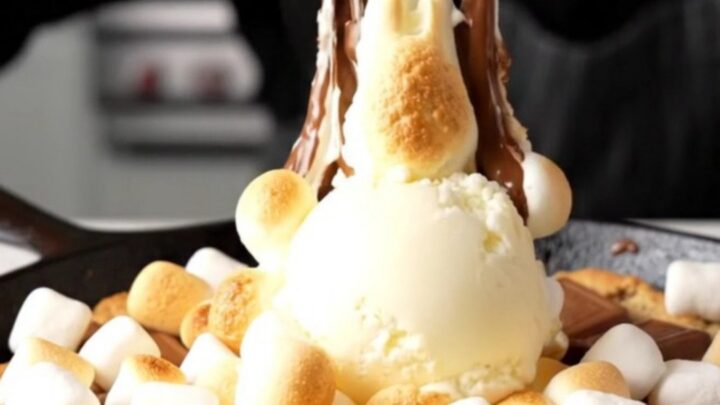
After adding the chocolate and marshmallows, the skillet returns to the oven under the broiler. The marshmallows puff up and turn golden brown, with some charred spots for flavor. The chocolate melts into a glossy layer. The top is bubbly and caramelized, and the whole skillet looks like a giant, irresistible s'more.
Cool and Serve
- Cool SlightlyRemove the skillet from the oven and let it cool for 5 minutes on a wire rack. This allows the chocolate to set slightly and prevents the topping from sliding off when serving.Look for The skillet is warm but not too hot to touch; the topping is set.Tip Cooling briefly makes it easier to scoop clean portions.
- Serve WarmScoop the warm skillet cookie into bowls or plates, making sure each serving includes some melted chocolate, toasted marshmallow, and cookie. Serve immediately while the marshmallow is still stretchy and the chocolate is molten.Look for Each spoonful has a gooey, stretchy marshmallow and melted chocolate.Tip A scoop of vanilla ice cream on top balances the warm, gooey texture.
After a 5-minute rest, the skillet cookie is ready to serve. The topping has set slightly but is still warm and gooey. When you scoop into it, you get a perfect bite of cookie, melted chocolate, and stretchy marshmallow. The contrast of textures—crisp edges, soft center, gooey topping—is exactly what you want.
Common mistakes
A common mistake is overbaking the cookie base, which makes it dry and crumbly instead of soft and chewy. Keep the baking time to 15 minutes and remember the residual heat will continue to cook it.
Another issue is burning the marshmallows under the broiler—watch them closely and rotate the skillet if needed. Also, make sure to press the dough evenly into the skillet so it bakes uniformly. If the dough is too sticky, chill it for 10 minutes before pressing.
How to tell it’s done
The cookie base is done when the edges are set and lightly golden, and the center is still soft and slightly puffy—it should look underdone but not raw. The safe internal temperature for the egg is 160°F (71°C); if you want to verify, insert an instant-read thermometer into the center of the cookie after baking.
After broiling, the marshmallows should be puffed and golden brown with some charred spots. The chocolate should be melted and glossy. The cookie will firm up slightly as it cools, so it's best served warm.
- Egg dishes: 160°F (71°C) in the thickest part
Up next · Part 3 of 3
4 variations · storage & make-ahead · 5 answers · printable card
Tips, FAQ & printable recipe (Part 3)← Back to the ingredients (Part 1)