Dinner · Part 2 of 3: Instructions
French Onion Meatloaf with Bubbly Gruyère Topping Step-by-step instructions
- Prep
- Cook
- Total
- Serves
- 8
Before you start
Set up the kitchen before the first flame goes on. Peel and thinly slice the onions — a full 2 pounds cooks down dramatically, so do not judge by volume in the raw state. Grate the Gruyère from a block so it melts smoothly, mince the garlic, strip the thyme, beat the eggs in a small bowl and measure the breadcrumbs, Worcestershire sauce and beef broth.
Ingredients at a glance (13)
- 3 tbsp unsalted butter
- 2 lb yellow onions, thinly sliced
- 1 1/2 tsp kosher salt, divided
- 1/2 cup beef broth
- 3 garlic cloves, minced
- 1 tbsp fresh thyme leaves
- 1 tbsp Worcestershire sauce
- 2 lb ground beef, 80/20
- 2 large eggs, lightly beaten
- 3/4 cup plain breadcrumbs
- 1/2 tsp freshly ground black pepper
- 1 1/2 cups shredded Gruyère cheese
- Fresh parsley, chopped, for serving
Instructions
Caramelize the onions
- Start the onions in butterMelt the butter in a large skillet over medium heat. Add the sliced onions and 1/2 tsp of the kosher salt, and toss so every strand picks up a little fat. Cook, stirring every few minutes, letting the onions soften and release their liquid before the real browning begins.Look for The onions turn from opaque white to glossy and translucent, and the kitchen smells sweet.Tip Slice the onions evenly, about 1/4 inch thick, so they soften at the same rate and no piece burns early.
- Caramelize low and slowLower the heat to medium-low and keep cooking the onions for 30 to 35 minutes, stirring more often as the bottom picks up color. Scrape the browned bits off the pan base each time; they melt back into the onions and build the deep, sweet flavor that makes this loaf taste like the soup.Look for The onions collapse into a thick, deep amber mass with no crisp edges.Tip If the pan looks dry or the onions stick, add a splash of water and keep going — patience, not extra butter, does the work.
- Deglaze and seasonPour in the beef broth and scrape the skillet bottom clean, letting the liquid bubble away until mostly absorbed. Stir in the garlic, thyme and the remaining 1 tsp salt, and cook 1 minute more. Transfer the onion mixture to a shallow bowl and set it aside to cool while the oven heats.Look for The mixture is thick, glossy and spoon-holding, with a fragrant broth-and-herb aroma.Tip Cooling the onions before mixing keeps the fat from smearing and the eggs from beginning to set prematurely in the warm mixture.
By the end of this phase the onions should be a thick, glossy, deep-amber mass that holds its shape on a spoon, with no crisp or burnt edges and a sweet, savory smell filling the kitchen. The broth should be fully absorbed, the garlic and thyme evenly distributed, and the whole mixture cooled enough that the bowl feels only warm, not hot, from below.
Mix and shape the loaf
- Build the meatloaf baseHeat the oven to 375°F (190°C). In a large bowl, gently combine the ground beef, eggs, breadcrumbs, Worcestershire sauce and black pepper with your hands. Stop as soon as the mixture looks uniform — overworking the meat is what turns a meatloaf dense and crumbly instead of tender.Look for The mixture holds together when squeezed, with visible flecks of pepper and no dry pockets.Tip Keep the ground beef in the refrigerator until the moment it is mixed; cold meat combines more cleanly and stays safer.
- Fold in the onionsAdd the cooled caramelized onions to the bowl, reserving a generous spoonful for the top. Fold them through the meat with a few deliberate turns so ribbons of onion run through every slice rather than disappearing into the mix. The mixture should feel moist but not sticky.Look for Onion ribbons are distributed throughout, with no large clumps in one spot.Tip Count the folds — about ten turns is usually enough. More handling squeezes out the juiciness you worked to keep.
- Shape the loafTransfer the mixture to a 9x5-inch loaf pan or shape it free-form on a rimmed baking sheet, pressing gently into an even loaf about 2 1/2 inches tall. Smooth the top, then spread the reserved onions over it. Keep the meat cold until it goes into the oven.Look for The loaf holds a clean rectangle or oval with a firm, even surface.Tip A free-form loaf on a baking sheet lets the edges brown on all sides; the loaf pan gives cleaner, sandwich-ready slices.
The meat mixture should feel moist and cohesive, holding together when squeezed, with ribbons of caramelized onion running evenly through it and no dry pockets of breadcrumb or large clumps of onion in one place.
The shaped loaf should sit firm and even, about 2 1/2 inches tall, with the reserved onions spread across the top. It should still be cold to the touch going into the oven.
Bake, cheese and rest
- Bake until nearly doneBake the loaf for 40 minutes, until the internal temperature reaches 150°F (66°C) on an instant-read thermometer and the top looks set. The onions on top will darken at the edges and the fat will pool visibly around a free-form loaf. Keep the thermometer handy from here on.Look for The loaf is firm to a light touch and juices run clear at the edges.Tip Check through the oven door rather than opening it early; each peek drops the temperature and stretches the bake.
- Top with cheese and finishTake the loaf out and scatter the shredded Gruyère evenly over the top, pushing it to the edges. Return it to the oven for 8 to 10 minutes, until the cheese is fully melted, bubbly and browned in spots, and the meat registers 160°F (71°C) at the center — the safe temperature for ground meat and for the eggs binding it.Look for The cheese stretches in glossy strands and shows golden patches; the thermometer reads 160°F (71°C).Safe temperature 160°F (71°C) internal temperature (ground meat)Tip For deeper browning, run it under the broiler for the last minute, watching constantly so the cheese never scorches.
- Rest before slicingLet the meatloaf rest for 10 minutes on a cutting board. The juices redistribute during this wait, so the first slice comes out moist instead of pooling liquid on the board. Scatter the chopped parsley over the melted cheese just before serving.Look for Only a thin rim of juice appears on the board when the first slice is cut.Tip Use a sharp knife pulled in one smooth stroke; sawing drags the cheese off the top of the slice.
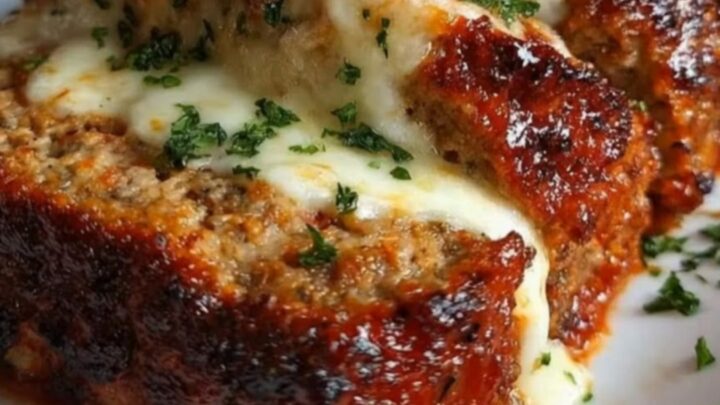
- Serve thick, steaming slicesCut the loaf into thick slices and lift each one with a metal spatula so the melted cheese stretches and stays on top. Serve right away while the cheese is still glossy and the onions are steaming, with the pan juices spooned over if a free-form loaf left any behind.Look for Each slice holds its shape, cheese draping over the edge and onions showing in the crumb.Tip A wide spatula slid fully under the slice keeps the cheese cap intact from board to plate.
The loaf is done when the thermometer reads 160°F (71°C) at the center, the Gruyère has melted into a bubbling, browned cap, and the onion edges have darkened.
After the 10-minute rest, the first slice should lift cleanly with a metal spatula, the cheese stretching in glossy strands, and the crumb should look moist and tender with clear juices inside, not pooling on the board. The parsley goes on at the very last moment so it stays bright against the melted cheese.
Common mistakes
The most common misstep is rushing the onions. At medium heat they brown at the edges but stay sharp inside; only a long, low cook turns them sweet and tender, so budget the full 30 to 35 minutes and stir more often toward the end.
The second mistake is overmixing the meat — kneading it like dough gives a dense, crumbly loaf, so combine just until uniform.
How to tell it’s done
The only reliable test is temperature: the center of the loaf must reach 160°F (71°C), the safe internal temperature for ground meat, which also cooks the eggs binding the mixture through.
Visually, the cheese is fully melted, bubbling and patched with golden brown, the onion cap is dark at the edges, and any juices around a free-form loaf run clear rather than pink.
- Ground meat: 160°F (71°C) in the thickest part
- Egg dishes: 160°F (71°C) in the thickest part
Up next · Part 3 of 3
4 variations · storage & make-ahead · 5 answers · printable card
Tips, FAQ & printable recipe (Part 3)← Back to the ingredients (Part 1)