Dinner · Part 2 of 3: Instructions
French Onion Garlic Butter Pork Roast: 5-Ingredient Crockpot Dinner Step-by-step instructions
- Prep
- Cook
- Total
- Serves
- 8
Before you start
Before you start, make sure your slow cooker is clean and ready. If using a frozen roast, thaw it in the refrigerator overnight—do not cook from frozen. Slice the onions thinly and even so they cook down uniformly.
If you're making your own cowboy butter, do that ahead of time and keep it chilled until ready to use. Have the beef consommé measured and the egg noodles ready to cook when the pork is done. The prep takes just 10 minutes, so you can easily do it in the morning before work or school.
Ingredients at a glance (5)
- 3 1/2 lb boneless pork sirloin roast
- 2 large Vidalia onions, thinly sliced
- 1 cup beef consommé
- 4 tbsp cowboy garlic butter, cut into medallions
- 12 oz buttered egg noodles, for serving
Instructions
Layer and Season
- Layer the RoastPlace the pork sirloin roast in the center of a 6-quart slow cooker insert. Scatter the sliced Vidalia onions over the top and around the sides of the roast. Pour the beef consommé around the base, being careful not to rinse the onions off the meat.Look for The roast sits snugly in the insert with onions piled on top and consommé pooling around the bottom.Tip Use a spoon to gently press the onions onto the roast so they stay in place during cooking.
- Add the Garlic ButterPlace the four medallions of cowboy garlic butter evenly across the top of the roast, spacing them so they melt and baste the meat as it cooks. No need to stir or mix.Look for The butter medallions sit on the roast, ready to melt into the meat during slow cooking.Tip If the butter is too cold to slice, let it sit at room temperature for 10 minutes first.
At the end of this phase, the slow cooker insert holds the raw pork roast in the center, topped with a heap of sliced onions. The beef consommé pools around the base, and the butter medallions sit on top. The aroma is fresh and savory, with the promise of a rich meal to come. Everything is arranged neatly, ready to cook.
Slow Cook and Shred
- Slow-Cook Until TenderCover the slow cooker and cook on LOW for 8 to 10 hours, or on HIGH for 4 to 5 hours, until the pork is fork-tender and easily shreds. The internal temperature should reach at least 145°F (63°C) for food safety, but the meat will be more tender if cooked longer. Let it rest for 3 minutes before slicing.Look for The roast is deeply browned and falling apart; the onions are translucent and the liquid is bubbling gently.Safe temperature 145°F (63°C) internal temperature (steaks, chops and roasts)Tip Avoid opening the lid during cooking—each peek releases heat and adds 20 minutes to the cook time.
- Shred the PorkTransfer the roast to a cutting board and let it rest for at least 3 minutes. Use two forks to shred the pork into bite-sized pieces, discarding any large fat pieces. Return the shredded pork to the slow cooker and stir it into the onion-butter gravy.Look for The pork shreds easily with little resistance, and the gravy is thick and aromatic.Safe temperature 145°F (63°C) internal temperature (steaks, chops and roasts)Tip Shred while the meat is still warm—it will be juicier and easier to pull apart.
After hours of slow cooking, the kitchen smells of caramelized onions and garlic butter. The pork is deeply browned and falls apart at the touch of a fork. The liquid has reduced into a glossy, savory gravy. Shredding the meat is effortless, and the shredded pieces are moist and flavorful, coated in the onion-butter sauce.
Serve and Enjoy
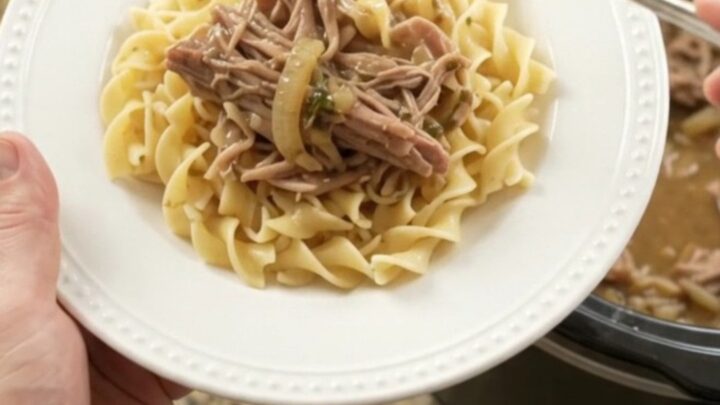
- Serve Over NoodlesSpoon the shredded pork and onion gravy over warm buttered egg noodles. Serve immediately, with extra gravy spooned over the top.Look for The pork is glossy with gravy, and the noodles are coated with butter.Tip For a low-carb option, serve over mashed cauliflower or roasted vegetables instead of noodles.
The final phase is all about assembly. Spoon the hot, shredded pork and gravy over a bed of buttered egg noodles. The pork is tender and glistening, the onions are silky, and the gravy is rich and aromatic. Each bite is a cozy, satisfying combination of textures and flavors, ready to be devoured.
Common mistakes
One common mistake is lifting the lid to check on the roast—this releases heat and extends the cooking time. Trust the process and keep the lid on.
Another pitfall is using a lean cut without enough liquid; the consommé and butter provide moisture, but if you're short on time and use a leaner cut, add a splash of beef broth to prevent dryness.
Also, avoid overcrowding the slow cooker—the roast should fit in a single layer with room for the onions. Finally, don't skip the rest time; it's crucial for juicy meat.
How to tell it’s done
The pork is done when it shreds easily with a fork and the internal temperature registers at least 145°F (63°C) on an instant-read thermometer. However, for the most tender results, cook until the meat is fall-apart tender, which typically takes 8–10 hours on LOW.
The onions should be soft and golden, and the liquid should be bubbling gently. If the pork is still firm after the minimum cooking time, continue cooking in 30-minute increments until it shreds easily. Always let the meat rest for at least 3 minutes before shredding to allow the juices to redistribute.
- Steaks, chops and roasts: 145°F (63°C) in the thickest part, then a 3-minute rest
Up next · Part 3 of 3
4 variations · storage & make-ahead · 5 answers · printable card
Tips, FAQ & printable recipe (Part 3)← Back to the ingredients (Part 1)