Desserts · Part 2 of 3: Instructions
Forty-Layer Antep Pistachio Baklava with Crispy Phyllo Step-by-step instructions
- Prep
- Cook
- Total
- Serves
- 24
Before you start
Before starting, make the syrup and let it cool completely. Thaw the phyllo dough according to package directions, usually overnight in the refrigerator, then bring it to room temperature for about 30 minutes.
Clarify the butter by melting unsalted butter and skimming off the foam, or use ghee. Have all ingredients measured and ready. Set up a work area with a damp towel to cover the phyllo sheets. Preheat the oven to 340°F (170°C) when you begin assembling.
Ingredients at a glance (6)
- 40 sheets tissue-thin baklava phyllo dough
- 1 1/2 cups clarified butter, melted
- 2 1/2 cups finely ground Antep pistachios
- 2 cups granulated sugar
- 1 cup water
- 1 tbsp fresh lemon juice
Instructions
Assemble the Layers
- Prepare the Syrup and PhylloIn a small saucepan, combine the sugar, water, and lemon juice. Bring to a boil over medium heat, stirring occasionally, then reduce to a simmer and cook for 10 minutes. Remove from heat and let cool completely. Meanwhile, gently unfold the phyllo sheets on a clean surface and cover with a damp towel to prevent drying.Look for Syrup thickens slightly and cools to room temperature.Tip Cool the syrup completely; hot syrup on hot baklava makes it soggy.
- Layer the First Twenty SheetsBrush the bottom and sides of a round copper pan or baking dish with clarified butter. Lay one sheet of phyllo in the pan, letting the edges curl up slightly. Brush the sheet generously with melted clarified butter. Repeat with 19 more sheets, brushing each one thoroughly.Look for Twenty even, buttered layers cover the pan.Tip Keep phyllo covered with a damp towel while working to prevent cracking.
- Add the Pistachio LayerSprinkle the finely ground pistachios evenly over the top of the twenty buttered phyllo layers, covering the entire surface in a thin, even layer.Look for A uniform green layer of pistachios.Tip Use a spoon or your hand to spread the nuts gently without packing.
You should have a neat stack of twenty buttered phyllo sheets, a layer of green pistachios, and another twenty buttered sheets on top.
The edges may curl slightly, and the butter should be evenly distributed. The pastry should look like a thick, golden block, ready for cutting.
Cut and Bake to Amber
- Top with Remaining PhylloPlace one sheet of phyllo over the pistachios and brush with clarified butter. Continue with the remaining 19 sheets, brushing each layer generously with butter. Make sure the top sheet is well-buttered to promote golden browning.Look for Twenty more buttery layers cover the nuts.Tip Press down gently as you layer to remove air pockets.
- Cut Diamonds and Pour ButterUsing a sharp knife, cut the layered pastry into diamond shapes, about 2 inches wide. Cut all the way through to the bottom. Pour the remaining clarified butter evenly over the cuts, making sure it seeps into the crevices.Look for Clean diamond cuts, butter pooling in the lines.Tip Wipe the knife between cuts for clean edges.
- Bake Until GoldenHeat the oven to 340°F (170°C). Bake the baklava for 50 minutes, until the top is deep golden amber and the layers are visibly crisp. Rotate the pan halfway through for even browning.Look for Deep golden color and a fragrant buttery aroma.Tip If the top browns too quickly, tent loosely with foil.
The diamonds are cut cleanly, and butter bubbles in the cuts. As it bakes, the top turns a deep golden amber, and the layers puff and separate. The kitchen smells of toasted butter and nuts. The baklava should be firm to the touch but still slightly springy.
Syrup and Rest
- Pour Syrup Over Hot BaklavaRemove the baklava from the oven and immediately pour the cooled syrup evenly over the hot pastry. Listen for the sizzle as the syrup hits the hot layers. Let the baklava absorb the syrup for at least 4 hours before serving.Look for Loud sizzle and syrup bubbling into the cuts.Tip Pour slowly and evenly to ensure every piece gets syrup.
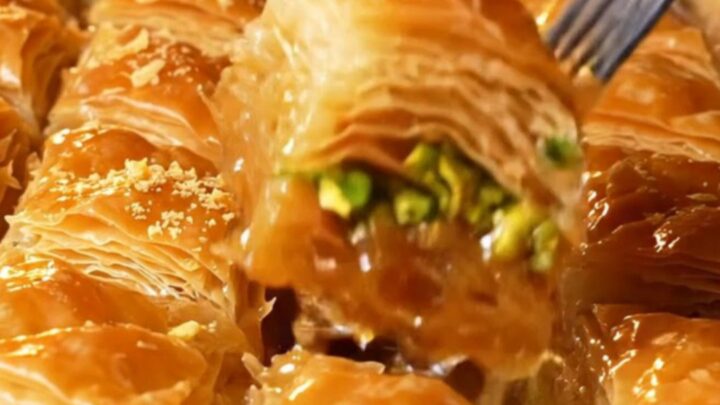
- Cool and ServeAllow the baklava to cool completely at room temperature, uncovered, so the layers stay crisp. Once cooled, lift a piece with a fork to admire the forty distinct layers. Serve at room temperature.Look for Crisp, shiny top and a audible crackle when lifted.Tip Do not cover while cooling; trapped steam softens the pastry.
The moment the syrup hits the hot pastry, there is a loud sizzle and the syrup bubbles up through the cuts. The baklava gradually absorbs the syrup, turning glossy. After resting, a piece lifted with a fork shows forty distinct, crisp layers.
Common mistakes
One common mistake is using warm syrup on hot baklava, which makes the pastry soggy. Always cool the syrup completely. Another is not brushing each phyllo sheet thoroughly with butter; dry spots will not crisp.
Cutting the baklava before baking is essential, but the cuts must go all the way through; otherwise, the pieces will not separate cleanly. Finally, do not cover the baklava while it cools, as trapped steam will soften the layers.
How to tell it’s done
The baklava is done when the top is a deep golden amber and the layers look visibly crisp and puffed. The butter should be bubbling around the edges, and the aroma will be intensely buttery and nutty.
To check, gently lift a corner piece with a fork; the layers should separate easily and feel dry to the touch, not doughy. If the top browns too quickly, tent with foil. After pouring the syrup, the baklava should absorb it within a few hours, and the top will become glossy.
Up next · Part 3 of 3
4 variations · storage & make-ahead · 5 answers · printable card
Tips, FAQ & printable recipe (Part 3)← Back to the ingredients (Part 1)