Dinner · Part 2 of 3: Instructions
Dump and Bake Chicken Parmesan Casserole (One Dish, No Boiling) Step-by-step instructions
- Prep
- Cook
- Total
- Serves
- 6
Before you start
Take the chicken out of the refrigerator while the oven preheats — a short spell at room temperature, no more than 30 minutes, helps it bake evenly.
Set out the baking dish, a large mixing bowl, a whisk, a spatula and a sheet of aluminum foil sized to overhang the dish. Grate the Parmesan and shred the mozzarella now, before hands get busy with raw chicken, and set them aside in a small bowl.
Ingredients at a glance (10)
- 1 1/2 lb boneless skinless chicken breasts, cut into 1-inch pieces
- 12 oz penne pasta, uncooked
- 3 cups marinara sauce (one 24-oz jar)
- 2 cups water
- 1 tsp garlic powder
- 2 tsp Italian seasoning
- 3/4 tsp kosher salt
- 1/2 tsp black pepper
- 2 cups shredded mozzarella cheese
- 1/2 cup grated Parmesan cheese
Instructions
Prep the sauce and chicken
- Heat the oven and grease the dishSet the oven rack in the middle position and heat the oven to 400°F (200°C). Grease a 9x13-inch baking dish lightly with butter, oil or nonstick spray, paying attention to the corners and sides where the sauce bubbles up and sticks. Set the dish next to the stove so assembly goes quickly.Look for The oven is ready when the preheat signal sounds and the dish slides across the greased surface without dragging.Tip A glass dish browns the edges a little faster than ceramic; either works, just keep an eye on the last ten minutes.
- Season the sauce in the bowlIn a large mixing bowl, whisk the marinara sauce with the water, garlic powder, Italian seasoning, salt and black pepper until the spices are evenly distributed. The water thins the sauce just enough for the dry pasta to absorb it while it bakes, so the casserole never tastes watery or bland at the end.Look for The sauce should pour easily off the whisk and look smooth, with no spice streaks left on the surface.Tip Taste the sauce now; it should be slightly saltier than you want the finished dish, since the pasta will absorb a lot of it.
- Cut the chicken into even piecesPat the chicken breasts dry with paper towels, then cut them into 1-inch pieces on a clean cutting board. Even pieces cook at the same rate, which matters in a bake where nothing is stirred during the first stretch. Add the pieces to the mixing bowl with the sauce and toss to coat every piece.Look for Aim for uniform cubes; pieces much larger than an inch will still be pink in the middle when the pasta is done.Tip Partly freezing the chicken for 15 minutes makes it much easier to cut into clean, even cubes.
By the end of the first phase the oven is at 400°F (200°C), the greased dish waits on the counter, and the work is all in the mixing bowl. The sauce should be smooth and pourable, seasoned noticeably — taste it and adjust the salt before anything goes in the dish, since pasta dulls seasoning.
Cover, bake and stir
- Build the casserole in the dishPour the uncooked penne into the greased baking dish and scatter the sauce-coated chicken pieces evenly over the top. Pour the remaining sauce from the bowl over everything, then stir with a spatula until every piece of pasta is submerged and coated. Spread the mixture into an even layer so it bakes uniformly.Look for No dry pasta should peek above the sauce line; press down any pieces that float to the surface.Tip Scrape the bowl well — every bit of seasoned sauce left behind is flavor the casserole never gets.
- Cover and bake the first stretchCover the dish tightly with a sheet of aluminum foil, crimping it around the edges to trap the steam. Bake in the preheated oven for 35 minutes. The trapped steam is what cooks the dry pasta in the sauce, so a tight seal here is the difference between tender penne and chalky, undercooked centers.Look for After about 20 minutes you should hear gentle bubbling around the edges of the dish.Tip If the foil is not wide enough, use two overlapping sheets and seal the seam along the long side of the dish.
- Stir and test the pastaRemove the dish carefully — steam will billow out when the foil lifts. Stir the casserole thoroughly, scraping the bottom and corners. Test a piece of penne: it should be tender with a slight bite. If the mixture looks dry or the pasta resists, add up to 1/4 cup hot water, stir, and re-cover for 5 more minutes.Look for The sauce should still be loose and glossy at this point; it thickens during the final uncovered bake.Tip Stirring once at this stage redistributes the liquid and prevents a dry, cemented layer at the corners.
The covered bake is the quiet phase: the only evidence is gentle bubbling audible around the edges after twenty minutes. When the foil comes off at 35 minutes, expect a rush of fragrant steam — tomato, garlic and herbs.
The penne should look plump and glossy, the sauce noticeably thicker than when it went in but still loose enough to stir easily, and the chicken pieces should be opaque on the outside.
Cheese, rest and serve
- Top with the cheesesScatter the shredded mozzarella evenly over the hot casserole, reaching all the way to the edges, then sprinkle the grated Parmesan over the top. Covering every inch of pasta with cheese protects the surface from drying out and gives you one continuous, stretchy layer instead of scattered patches.Look for The cheese should blanket the sauce completely, with only the thinnest edges of pasta visible at the rim.Tip Shred the mozzarella from a block if time allows; block-shredded cheese melts smoother than pre-shredded.
- Bake uncovered until the chicken is doneReturn the uncovered dish to the oven and bake 10 to 15 minutes, until the cheese is fully melted, bubbling at the edges and lightly golden in spots. Insert an instant-read thermometer into the center of several of the largest chicken pieces: it must read at least 165°F (74°C) for the chicken to be safely cooked through.Look for Look for active bubbling around the edges and a few toasted, brown-tipped patches of cheese on top.Safe temperature 165°F (74°C) internal temperature (poultry)Tip Check the chicken in at least three spots; a single reading near the edge can miss a cooler center pocket.
- Rest before scoopingLet the casserole rest on a cooling rack for 5 minutes after it leaves the oven. The sauce settles and thickens to a spoonable consistency, the cheese firms enough to pull in long strands instead of sliding off, and the dish is far easier to cut into clean portions with a spatula.Look for After five minutes the bubbling slows to a stop and the surface no longer ripples when the dish is nudged.Tip Resting also protects the glass dish from thermal shock if it is going straight onto a cold counter.
- Scoop and servePress a spatula straight down through the cheesy layer to the bottom of the dish, then lift a generous square onto each plate, letting the mozzarella stretch as it comes away. Serve while the cheese is still glossy and pulls with every bite, with extra Parmesan at the table for anyone who wants more.Look for A proper portion shows penne, chicken and sauce in every bite, with cheese stretching from dish to plate.Tip Warm the plates briefly so the cheese keeps its stretch until the casserole reaches the table.
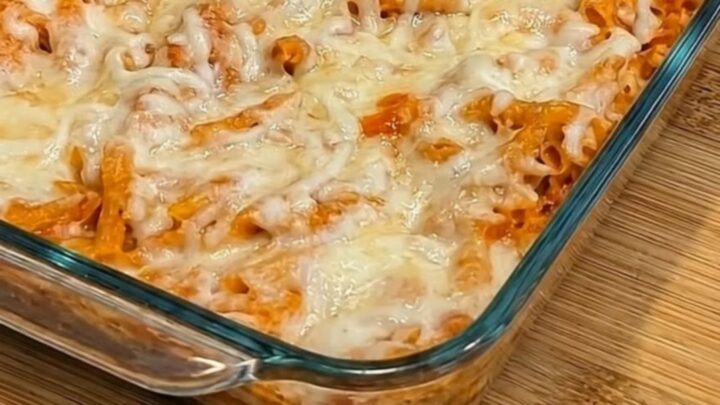
The final phase delivers the payoff. The cheese layer should be completely melted, glossy and bubbling at the edges, with a few lightly browned spots where the Parmesan has toasted — uniform pale cheese means it needs a few more minutes.
Probe the largest chicken pieces in several places; every reading must reach 165°F (74°C) before the dish comes out for good.
Common mistakes
The most common failure is a dry, undercooked pasta layer, and it almost always traces back to one of two things: too little liquid or a loose foil seal. Measure the water, crimp the foil around the rim of the dish, and resist peeking during the covered bake.
How to tell it’s done
The casserole is done when three things line up. First, the cheese: fully melted, bubbling actively at the edges, with scattered golden-brown patches on top — not merely softened.
Second, the pasta: every piece of penne tender throughout, with no chalky white core when bitten; the corners of the dish are the last place pasta finishes, so test there.
- Poultry: 165°F (74°C) in the thickest part
Up next · Part 3 of 3
4 variations · storage & make-ahead · 5 answers · printable card
Tips, FAQ & printable recipe (Part 3)← Back to the ingredients (Part 1)